Compare and Contrast Eastern and Western Philosophies

Ockham’s Razor, Zen Simplicity, and Musha Shugyō
Lesson Overview
This lesson explores three distinct traditions—Ockham’s Razor, Zen simplicity, and Musha Shugyō—that share a common pursuit: truth through disciplined reduction. Students will compare and contrast these traditions, analyze their cultural contexts, and reflect on how the principle of “stripping away the unnecessary” applies across philosophy, spirituality, and martial practice.
Learning Objectives
By the end of this lesson, students will be able to:
Key Concepts
Materials
- Whiteboard or projector
- Handouts summarizing each tradition - optional (see appendices)
- Visuals: Zen gardens, ink paintings, samurai imagery, medieval scholastic manuscripts - optional (see appendices)
- Short excerpts (quotes from Ockham, Zen koans, samurai training accounts)
Lesson Procedure
1. Introduction (10 minutes)
2. Direct Instruction (20 minutes)
- Ockham’s Razor 🪒
- Principle: “Do not multiply entities beyond necessity.”
- Context: Medieval scholastic debates, resistance to theological overreach.
- Application: Science, logic, everyday decision-making.
- Zen Simplicity🧘
- Principle: Enlightenment through subtraction.
- Context: Japanese Zen aesthetics—gardens, ink paintings, meditation.
- Application: Mindfulness, clarity, minimalism.
- Musha Shugyō ⚔️
- Principle: Distillation through trial.
- Context: Samurai wandering to test skill and spirit.
- Application: Discipline, resilience, mastery.
3. Guided Practice (15 minutes)
- Create a Venn Diagram comparing the three traditions (see last page for the Venn Diagram).
- Students work in pairs to identify overlaps (discipline, reduction, lived practice) and differences (philosophical vs. spiritual vs. martial).
- Share findings with the class.
4. Discussion & Reflection (15 minutes)
Prompt questions:
- How does “cutting away the unnecessary” look different in philosophy, spirituality, and combat?
- Why might simplicity be considered powerful?
- Can these principles be applied to modern challenges (e.g., decision-making, stress management, creativity)?
5. Application Activity (20 minutes)
- Students choose a modern scenario (e.g., designing a project, solving a conflict, organizing daily life).
- Apply one of the three traditions’ principles to simplify and clarify the situation.
- Share examples with the class.
Assessment
- Formative: Participation in Venn Diagram activity and discussion.
- Summative: Short reflective essay (1–2 pages) on how one tradition’s principle could be applied to their own life or studies.
Extension / Homework
- Research another tradition that emphasizes reduction (e.g., Stoicism, Minimalist art, Taoism).
- Compare it to one of the three studied today.
Teacher’s Notes
- Emphasize the lived nature of these traditions: they are not abstract theories, but practices tested in debate, meditation, and combat.
- Encourage students to see reduction not as deprivation, but as refinement toward mastery.
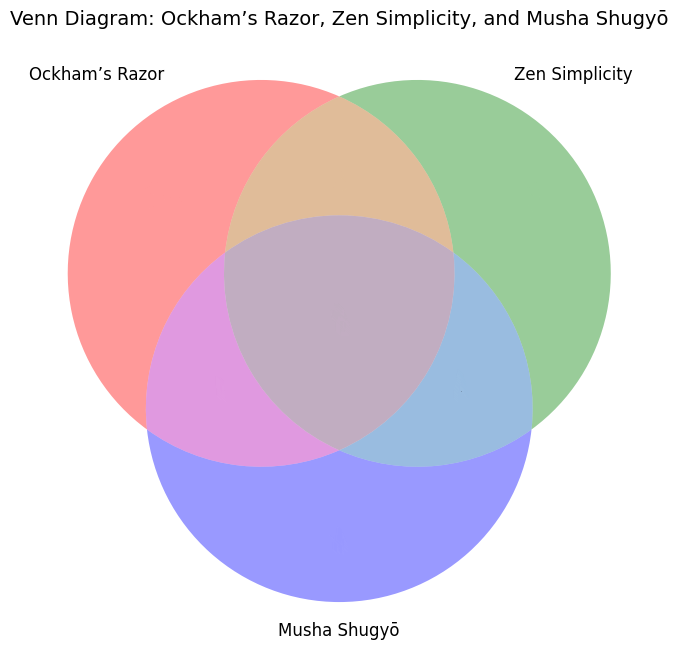
Shared overlaps:
Here’s a concise student-facing handout you can use in class. It distills each tradition into quick, memorable points:
Handout: Three Paths of Disciplined Reduction
🪒 Ockham’s Razor
🧘 Zen Simplicity
⚔️ Musha Shugyō
✨ Common Thread
