Encyclopedia Anachronistica


Alt Art
Champion
Middle East
Persian
Grey
Enemies must spend 1 additional action when attacking from a space in this Champion's base attack grid.
Xerxes crossed the Hellespont with the largest army the world had seen. He burned Athens, built Persepolis and Susa, and monuments like the Gate of All Nations.
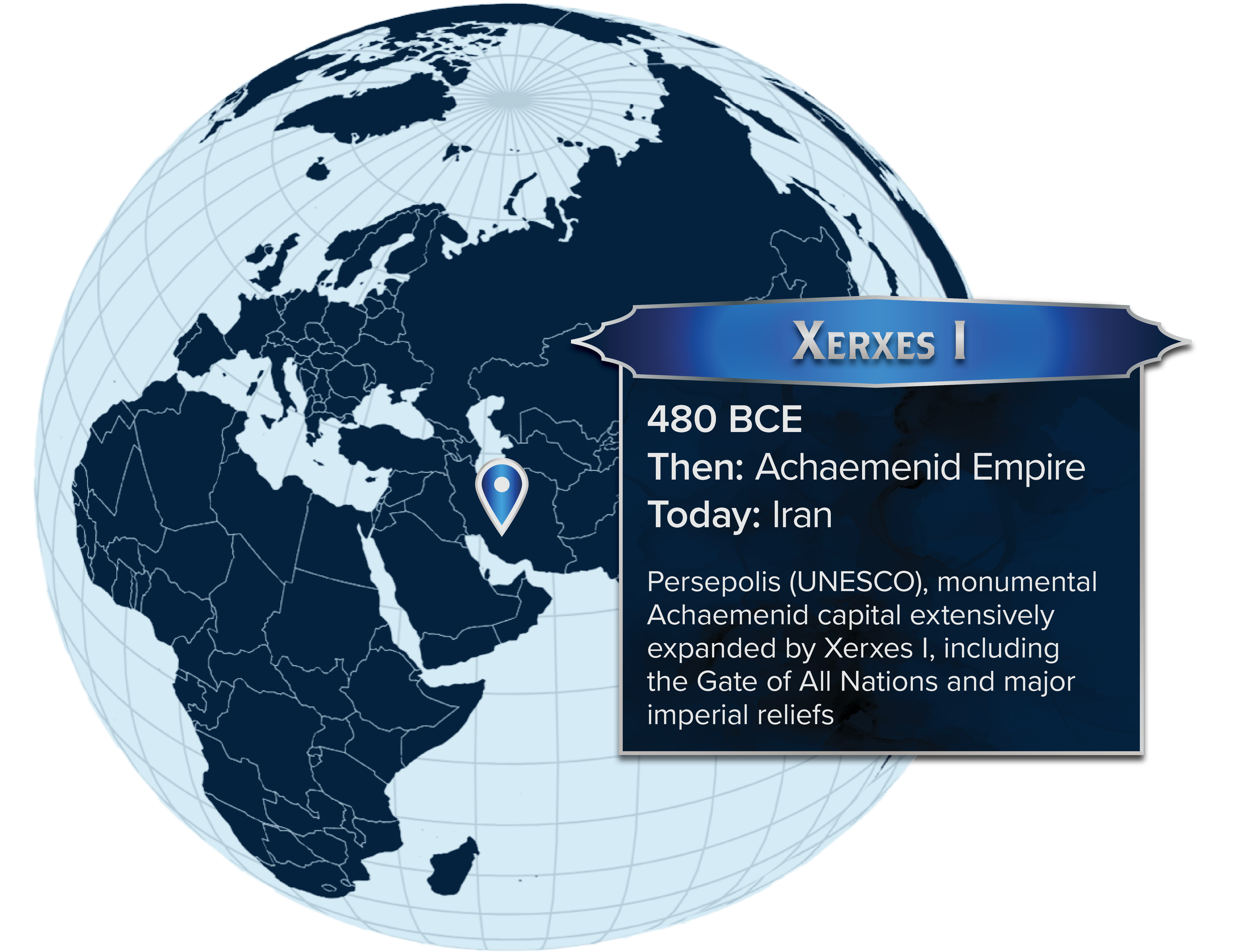
Before he was a cautionary tale, Xerxes I was the most powerful man on earth. Born around 519 BCE, son of Darius the Great and Atossa (daughter of Cyrus the Great), he inherited not just a throne but a legacy. His name in Old Persian, Khshayārshā, meant “Ruler of Heroes.” When he became king in 486 BCE, he commanded an empire stretching from the Indus Valley to the Aegean, from Egypt to the Caucasus. He was Shahanshah—King of Kings.
His reign began with rebellion. Egypt rose against Persian rule. Babylon defied him. Xerxes crushed both with ruthless efficiency, tearing down Babylon’s sacred statue of Marduk to show no city stood above the crown. With his empire secure, he turned to his father’s unfinished business: punishing Greece for the humiliation at Marathon.
In 480 BCE, Xerxes launched one of the largest invasions the ancient world had ever seen. Ancient sources claim he crossed the Hellespont with hundreds of thousands of soldiers and a fleet of 700–800 ships. To bridge the strait, his engineers lashed ships together into floating causeways. When storms destroyed them, Xerxes ordered the sea whipped with chains—a gesture both theatrical and terrifying. Then his army marched into Europe.
At Thermopylae, his forces clashed with King Leonidas and the 300 Spartans. The Greeks fought to the last man, but Xerxes broke through. He burned Athens to the ground. For a moment, it seemed Persia would swallow Greece whole. But at Salamis, the tide turned. Themistocles lured Xerxes’ massive fleet into the narrow straits, where Greek triremes rammed and sank them. The “invincible” armada shattered. Xerxes retreated to Asia, leaving his general Mardonius to continue the fight. A year later, at Plataea, the Persians were defeated and the dream of conquering Greece was over.
Back in Persia, Xerxes turned to building. He expanded Persepolis, completing the Gate of All Nations and beginning the monumental Hall of a Hundred Columns. He built palaces at Susa and Persepolis, filling them with reliefs of tribute-bearers from across the empire. His reign was one of grandeur, but also of strain. The Greek failure had drained resources. His lavish projects taxed his subjects. In 465 BCE, he was assassinated in his palace by Artabanus, commander of his guard.
Xerxes lives on in many traditions. To the Greeks, he was the archetype of hubris—an arrogant king who thought he could command the sea. To the Persians, he was a builder and ruler of vast domains. In the Bible’s Book of Esther, he appears as Ahasuerus, the king whose court became the stage for Jewish survival. His name became a symbol of both power and downfall.
He wasn’t just a king. He was a spectacle. He didn’t just march armies. He marched nations. He didn’t just build palaces. He built monuments to ambition. And when history remembered hubris, it remembered Xerxes.