Encyclopedia Anachronistica

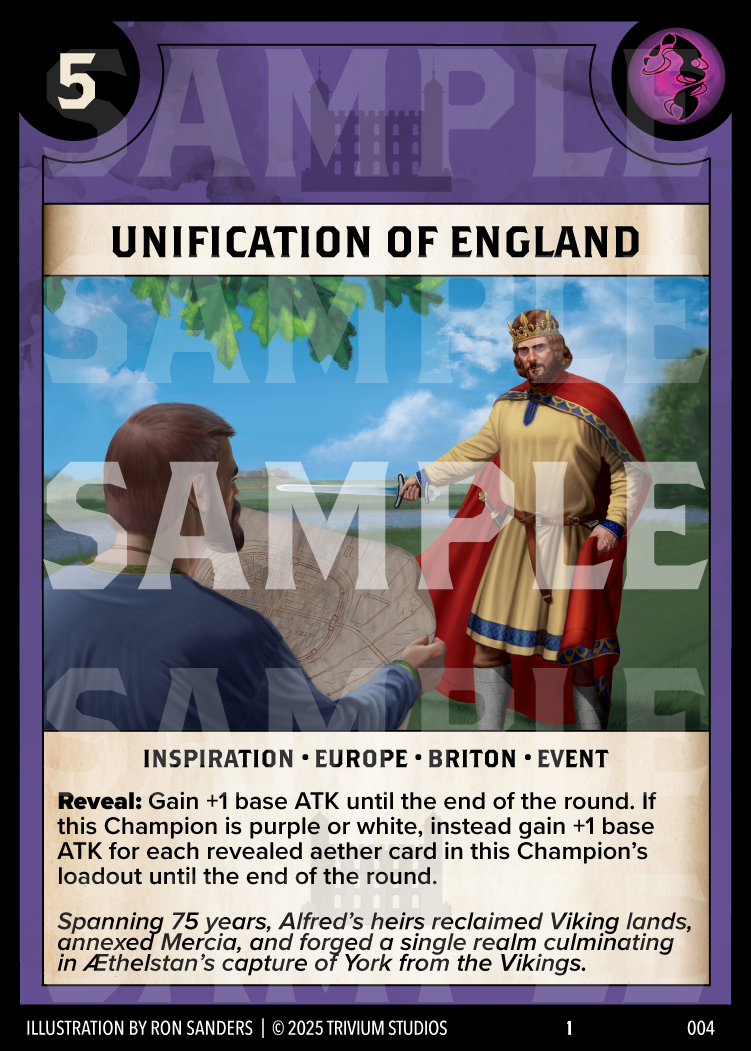
Standard
Inspiration
Europe
Briton
Event
Reveal: Gain +1 base ATK until the end of the round. If this Champion is purple or white, instead gain +1 base ATK for each revealed aether card in this Champion's loadout until the end of the round.
Spanning 75 years, Alfred's heirs reclaimed Viking lands, annexed Mercia, and forged a single realm culminating in Æthelstan's capture of York from the Vikings.

When Alfred the Great came to the throne in 871, “England” did not exist. What did exist was a patchwork of battered Anglo-Saxon kingdoms — Mercia, Northumbria, East Anglia, and Wessex — most of them already smashed or occupied by the Great Heathen Army. Alfred inherited not a realm, but a last stand. Yet by the end of his reign, he had laid the foundations for a single, unified English kingdom, a political identity that would outlive him by more than a thousand years.
The turning point came in 878, when Alfred won his desperate victory at the Battle of Edington, forcing the Viking leader Guthrum to accept baptism and withdraw into what would become known as the Danelaw. This was not just a military win — it was a geopolitical reset. By stabilizing the frontier between Wessex and Viking-controlled territory, Alfred created the breathing room needed to rebuild.
And rebuild he did. Alfred reorganized the military, creating a system of fortified towns (burhs) and a rotating army that could respond to raids without collapsing the economy. These reforms didn’t just defend Wessex — they projected its power. By the mid-880s, Alfred was strong enough to retake London, a symbolic and strategic prize. After reclaiming the city, he adopted a new title: “King of the Anglo-Saxons.” This was a political masterstroke. Alfred was no longer merely king of Wessex; he was positioning himself as the protector and leader of all free English people.
This shift in identity was reinforced by Alfred’s cultural reforms. He launched a sweeping program of translation, education, and legal codification, insisting that wisdom and literacy were essential for a functioning Christian society. These reforms weren’t just pious gestures — they were tools of unification. A shared language, shared texts, and shared law helped knit together populations that had once belonged to different kingdoms.
Alfred’s influence extended beyond his own borders. Many Mercians, displaced by Viking conquest, accepted Alfred’s overlordship. His marriage alliance with Mercia further strengthened this bond. By the time of his death in 899, Alfred had not conquered England — but he had invented the political framework that made unification possible. His son Edward the Elder and daughter Æthelflæd, Lady of the Mercians, would build on this foundation, gradually absorbing the Danelaw and bringing the English kingdoms under a single crown.
Alfred did not live to see a united England, but without him, the idea might never have existed. He turned survival into strategy, strategy into identity, and identity into a nation.