Encyclopedia Anachronistica

Alt Art
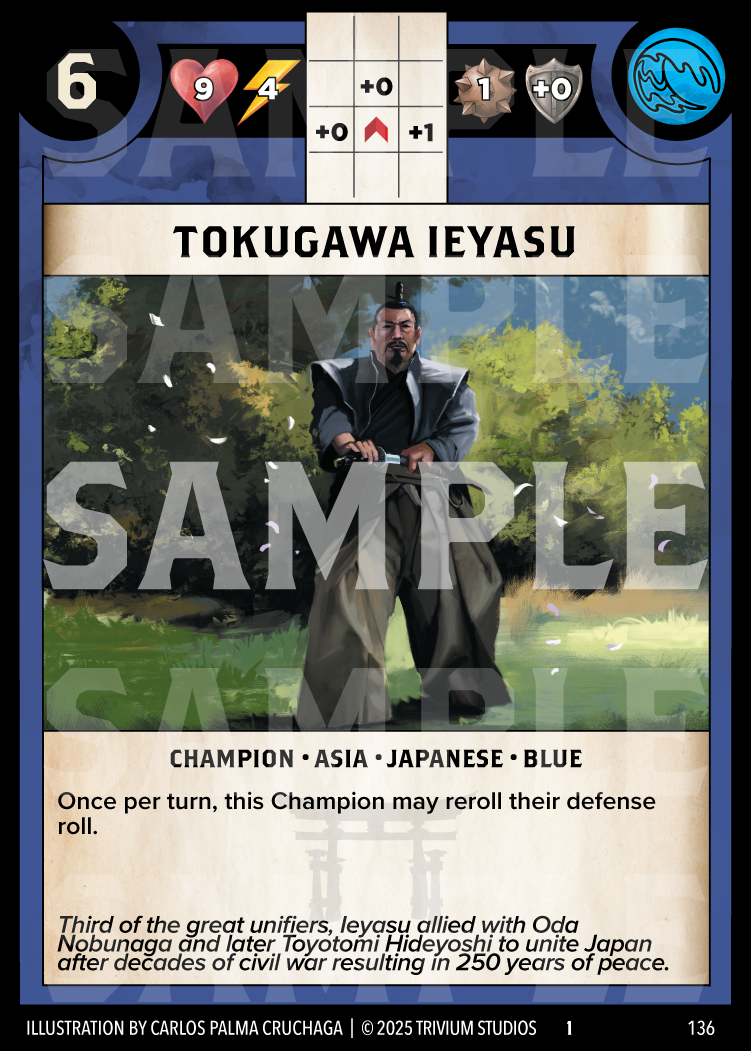
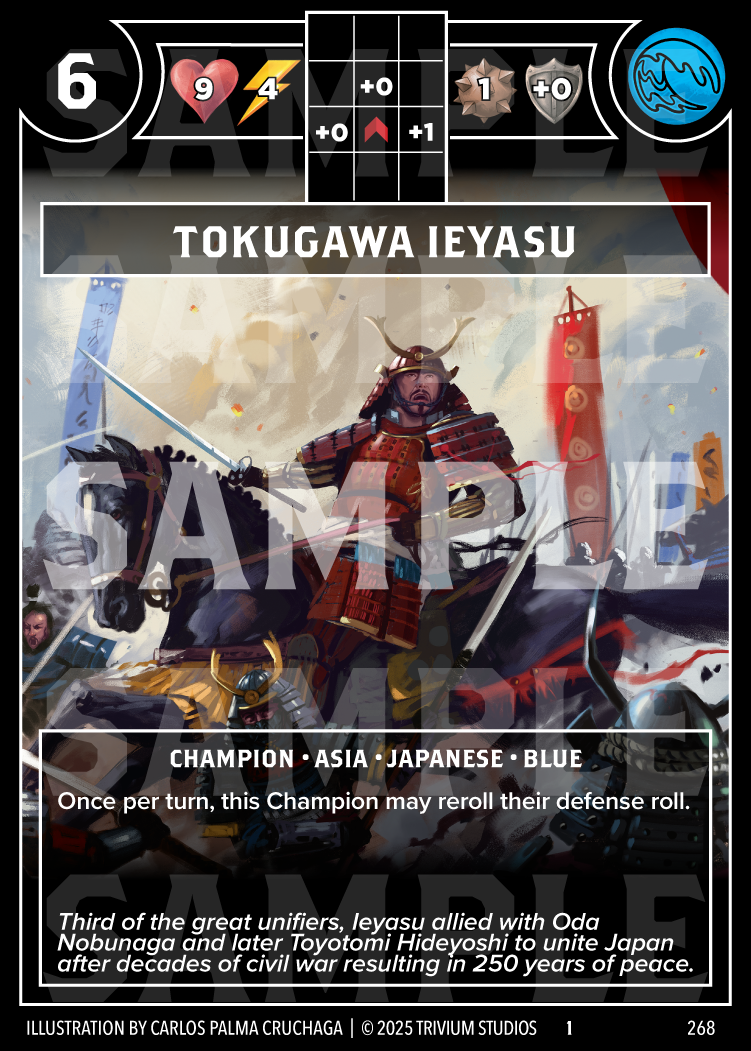
Champion
Asia
Japanese
Blue
Once per turn, this Champion may reroll their defense roll.
Third of the great unifiers, leyasu allied with Oda Nobunaga and later Toyotomi Hideyoshi to unite Japan after decades of civil war resulting in 250 years of peace.
Imagine you’re four years old and your father sends you off as a hostage to the rival Imagawa clan. On the way, you get kidnapped by the Oda clan—another rival—and they threaten to kill you unless your dad swears allegiance. His response? “Meh. Kill him, I’ll make another.” That’s the opening scene in the saga of Tokugawa Ieyasu, one of the most relentless, calculating, and transformative figures in Japanese history.
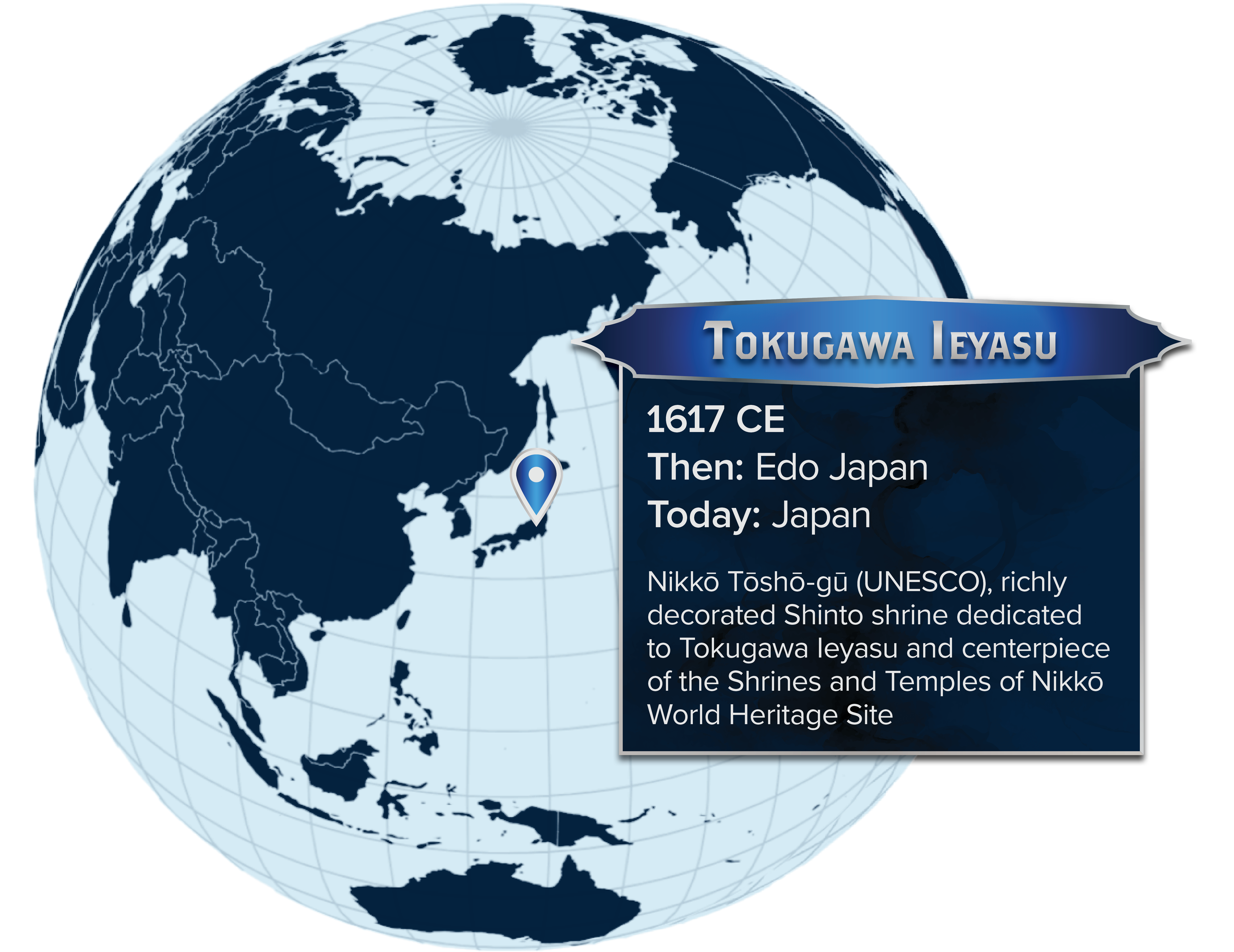
Born into the blood-soaked chaos of the Sengoku period, a century-long civil war where daimyos clashed like gods, Ieyasu emerged as the third and final of Japan’s Great Unifiers. He founded the Tokugawa shogunate, the longest-lasting military government in Japanese history, ruling for over 260 years. He turned a sleepy fishing village called Edo into a thriving metropolis—modern-day Tokyo—and built a castle so magnificent it became the foundation for today’s Imperial Palace.
Legend claims that a golden dragon flew over Okazaki Castle the day he was born, a celestial heads-up that greatness had arrived. Raised with the education of a noble and the training of a warrior, Ieyasu was shrewd, patient, and deadly. At 15, he led his first successful siege against Terabe Castle. His captivity ended when Oda Nobunaga, the first Great Unifier, wiped out Ieyasu’s host family. Ieyasu allied with Nobunaga and began carving his way through central Japan, turning resistance into submission and rivals into allies.
He was ruthless. When his wife and heir were accused of plotting against Nobunaga, he had them executed without hesitation. After Nobunaga’s death, Ieyasu aligned with Toyotomi Hideyoshi, the second Great Unifier. Though tensions flared and thousands died in skirmishes, Ieyasu eventually accepted a role as one of Hideyoshi’s Five Great Elders and relocated to Edo, where he built a new castle, boosted trade, and amassed wealth and influence.
On his deathbed, Hideyoshi asked Ieyasu to protect his five-year-old son, Hideyori. Ieyasu agreed—then, after Hideyoshi’s death, moved into Osaka Castle and began consolidating power. In 1600, he crushed the Toyotomi loyalists at the Battle of Sekigahara, the bloodiest samurai clash in history. Over 40,000 warriors died in a single day, and Ieyasu emerged as the undisputed ruler of Japan.
Knowing how dangerous a child heir could become, Ieyasu later fabricated a pretext to eliminate Hideyori and his family, securing his grip on power. As shogun, he unified Japan under a single government, stripped the emperor of authority while preserving the imperial title, and forced daimyos to alternate residence between their domains and Edo—a brilliant system of control. He expelled Christian missionaries, fearing foreign influence, but maintained lucrative trade with European powers.
Under his rule, Japan entered an era of peace, stability, and prosperity unmatched in its history. Tokugawa Ieyasu wasn’t just a warlord—he was a master architect of empire, a strategist who outlived his rivals, and a ruler who turned bloodshed into order.