Encyclopedia Anachronistica

Standard
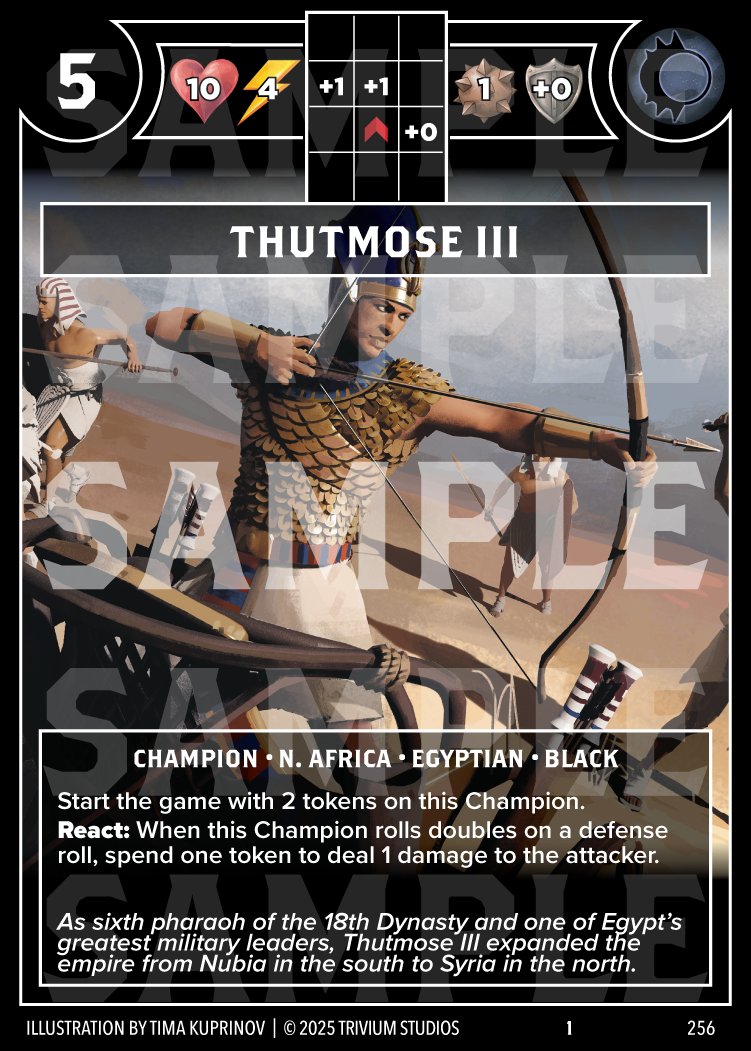
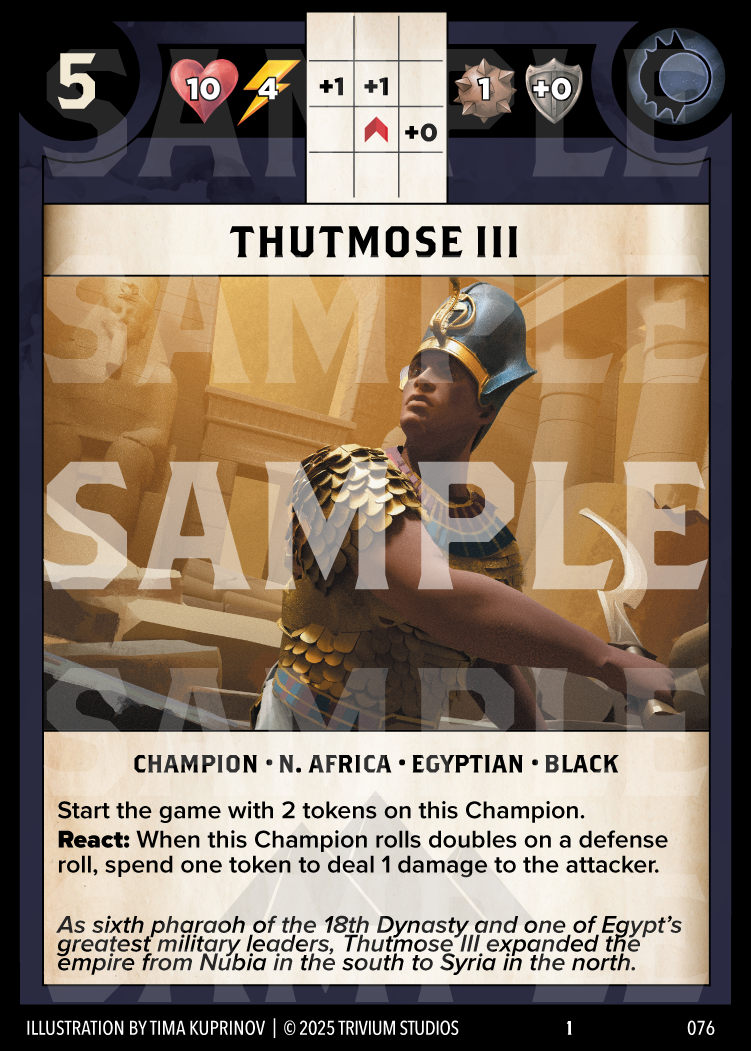
Champion
N. Africa
Egyptian
Black
Start the game with 2 tokens on this Champion. React: When this Champion rolls doubles on a defense roll, spend one token to deal 1 damage to the attacker.
As sixth pharaoh of the 18th Dynasty and one of Egypt's greatest military leaders, Thutmose IIl expanded the empire from Nubia in the south to Syria in the north.
Thutmose III, sixth pharaoh of the 18th Egyptian dynasty, racked up a staggering record of victories—seventeen major campaigns in about twenty years, with no recorded defeats. Compare that win-loss record to just about anyone else in history. Napoleon? Second place. Alexander? Close, but Thutmose’s streak is legendary.
Born around 1481 BCE, he was only a toddler when his father, Thutmose II, died. Too young to rule, his stepmother and aunt, Hatshepsut, took the throne and ruled for over two decades. While she built temples and traded with Punt, young Thutmose was trained in the arts of war—archery, wrestling, horsemanship, and the deadly khopesh sickle-sword. By the time Hatshepsut died, he was ready to unleash Egypt’s armies.
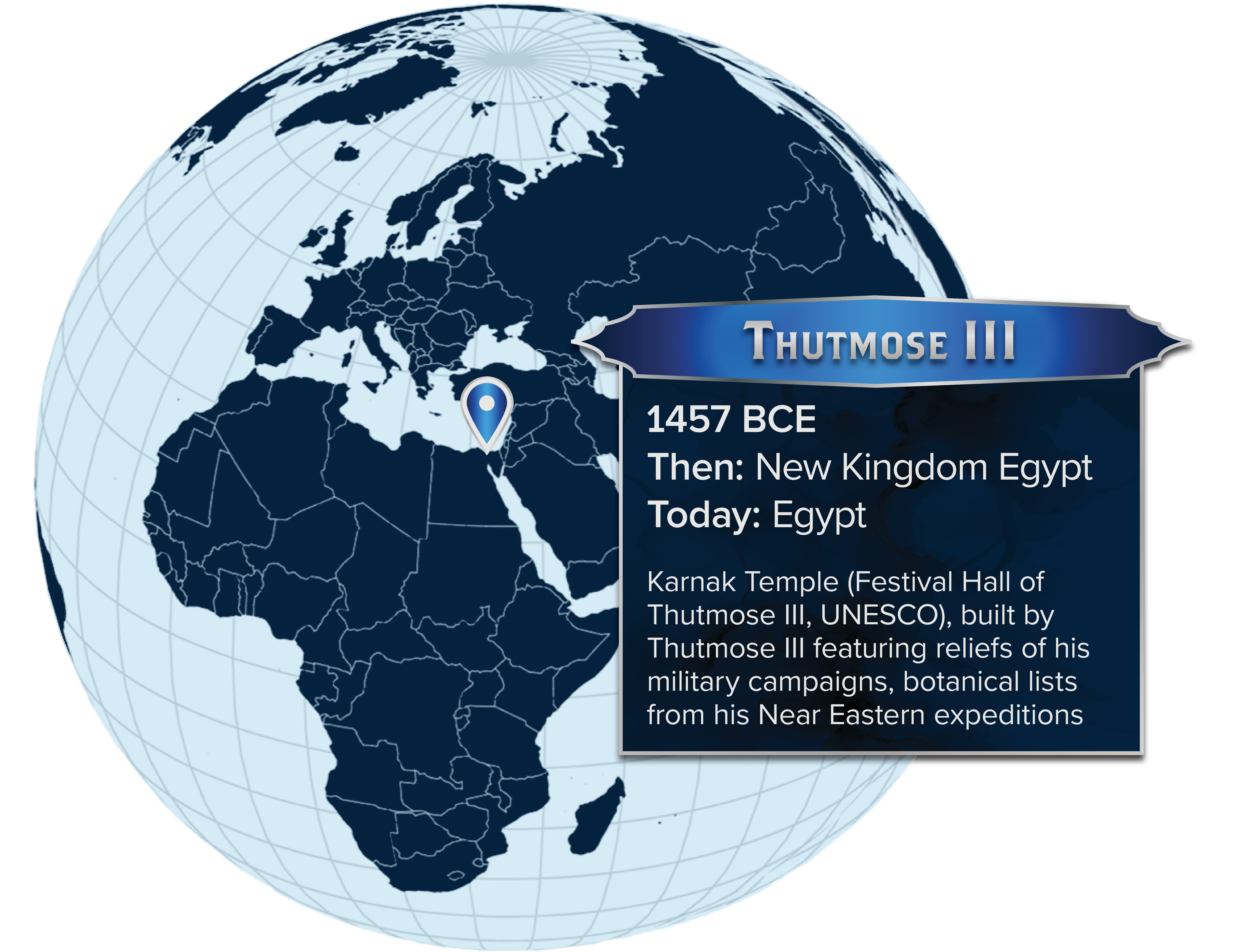
His first great test came at the Battle of Megiddo around 1457 BCE. The king of Kadesh and his Canaanite allies rebelled, thinking they could shake off Egyptian tribute. Thutmose ignored his generals’ cautious advice and marched his army single-file through a narrow mountain pass. It was a gamble, but it paid off: he struck the enemy from the rear, split their forces, and routed them. The battle was so decisive it became the first recorded battle in history, inscribed in detail on the walls of Karnak.
From there, Thutmose went on a rampage. He subdued Syria, cleverly taking noble hostages to keep the elites in line and controlling food supplies to enforce loyalty. Against the Mitanni, he pulled off one of the boldest moves of the Bronze Age: having ships built in Egypt, disassembled, carried across land, and reassembled on the Euphrates for a surprise crossing. The Mitanni were caught flat-footed, and Thutmose plundered their lands before celebrating with elephant and lion hunts on horseback.
He didn’t stop there. Thutmose pushed further south into Nubia than any pharaoh before him, securing Egypt’s gold mines and crushing rebellions. In total, he claimed to have subdued over 350 cities. His empire stretched from the Euphrates in the north to Napata in Nubia, the largest Egypt would ever control.
When not campaigning, he built. Temples, obelisks, and monuments rose across Egypt. He expanded Karnak, commissioned towering obelisks (some of which now stand in Rome, London, and New York), and left behind inscriptions detailing his triumphs. He even oversaw technological advances, with glass vessels appearing during his reign.
For thirty years after Hatshepsut’s death, Thutmose III expanded, solidified, and glorified the 18th Dynasty. His reign left one of the richest, best-documented legacies of any ruler of the ancient world. That was Thutmose.