Encyclopedia Anachronistica


Standard
Champion
Europe
Greek
Red
During round zero, this Champion gains +3 initiative. Place this Champion in any unoccupied space in the Arena.
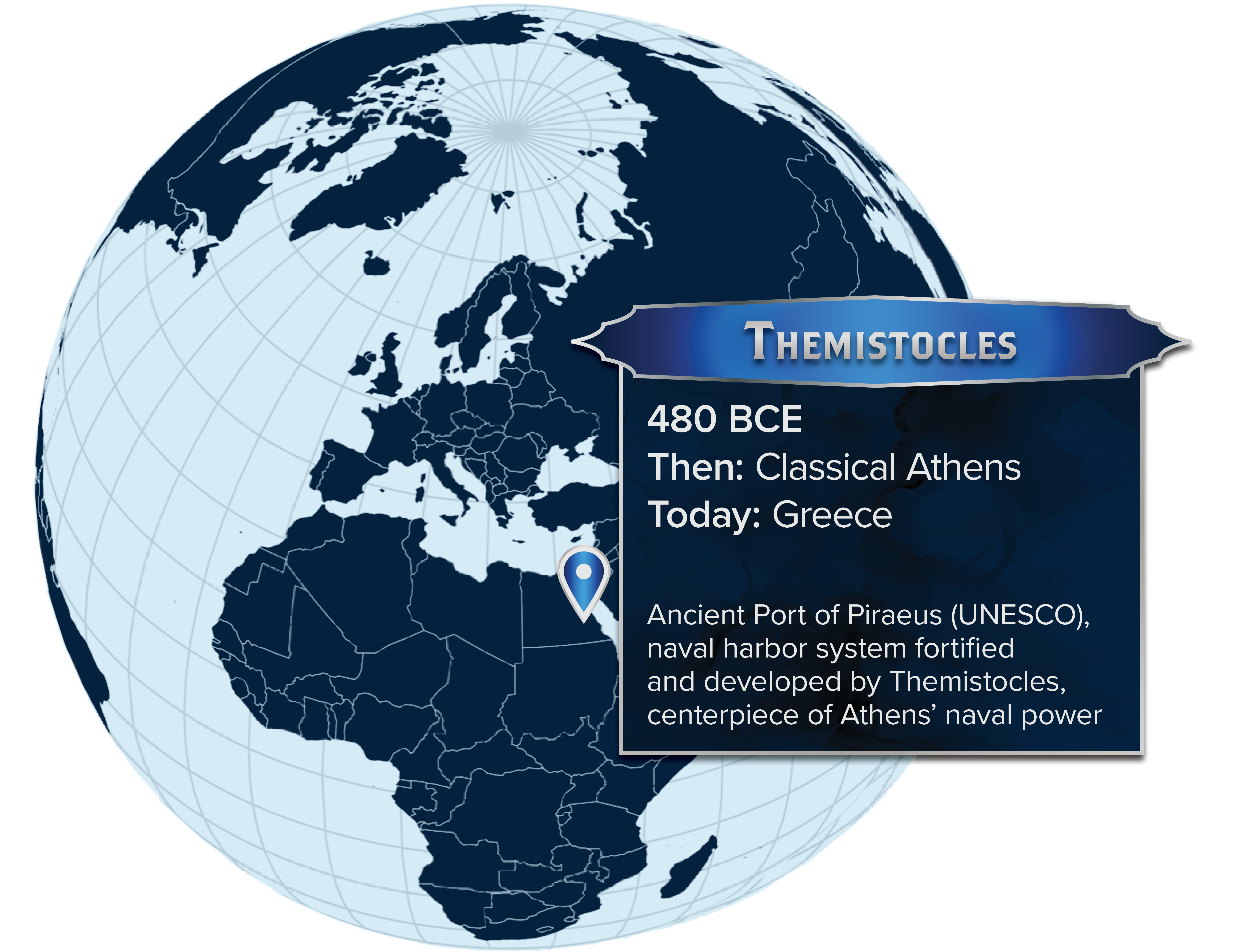
Themistocles built a strong Athenian navy and, under his leadership, destroyed the Persian fleet of Xerxes I at the Battle of Salamis turning the tides of the war.
The nexus of a crisis can forge great leaders.
At 34, Themistocles fought in the Battle of Marathon, watching the Greeks—outnumbered more than 10 to 1—slice through Persian lines with disciplined phalanxes, drenching the field in Persian blood. But Themistocles knew the Persians would return, and next time, they’d be ready for a land fight. So, he made sure they’d die drowning.
That meant building a nautical nightmare: high-speed, lightweight, hyper-maneuverable ships with aquatic agility the world had never seen—the Greek trireme. With 170 oarsmen stacked across three decks, the trireme was a fire-slinging missile designed to ram enemy hulls straight to Poseidon.
Born a political outsider, Themistocles didn’t come from elite circles, didn’t study poetry, and couldn’t jam on a lyre. But he was brilliant, ambitious, and saw what others didn’t: Athens needed a civilization-saving navy. When another archon balked at the cost, Themistocles allegedly maneuvered him into a scandal that led to exile. Over 300 triremes were built, just in time for Persia’s second invasion.
As Xerxes marched a massive force to Thermopylae, greeted by Leonidas and his Spartan warriors, Themistocles took command of the Greek navy and bottled up the sea—blocking Persian flanking routes. Though outnumbered, the Greek fleet held its own, forcing Xerxes to bet on his own overwhelming numbers.
Themistocles evacuated Athens and baited Xerxes into the narrow Strait of Salamis. Xerxes, seated high on a throne to watch Greece fall, sent in his fleet. The Greeks feigned retreat, luring Persian ships into the straits. Then they spun on a drachma and turned the disorganized fleet into floating toothpicks. With no room to maneuver and Greek ships ramming at will, fire arrows flew, hoplites boarded burning decks, and chaos reigned—with Xerxes watching it all with a horrified stare.
The Battle of Salamis wasn’t just a naval clash—it was a demolition derby of divine proportions. As Persian ships jammed into the straits, Greek triremes turned the sea into a battlefield of splinters and screams. Among Xerxes’ commanders was Artemisia of Caria, the lone female admiral in the Persian fleet, who fought with such ferocity that Xerxes reportedly exclaimed, “My men have become women, and my women men!”
Meanwhile, Themistocles’ fleet was everywhere at once, slamming prows into hulls, unleashing hoplites onto decks, and turning the Persian navy into a floating graveyard. The straits echoed with the sound of cracking timber, fire-lit screams, and the roar of Greek victory. Salamis wasn’t just a win—it was a reckoning.
The Persian king fled Greece, leaving his army stranded without supply lines or naval support. Themistocles, architect of the Athenian navy, had won one of the most decisive battles in history—preserving Greek culture and setting the stage for its influence to echo across the ancient world.