Encyclopedia Anachronistica

Chrono
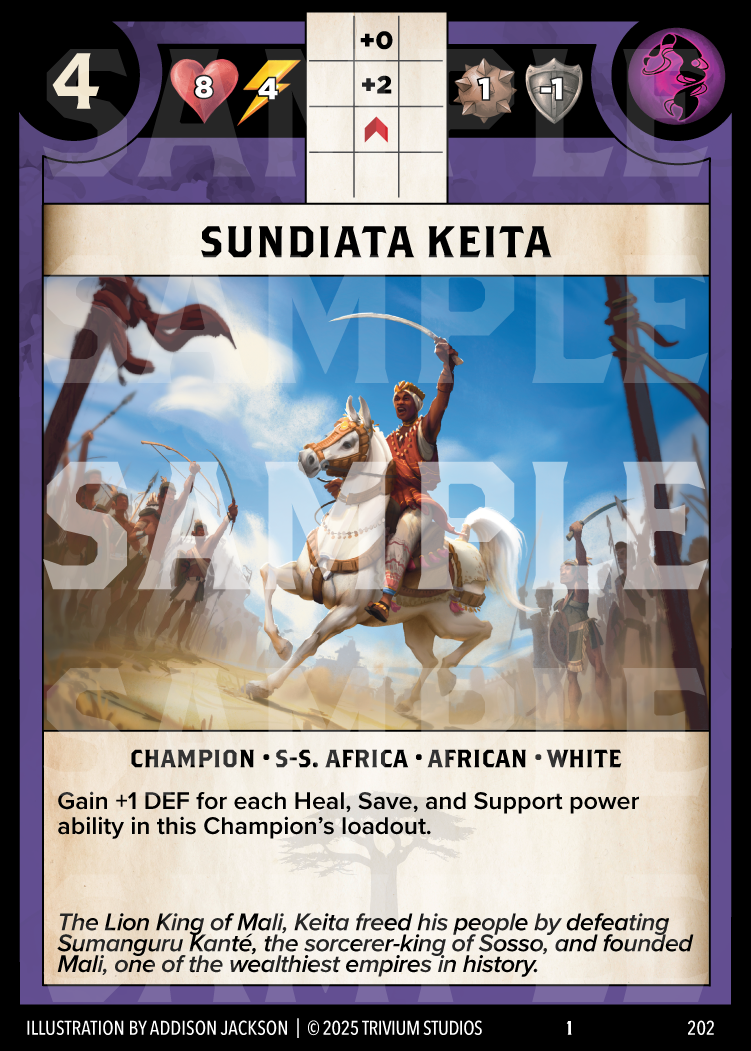
Champion
S-S. Africa
African
White
Gain +1 DEF for each Heal, Save, and Support power ability in this Champion's loadout.
The Lion King of Mali, Keita freed his people by defeating Sumanguru Kante, the sorcerer-king of Sosso, and founded Mali, one of the wealthiest empires in history.

Before he was a king, Sundiata Keita was a prophecy. Born around 1217 CE to Naré Maghann Konaté and Sogolon Condé, he was the child foretold by hunters: a son of a hunchbacked woman who would rise to greatness. But as a boy, Sundiata couldn’t walk. He crawled on the ground while others mocked him. His rivals dismissed him as weak. His own people doubted him. Until one day, with iron braces on his legs, he stood. The griots (a West African oral historian, storyteller, poet, and musician) say the earth itself trembled when he took his first steps.
When his father died, Sundiata’s half-brother Dankaran Touman seized the throne, and his mother Sogolon fled with her children into exile. For years, Sundiata wandered across West Africa, learning politics, forging alliances, and gathering strength. Meanwhile, the Sosso king Soumaoro Kanté rose to power, conquering kingdoms and terrorizing the Mandinka. Soumaoro was said to be a sorcerer, invulnerable to weapons, his palace filled with the skulls of enemies. The Mandinka called for Sundiata to return.
In 1235, he answered. At the Battle of Kirina, Sundiata faced Soumaoro. According to legend, Soumaoro could not be killed by iron or steel. But Sundiata’s griot, Balla Fasséké, discovered his weakness: a cock’s spur. Sundiata fashioned an arrow tipped with it and struck Soumaoro, breaking his magic. The Sosso fled, their empire collapsed, and Sundiata emerged as the liberator of the Mandinka.
From that victory, Sundiata built the Mali Empire. He united clans under the Keita dynasty, established his capital at Niani, and seized control of the goldfields of Wangara. He razed Kumbi, the old capital of Ghana, erasing the last symbol of the fallen empire. His generals expanded Mali’s borders north to the Sahara, east to the Niger, west to the Senegal, and south into the forests. Trade flourished. Merchants came from across Africa and beyond. Mali became one of the great powers of the medieval world.
Sundiata was both Muslim and traditionalist. He respected Islam, which appealed to merchants and scholars, but he also fulfilled the sacred duties of a Mande king, blending faiths to hold his diverse empire together. He issued the Manden Charter, a declaration of rights and laws remembered in oral tradition and recognized by UNESCO as part of humanity’s intangible heritage. It proclaimed justice, social harmony, and the protection of the weak.
He died around 1255, but his legend never did. The griots call him the “Lion of Mali,” the founder whose roar still echoes in West African memory. His descendants ruled for centuries, including his great-nephew Mansa Musa, the wealthiest man in history. Sundiata didn’t just win a battle. He created a civilization.