Encyclopedia Anachronistica

Standard
Inspiration
Asia
Mongol
Event
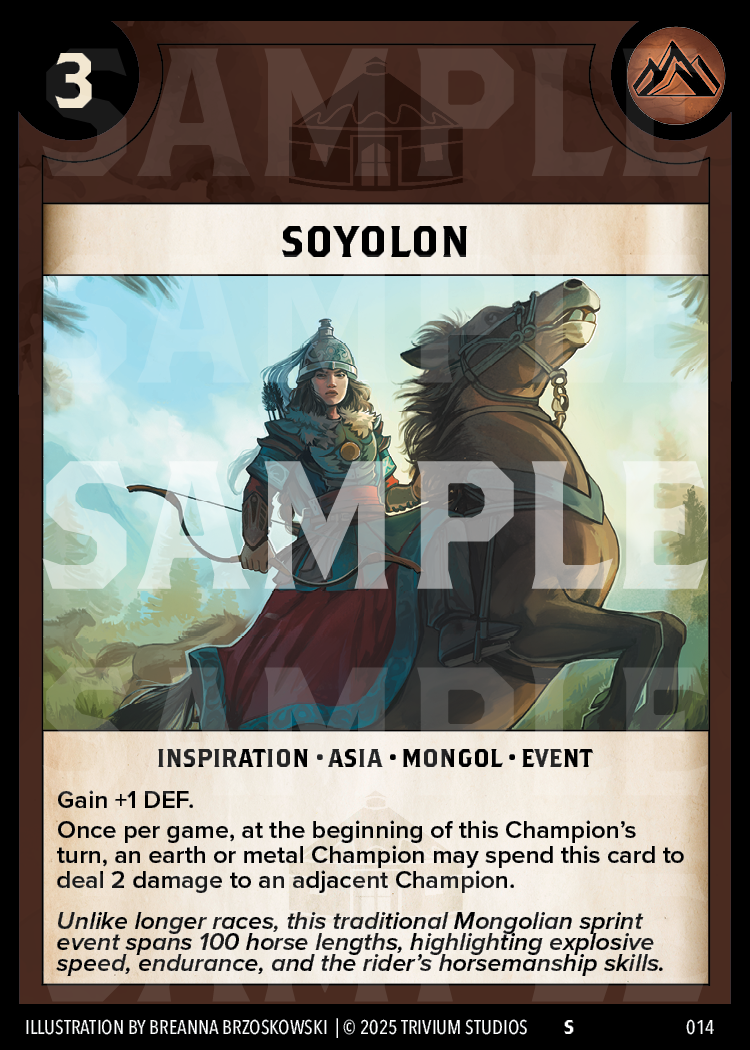
Gain +1 DEF. Once per game, at the beginning of this Champion's turn, an earth or metal Champion may spend this card to deal 2 damage to an adjacent Champion.
Unlike longer races, this traditional Mongolian sprint event spans 100 horse lengths, highlighting explosive speed, endurance, and the rider's horsemanship skills.
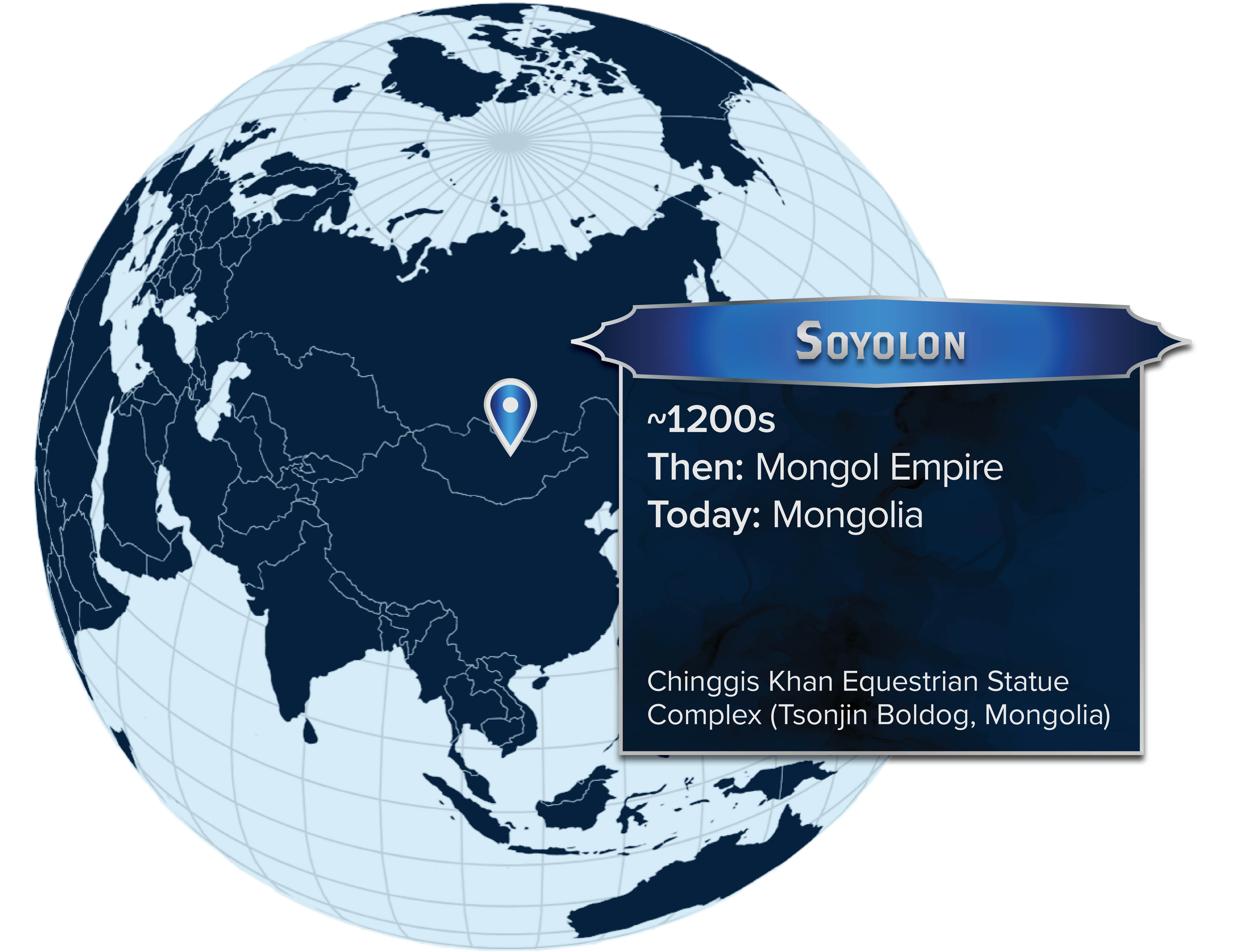
The soyolon is the five-year-old class of Mongolia’s legendary long-distance horse races, a test of endurance and lineage that threads nomadic tradition through the modern Naadam festival, where wind-scoured steppe tracks turn young jockeys and battle-bred horses into national heroes. Rooted in the pastoral life of the steppes, horse racing long served as a showcase of horsemanship, stamina, and the deep bond between herder and herd; today’s soyolon carries that lineage forward with age-tiered distances that reward hard conditioning and tactical pacing over raw speed. In the State Naadam, children ages seven to thirteen ride—once bareback, now with mandated helmets, vests, and protective gear—mirroring the historic expectation that youth learn courage, balance, and responsibility in the saddle while adapting to modern safety standards.
Historically, Naadam gathered wrestlers, archers, and horsemen from wide horizons, but the racing culture stretched beyond a single holiday—spring races, Lunar New Year events, and regional meets kept herds tuned and reputations sharp. The soyolon’s place amid these is distinctive: five-year-olds balance maturity with freshness, capable of maintaining punishing gallops across straight, open courses where navigation yields to endurance against heat, dust, and sudden rain squalls. Trainers prepare horses for at least a month, cycling through staged regimens that strip weight, build cadence, and peak speed, monitoring sweat color and droppings like a living ledger of readiness—a meticulous, almost scientific ritual codified by generations of herders who read horses the way scholars read manuscripts.
Naadam’s central stage near Ulaanbaatar runs across mid-July, with races held on open fields at Khui Doloon Khudag; distances vary by age class, and the soyolon goes far enough to punish any lapse in conditioning or lineage. Cross-bred horses are barred from State Naadam, a deliberate guardrail to preserve the character of the Mongolian horse—compact, tough, and wise to weather—while an entire parallel race day on July 13 gives cross-breds their own spotlight. Prestige also flows through the Ikh Hurd, the “Grand Speed,” where the very best compete; scores for top finishers there count double those earned at the State Naadam, elevating trainers and bloodlines into folklore as surely as any ballad.
Recent soyolon fields show how tradition scales to the national stage: in the 2025 State Naadam, 195 horses registered, 128 met wither-height requirements, and the winning chestnut hailed from Khovd, with top-five finishers spanning aimags (provinces) from Khentii to Govi-Altai—a map of pride galloping across Mongolia. These numbers aren’t mere statistics; they’re the living pulse of a culture where a horse’s maternal line is scrutinized, where sweat is scraped with a khusuur, and where a child’s steady seat under a vast sky becomes the nation’s heartbeat. The soyolon endures because Mongolia still listens to hooves and horizon—and races not just to win, but to honor the road that made them.