Encyclopedia Anachronistica


Chrono
Champion
Europe
Freedom Fighter
Gold
Gain +1 base ATK for each revealed companion and icon card in this Champion's loadout. Gain +1 weapon ATK for each minion card in the Arena or in this Champion's discard pile.
Trained by the Ottomans, Christian knight Skanderbeg, the Dragon of Albania, used their tactics against them and repelled 13 Ottoman invasions for two decades.
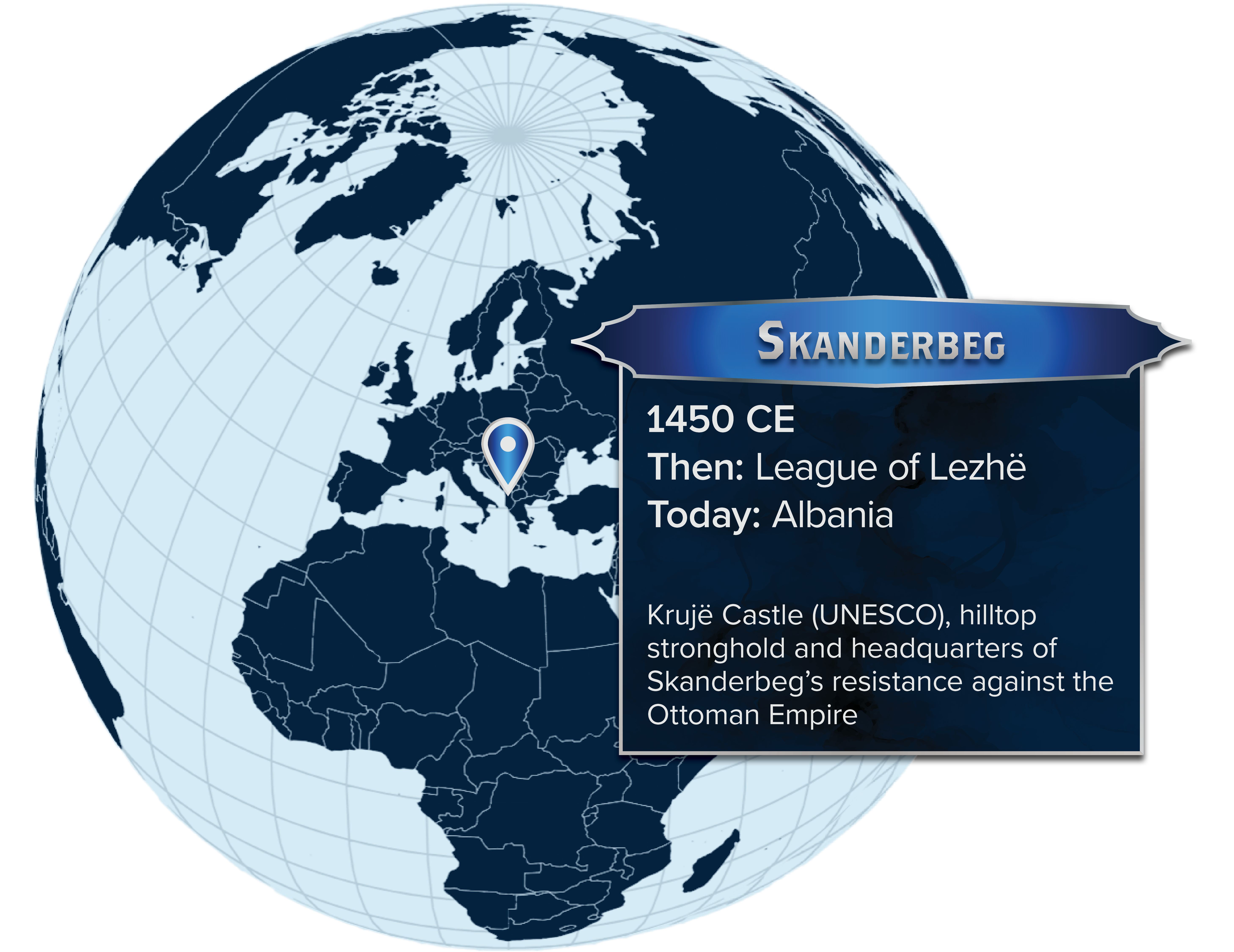
Before he became a symbol of resistance, George Kastrioti was a hostage. Born in 1405 to an Albanian noble family, he was seized by the Ottoman Empire as a child and raised to serve the sultan. They gave him a new name—İskender Bey, “Lord Alexander”—a nod to Alexander the Great. He trained as a soldier, converted to Islam, and rose through the ranks. But the empire hadn’t broken him. It had sharpened him.
In 1443, during a campaign in Hungary, Skanderbeg saw his moment. He deserted the Ottoman army, rode back to Albania, and seized the fortress of Krujë. He renounced Islam, reclaimed his Christian faith, and declared war on the empire that had raised him. It wasn’t just rebellion. It was a reclamation.
For the next 25 years, Skanderbeg led a guerrilla war against the Ottomans. He united Albanian clans, forged alliances with Naples, Venice, and the Papacy, and turned mountain passes into death traps. He fought off repeated invasions, including three major sieges of Krujë. Sultan Mehmed II—the conqueror of Constantinople—personally led one of them. Skanderbeg made him retreat.
His tactics were brutal and brilliant. He used terrain, surprise, and speed. He struck supply lines, ambushed columns, and vanished into the hills. His forces were small, but his reputation was enormous. European powers hailed him as the “Athleta Christi”—Champion of Christ. The Ottomans called him “the cursed infidel.” Both sides agreed: he was a problem.
Skanderbeg wasn’t just a warrior. He was a strategist, a diplomat, and a myth-maker. He wore a helmet with a goat’s head crest, symbolizing strength and defiance. He signed letters with imperial flair. He negotiated treaties while sharpening swords. He didn’t just fight battles. He built a legend.
He died in 1468 of malaria, not battle. After his death, Albania fell to the Ottomans. But his legacy endured. His name became a rallying cry for Albanian identity, resistance, and independence. His statue stands in Tirana. His story is taught in schools. His helmet appears on coins and sits in a museum. He didn’t just defend a fortress. He became one.
He wasn’t a king with a crown. He was a rebel with a cause. He didn’t just defy an empire. He made it bleed. And when history looked for a symbol of resistance, it found Skanderbeg—riding with fury, fighting with fire.