Encyclopedia Anachronistica

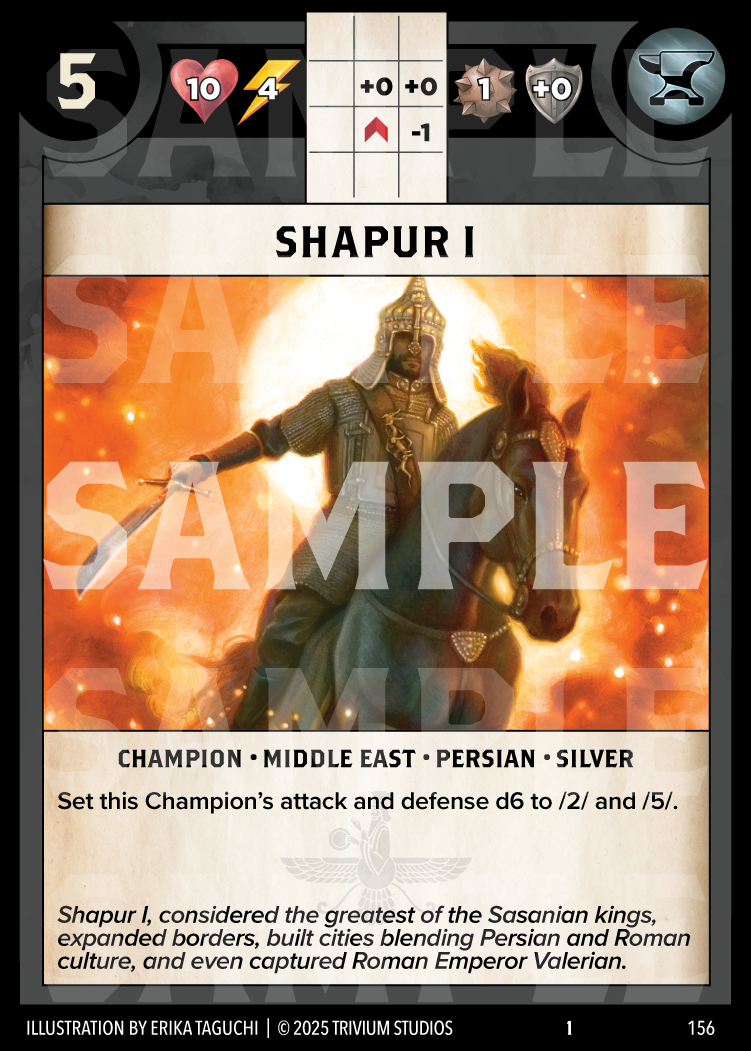
Standard
Champion
Middle East
Persian
Silver
Set this Champion's attack and defense d6 to /2/ and /5/.
Shapur I, considered the greatest of the Sasanian kings, expanded borders, built cities blending Persian and Roman culture, and even captured Roman Emperor Valerian.
Sometimes history’s titan is, mostly, a nice guy—intelligent, kind-hearted, logical, wise, brave, scholarly, and more than capable of dismembering the world’s toughest invaders and beating them to death with their own arms. Shapur I, second king of the Sasanian Empire, was that paradox: a philosopher-warrior who could crush Roman legions before breakfast and still be remembered fondly in the Talmud.
Unlike most historical dads, Shapur’s father, Ardashir I, was hands-on—teaching his son how to manage an empire and how to expand it with precision. Shapur took the throne around 240 CE and immediately began kicking Roman legions out of western territories, capturing cities in Syria, and causing enough headaches that Emperor Philip the Arab handed over Armenia and 500,000 gold denarii in a peace treaty. Then he broke it. Shapur, unimpressed, crushed a western rebellion and vaporized a Roman army of 60,000 at Barbalisus, burning 36 forts and cities across Syria—but sparing religious sanctuaries.
During his campaigns in Roman Syria, Shapur I sacked numerous cities but spared some religious sites, possibly out of respect or strategic restraint. Within his empire, he maintained a policy of religious tolerance, and although many Christians were deported from Roman territories, they were generally allowed to worship freely. Then came his most legendary feat: the capture of Roman Emperor Valerian at the Battle of Edessa in 260 CE. It was the first—and only—time a Roman emperor was taken alive in battle. What happened next depends on the source. Some say Valerian was treated well and helped build the city of Bishapur. Others claim Shapur used him as a human mounting block, kept him in a cage, and eventually had him skinned, stuffed with manure, and displayed at a Roman temple as a warning. Either way, Rome never forgot.
At the siege of Dura-Europos, Shapur’s forces may have used one of the earliest forms of chemical warfare. When Roman troops tunneled under the walls, the Sasanians ignited sulfur and pitch, releasing toxic sulfur dioxide and killing twenty soldiers underground.
Shapur didn’t just conquer—he stabilized. He continued his policies of religious tolerance, was mentioned favorably in Jewish texts, and minted coins labeling himself “King of Eran and Aneran”—a declaration that all peoples, Iranian or not, were under his protection. These coins have been found from China to Scandinavia.
He modernized the Sasanian military, adding war elephants, cataphracts (armored cavalry), and upgraded Roman chainmail into superior Persian armor. His public works were monumental: centralized government, massive irrigation systems, historical reliefs carved into cliffs, and a boom in urban development. He couldn’t stop building.
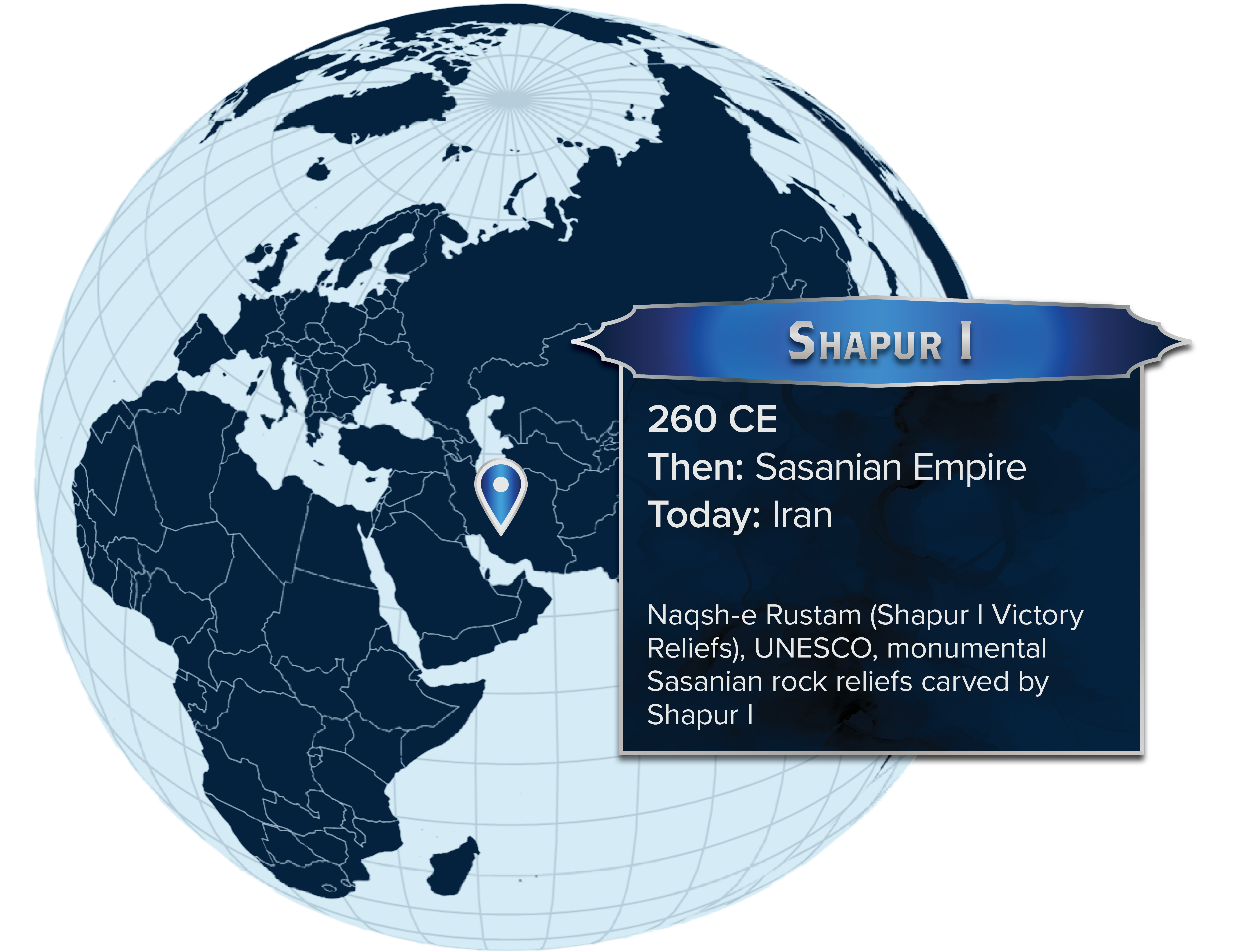
If you want to see this warrior-king in stone, visit the Colossal Statue of Shapur I in southern Iran. Standing 7 meters tall, it’s been towering over history for 1,400 years—a granite echo of the man who humbled Rome and built an empire with brains, brawn, and benevolence.