Encyclopedia Anachronistica

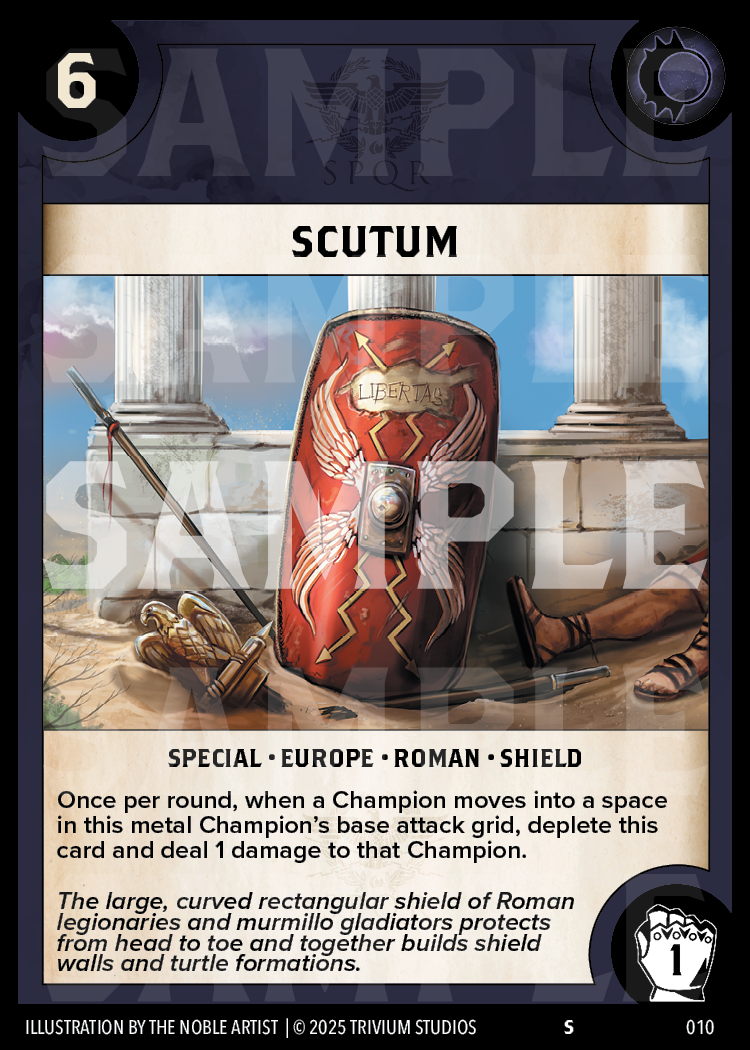
Standard
Special
Europe
Roman
Shield
Once per round, when a Champion moves into a space in this metal Champion's base attack grid, deplete this card and deal 1 damage to that Champion.
The large, curved rectangular shield of Roman legionaries and murmillo gladiators protects from head to toe and together builds shield walls and turtle formations.

The scutum’s origins reach back to the early Italic peoples of the 8th century BC, when oval and oblong shields began replacing the smaller round clipeus of the Greek-style hoplite phalanx. By the 4th century BC, Rome abandoned the rigid phalanx for the more flexible manipular formation, and with this tactical revolution came the scutum: a larger, semi-cylindrical shield that covered a soldier from shoulder to knee. This innovation allowed legionaries to fight in staggered lines, advancing with greater maneuverability while still presenting a formidable wall of protection. Ancient writers like Polybius described the scutum as about four feet tall (120 cm) and two and a half feet wide (75 cm), built from layers of wood glued at right angles, covered with canvas and calfskin, and reinforced with iron edging. At its center sat the umbo, a domed boss that could deflect missiles or be used offensively to strike an opponent.
The scutum’s curved design was more than aesthetic—it was tactical genius. Unlike flat shields, its convex surface deflected blows, while overlapping edges allowed soldiers to lock together in the famous testudo (“tortoise”) formation. In this arrangement, front ranks held their scuta forward while those behind raised them overhead, creating an almost impenetrable shell against arrows and stones. This tactic became legendary, symbolizing Roman discipline and unity. Painted decorations—eagles, thunderbolts, or cohort insignia—added both divine symbolism and battlefield identification, ensuring that soldiers could recognize comrades even amid chaos.
Over centuries, the scutum evolved. Early versions were oval, but by the late Republic and early Empire, the rectangular semi-cylindrical form dominated. It was heavy, often weighing around 10 kg, but its size meant legionaries could thrust with the short gladius from behind near-total cover. By the 3rd century AD, however, as Rome’s armies shifted toward more mobile tactics and diverse troop types, the scutum gradually disappeared, replaced by smaller oval or circular shields better suited to cavalry and skirmishers.
Yet one scutum survives to this day: the Dura-Europos scutum, discovered in Syria during excavations in the 1930s. Found in Tower 19 of the city walls, where Roman defenders perished during a Sassanid siege in 256 AD, it is the only known semi-cylindrical scutum preserved from antiquity. Broken into thirteen pieces but painstakingly reconstructed, it measures about 105 cm tall and 41 cm wide. Its painted surface once displayed an eagle with a laurel wreath, winged Victories, and a lion—symbols of Roman triumph. The shield’s survival owes much to Dura-Europos’ arid climate, which preserved organic materials like wood and hide. Today, this extraordinary artifact resides in the Yale University Art Gallery, offering a rare, tangible glimpse into the equipment that made Rome’s legions unstoppable.