Encyclopedia Anachronistica

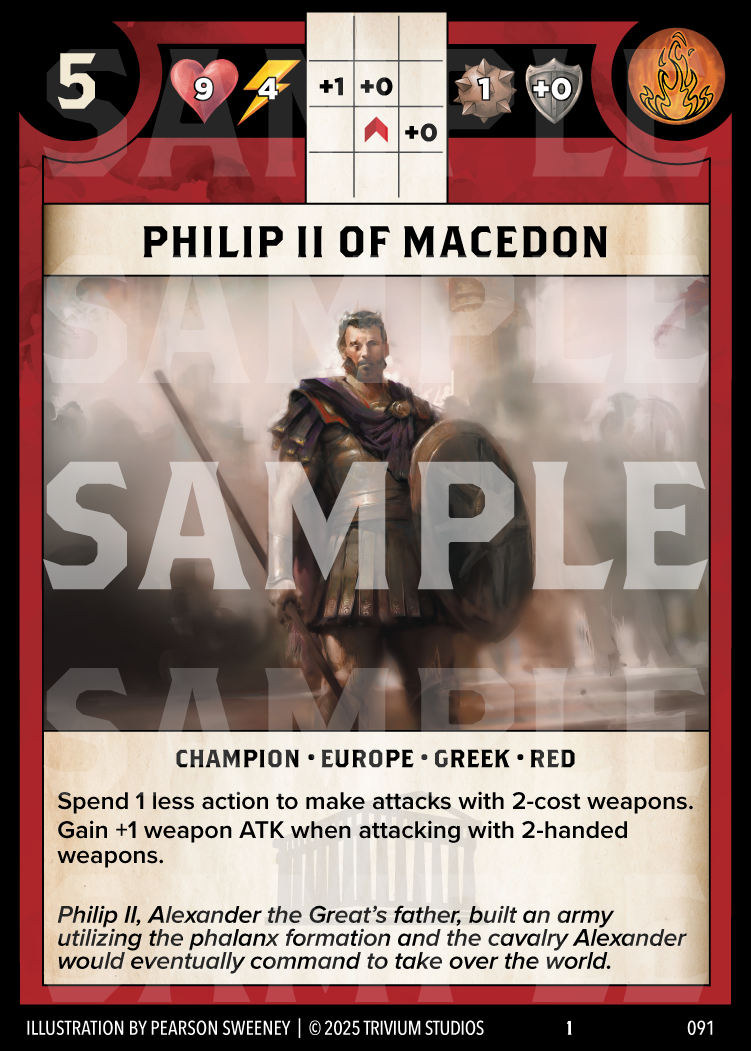
Standard
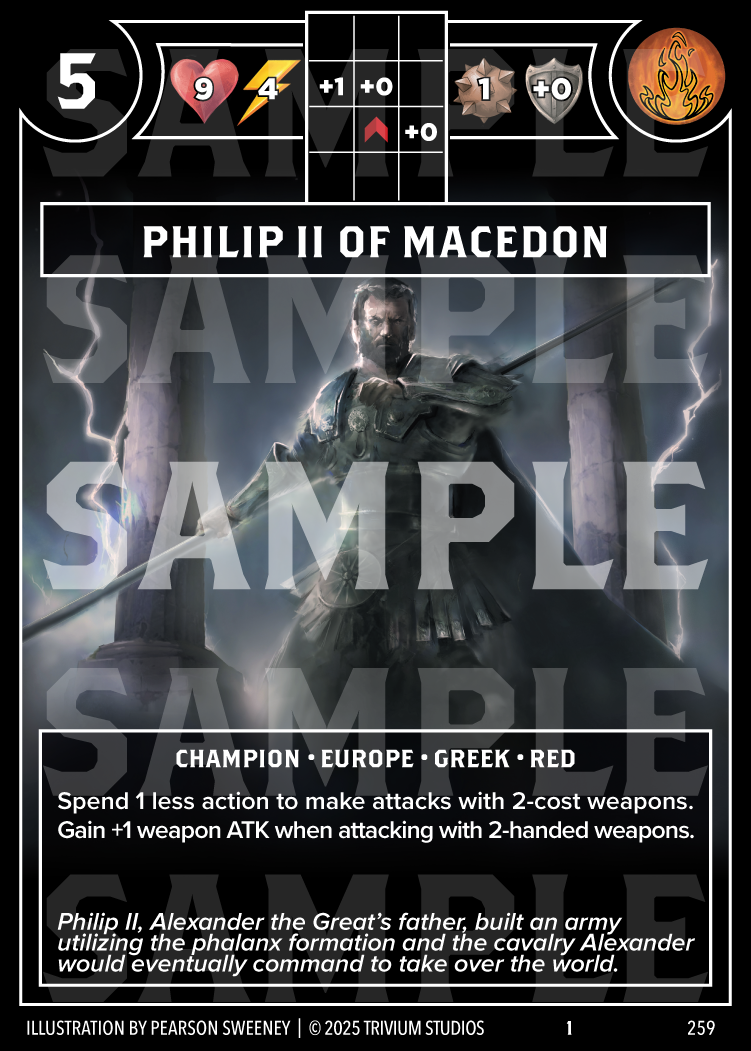
Champion
Europe
Greek
Red
Spend 1 less action to make attacks with 2-cost weapons. Gain +1 weapon ATK when attacking with 2-handed weapons.
Philip II, Alexander the Great's father, built an army utilizing the phalanx formation and the cavalry Alexander would eventually command to take over the world.
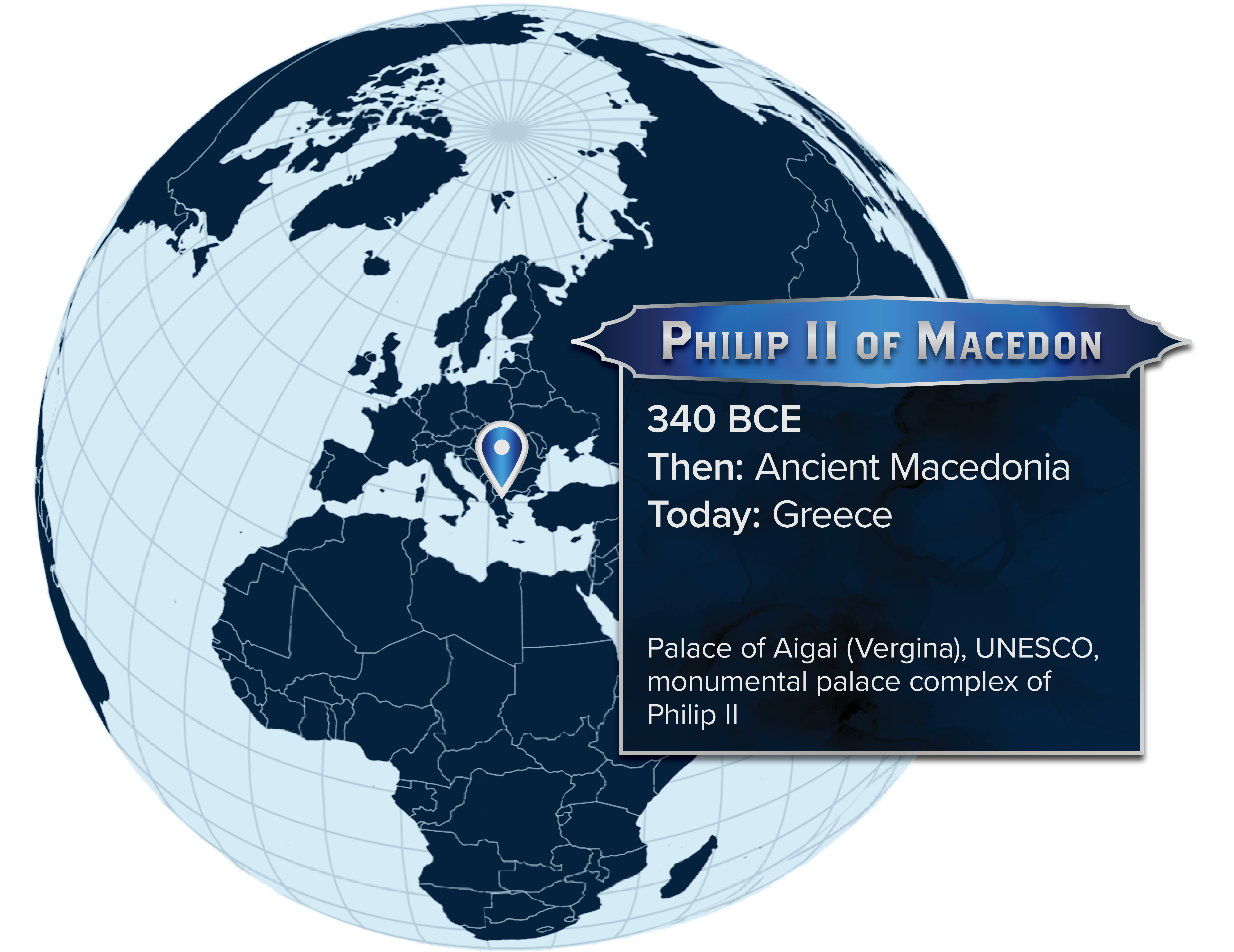
Who gets credit for a kill? The one who invented the gun, loaded it, aimed it—or the one who pulled the trigger? Let’s talk about Philip II of Macedon: steamroller, king, Olympic champion, and father of Alexander the Great.
Philip inherited Macedon on the brink of collapse and transformed it from a backwater into the dominant power of the region, poised to challenge the Persian superpower. Surrounded by hostile Illyrians, Paeonians, and Thracians, Philip got to work—applying his own tactical genius and recruiting every sharp mind he could find to overhaul his military from disorganized rabble into a disciplined war machine.
He began with the creation of one of the nastiest units ever to bloody a battlefield: the Macedonian phalanx. By replacing the traditional 2–3 meter dory with the 6-meter sarrisa, Philip extended the reach and impact of his infantry. A wall of 80 of these death-dealing spears advancing in tight formation was enough to send enemies sprinting for safety.
Macedon’s terrain was ideal for horse breeding, and Philip capitalized by ditching slow ox-carts in favor of fast, multi-role warhorses. He revamped his cavalry—The Companions—with the xyston lance and introduced the wedge formation, a 200-horse spearhead designed to shatter enemy lines while infantry cleaned up the dazed and confused enemy leftovers. He didn’t stop there: siege warfare got a makeover too. With top-tier engineers, Philip’s siege towers, catapults, and battering rams became the envy of the ancient world.
Once Hellenic warfare was perfected, Philip turned inward to unify Greece. He showcased his new army to the Illyrians, who lost 7,000 men in stunned defeat. At the Battle of Chaeronea, he crushed a Greek alliance led by Athens and Thebes, killing 6,000 and capturing thousands more. At Methone, he lost an eye to an arrow—and responded by leveling the city. Later, 6,000 Phocians were killed and 3,000 drowned for desecrating a temple.
Philip’s diplomatic brilliance then took center stage. He convinced the Greek city-states to grant him command of their armies as Hegemon of the Hellenic League, allowing them to retain local governance while uniting under his military leadership. With Greece consolidated, Philip launched his campaign against Persia. His advance force of 10,000 began liberating Greek cities along Anatolia’s coast, sparking revolts against Persian rule.
Then came the twist: Philip was assassinated by his bodyguard in a bizarre palace conspiracy. But by then his gun was built, loaded, and aimed. His son Alexander may have pulled the trigger—but Philip II of Macedon was the original architect of conquest.