Encyclopedia Anachronistica

Standard
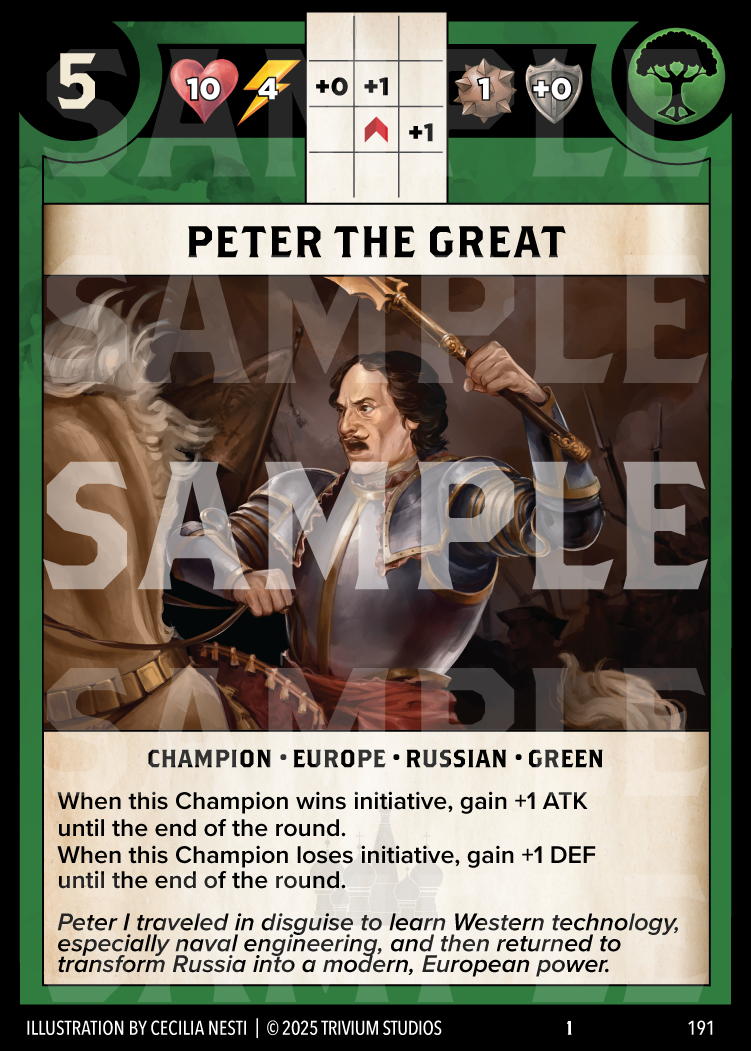
Champion
Europe
Russian
Green
When this Champion wins initiative, gain +1 ATK until the end of the round. When this Champion loses initiative, gain +1 DEF until the end of the round.
Peter I traveled in disguise to learn Western technology, especially naval engineering, and then returned to transform Russia into a modern, European power.
Peter the Great ruled over a Russia that was still in the Middle Ages while the rest of Europe had already undergone the Renaissance, the Reformation, and the Enlightenment. He wasn’t having any of that. He would drag Russia into the modern era or die trying, rocketing it through those missing Ages and putting it squarely on the map as an international power for the first time.
To bring European technology, scholarship, and culture to Russia meant one thing—fight a war with Sweden. The Swedes, firmly part of advanced Europe, had a fearsome army, a powerful navy, and control of the Baltic Sea. Peter took the tangled mess jokingly called the Russian army and turned it inside out with reforms modeled on European militaries. He pushed industrialization, built factories, and created a navy to protect Russia’s trade. Unlike many palace-bound rulers, Peter had received a more open-minded education from his mother, which made him stand out as a curious, unconventional tsar.
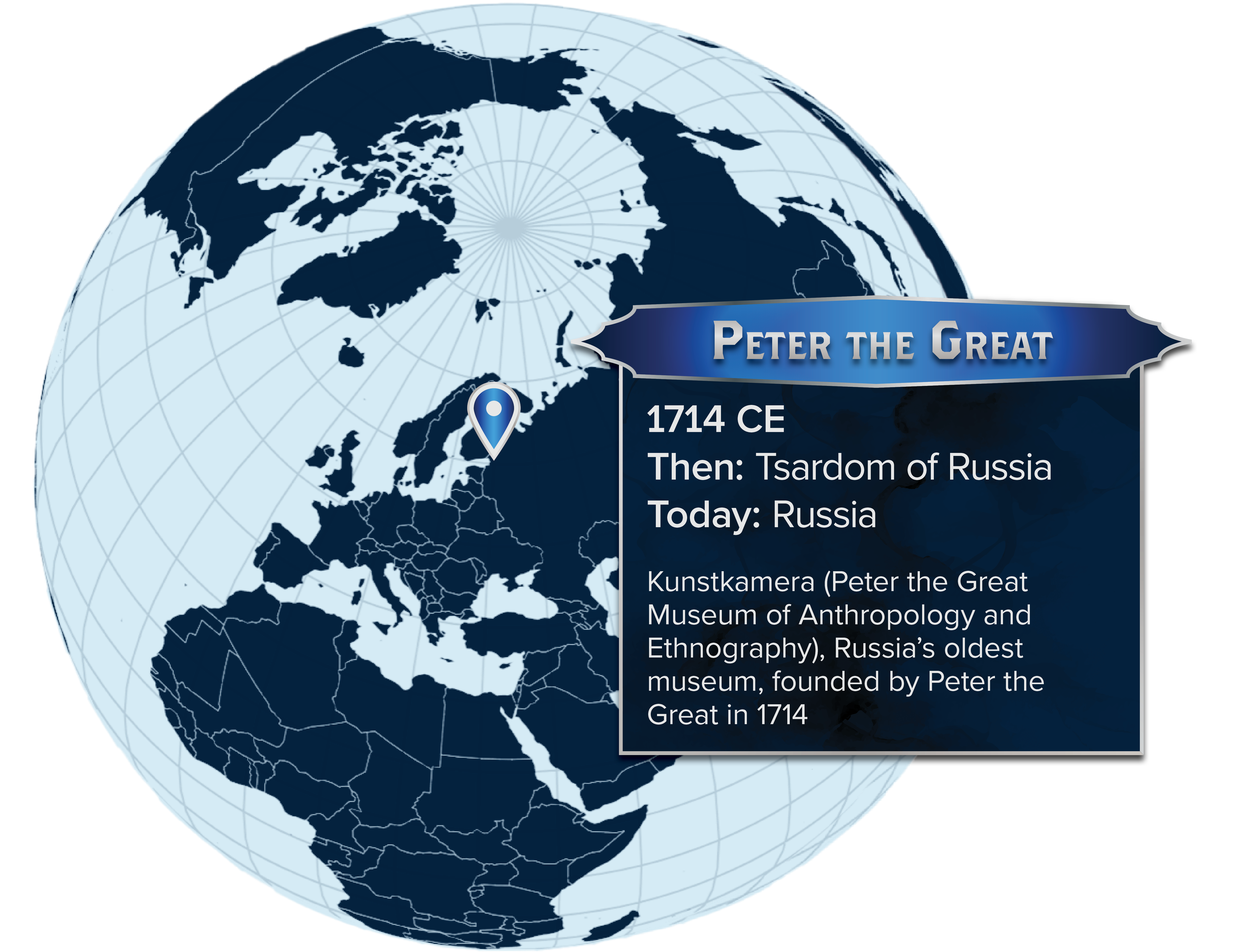
Russia’s size was vast, but it lacked access to the Black, Baltic, or Caspian Seas. What Peter didn’t have; he intended to take. He practiced first against the Tatars, building a fleet on the Don River, capturing Azov, and beginning construction of a massive navy. Realizing his ships were outdated, he made an incredible decision and disguised himself as a common soldier and traveled incognito to Western Europe. In the Netherlands and England, he worked in shipyards, learned shipbuilding from the Dutch East India Company and the Royal Navy, and studied schools, factories, arsenals, and museums. After about a year and a half, he returned with cutting-edge knowledge and applied it across Russian life.
Back home, after brutally suppressing the rebellious streltsy guard, Peter turned to his great test: Sweden. For 21 years, he fought the Great Northern War. He didn’t just command from afar—he put on a sailor’s jacket to serve on warships, donned an officer’s uniform to charge into battle, and worked in shipyards with axe and apron. His strategy at Poltava in 1709 crushed the Swedish army, turning Sweden into a second-rate power.
Peter then built the port city of St. Petersburg on the Baltic, moved the capital there, and declared Russia an empire. He expanded south into Persia, secured access to the Caspian, and pushed Russia to the forefront of metallurgy and industry. Foreign trade increased sevenfold. By the end of his reign, Russia had been transformed from a medieval backwater into a European powerhouse.