Encyclopedia Anachronistica

Standard
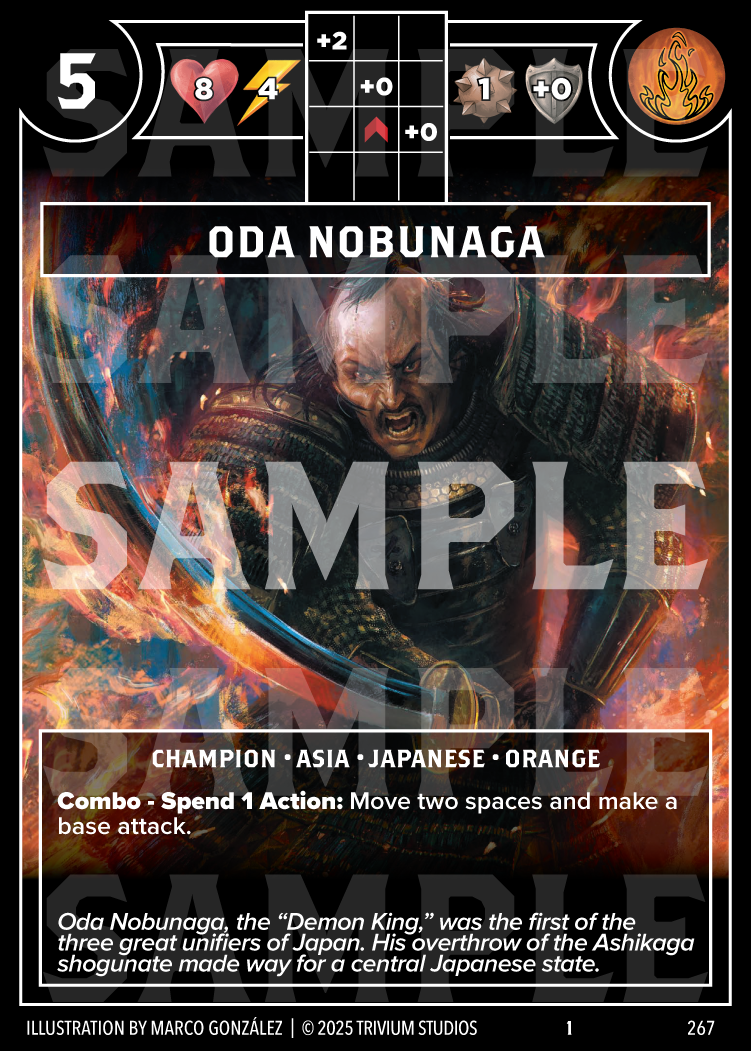
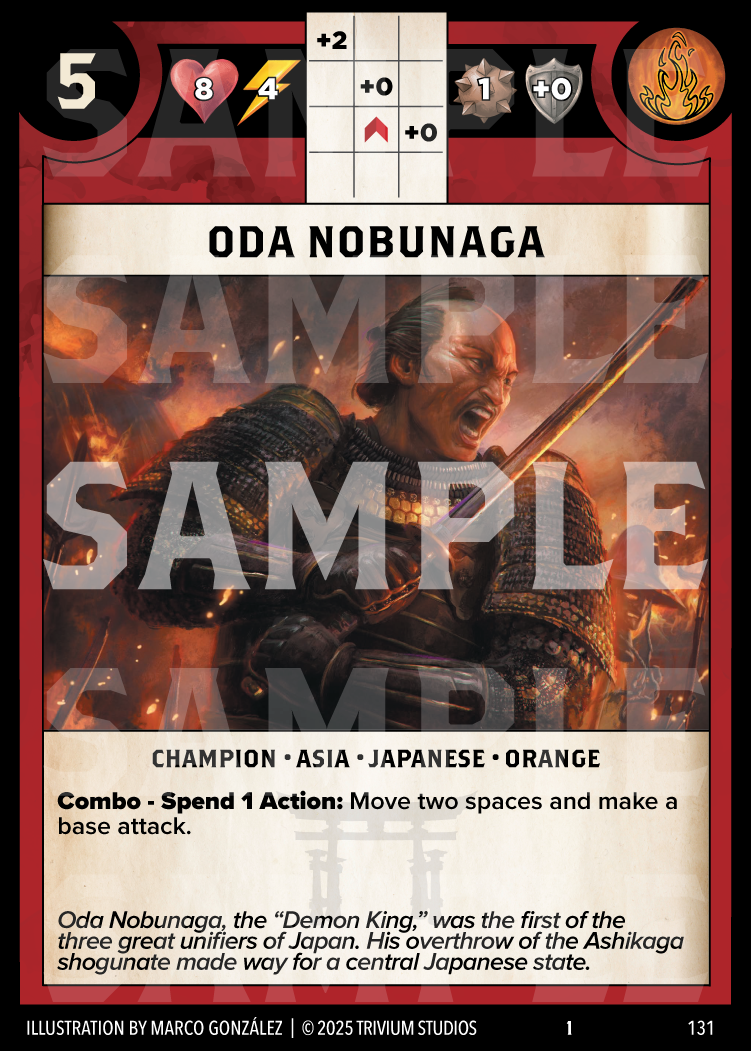
Champion
Asia
Japanese
Orange
Combo - Spend 1 Action: Move two spaces and make a base attack.
Oda Nobunaga, the "Demon King," was the first of the three great unifiers of Japan. His overthrow of the Ashikaga shogunate made way for a central Japanese state.
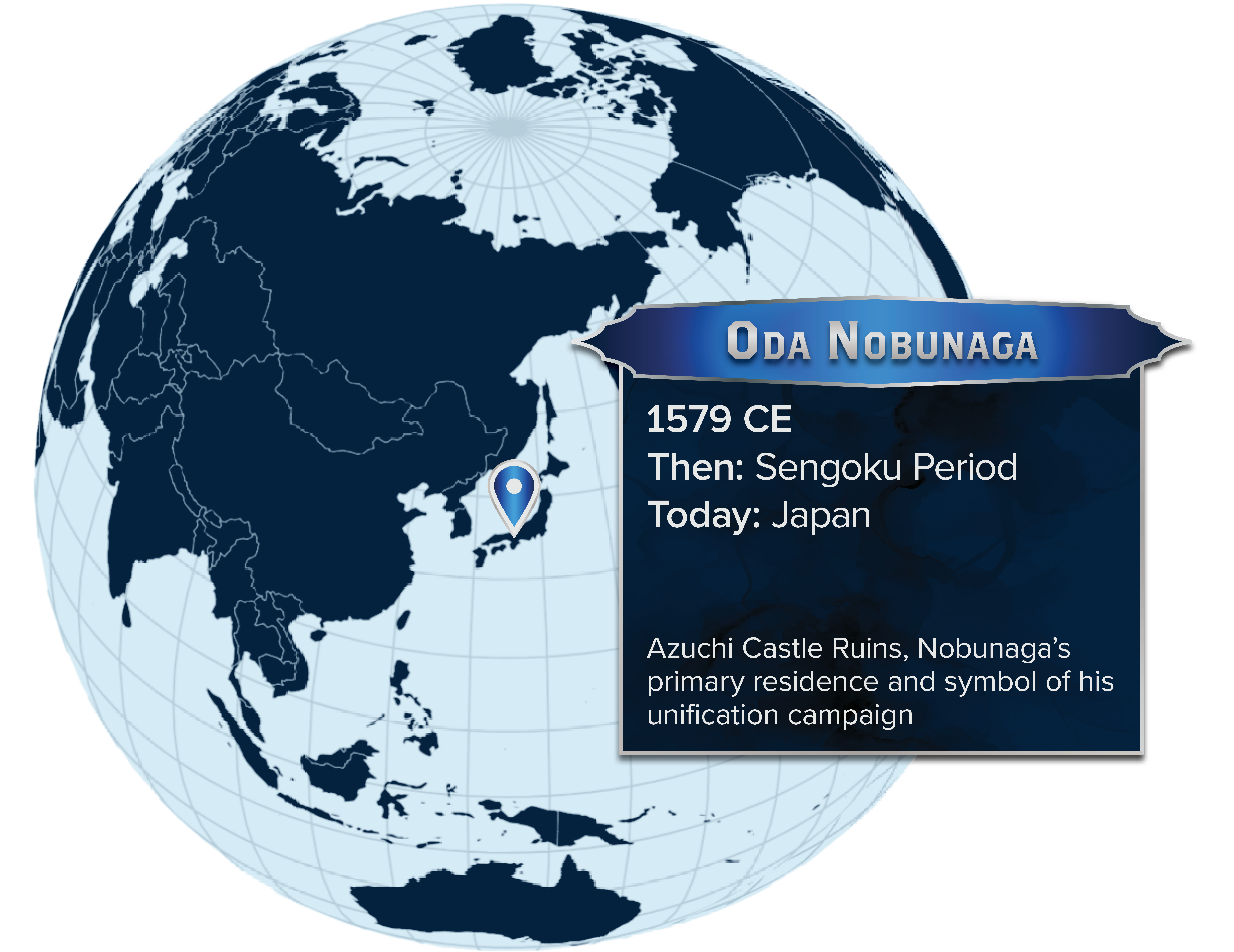
The Demon King. Who in Jigoku (Hell) earns a title like that? In Japan, say “The Demon King” and everyone knows you mean Oda Nobunaga—the first of three warlords who would unify the fractured archipelago. Nobunaga didn’t just challenge the status quo; he detonated it. Born to a daimyo in feudal Japan, a time when 66 rival kingdoms clawed for dominance and the shogun was a ceremonial ghost, Nobunaga was a problem child with a flair for chaos. He was dubbed the Fool of Owari—an arrogant, erratic, sword-swinging misfit who once threw incense at his father’s funeral altar. One of his tutors allegedly committed seppuku just to shock him into maturity.
When his father died, Nobunaga turned his volatile energy into a campaign of conquest. Two uncles tried to block his rise, calling him unstable. He responded by infiltrating one’s castle and decapitating him, then executing the other and his entire family. Skull cups? Real. It’s been said Nobunaga drank sake from lacquered craniums—his own twisted toast to victory.
Then came Imagawa Yoshimoto, a powerful daimyo marching 25,000 troops across Oda territory en route to Kyoto, aiming to crown himself shogun. Nobunaga had maybe 3,000 men. He didn’t flinch. He set up a fake camp with decoy soldiers and banners, then flanked Yoshimoto’s position under cover of a thunderstorm. The Imagawa forces, drunk and unarmored, were ambushed in a narrow valley. What followed wasn’t a battle—it was a massacre. Nobunaga’s forces tore through the camp, and Yoshimoto was beheaded in a single stroke. The Battle of Okehazama (1560) became the turning point that launched Nobunaga’s rise.
From there, Nobunaga recruited two future legends: Toyotomi Hideyoshi and Tokugawa Ieyasu. Together, they would reshape Japan. Nobunaga embraced Western technology, importing firearms and ships from Jesuit missionaries. He ordered hundreds of matchlocks and trained ordinary farmers to kill samurai—no sword skills required. At the Battle of Nagashino (1575), he pioneered volley fire tactics, breaking the Takeda cavalry and signaling the end of traditional samurai warfare.
He also used the Jesuits as political leverage. To curry favor, he targeted their enemies: Buddhist warrior-monks. The most infamous episode came in 1571, when Nobunaga led 30,000 troops up Mount Hiei and annihilated the Enryaku-ji temple complex. He slaughtered monks, scholars, women, and children, burned 3,000 buildings, and hunted down survivors. It wasn’t just a military strike, it was a message: no institution, religious or imperial, would stand in his way.
By 1582, Nobunaga controlled nearly half of Japan. But his reign ended in fire. While resting at Honnō-ji temple in Kyoto, he was betrayed by his general Akechi Mitsuhide. Mitsuhide’s forces surrounded the temple and set it ablaze. Nobunaga, caught off guard and outnumbered, reportedly committed seppuku. His body was never found. Some say he died in the flames. Others whisper he escaped. Either way, the Demon King vanished in a blaze of steel and smoke.