Encyclopedia Anachronistica

Chrono
Inspiration
Europe
Briton
Ideology
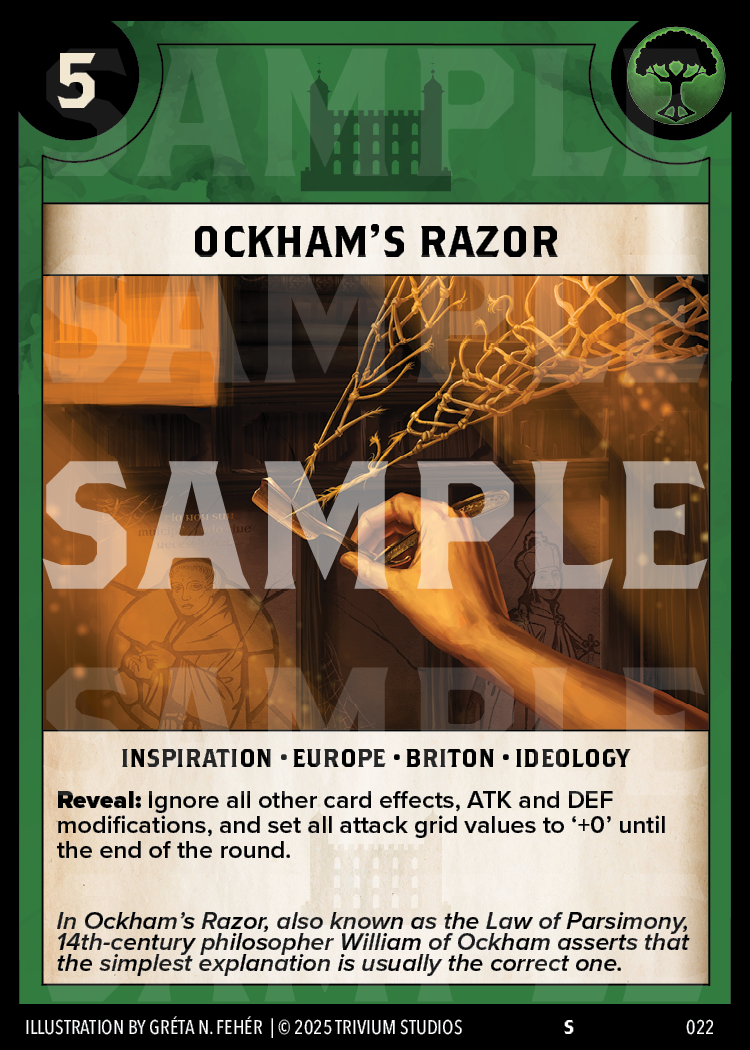
Reveal: Ignore all other card effects, ATK and DEF modifications, and set all attack grid values to '+0' until the end of the round.
In Ockham's Razor, also known as the Law of Parsimony, 14th-century philosopher William of Ockham asserts that the simplest explanation is usually the correct one.

Ockham’s Razor, the legendary blade of logic, was forged not in steel but in the fierce fires of medieval philosophy—where it sliced through bloated theories and left only what was necessary. At its core, this principle champions simplicity: when faced with competing explanations, the one with the fewest assumptions should be preferred. But behind that elegant idea lies a turbulent history of rebellion, reason, and radical thought.
The razor is named after William of Ockham (c. 1285–1347), an English Franciscan friar, philosopher, and theological troublemaker born in the village of Ockham in Surrey. Though he didn’t invent the idea, Ockham wielded it with such precision and frequency that it became forever associated with his name. His Latin phrasing—Pluralitas non est ponenda sine necessitate (“Plurality should not be posited without necessity”)—became a rallying cry for thinkers who sought clarity over complexity.
Ockham’s Razor wasn’t just a tool of logic—it was a weapon in a war of ideas. In the 14th century, William found himself at odds with the Catholic Church, particularly Pope John XXII. Ockham argued that the Church had no divine right to own property, aligning himself with the radical “Spiritual Franciscans.” Summoned to Avignon to defend his views, he fled under threat of excommunication and took refuge with the Holy Roman Emperor Louis IV. There, he continued to write, sharpening his philosophical blade against both papal authority and metaphysical excess.
The principle itself, however, has deeper roots. Aristotle hinted at it when he wrote that the best explanations require the fewest assumptions. Later thinkers like Maimonides, Duns Scotus, and Durandus of Saint-Pourçain echoed similar ideas. But it was Ockham who made it famous, applying it relentlessly to theology, metaphysics, and epistemology. He used it to argue against the existence of unnecessary universals, laying the groundwork for nominalism—the belief that only individual things exist, not abstract categories.
Ironically, the phrase “Ockham’s Razor” didn’t appear until centuries after his death. It was first coined in the 17th century by Libert Froidmont, who referred to it as novacula Occami—“Ockham’s razor”—a metaphorical blade for shaving away superfluous entities.
Today, Ockham’s Razor is a cornerstone of scientific reasoning, used in fields from biology to cosmology. It’s not infallible—sometimes the truth is complex—but it remains a powerful heuristic. It reminds us that elegance matters, that truth often hides in the obvious, and that the sharpest minds know when to cut away the clutter.