Encyclopedia Anachronistica


Standard
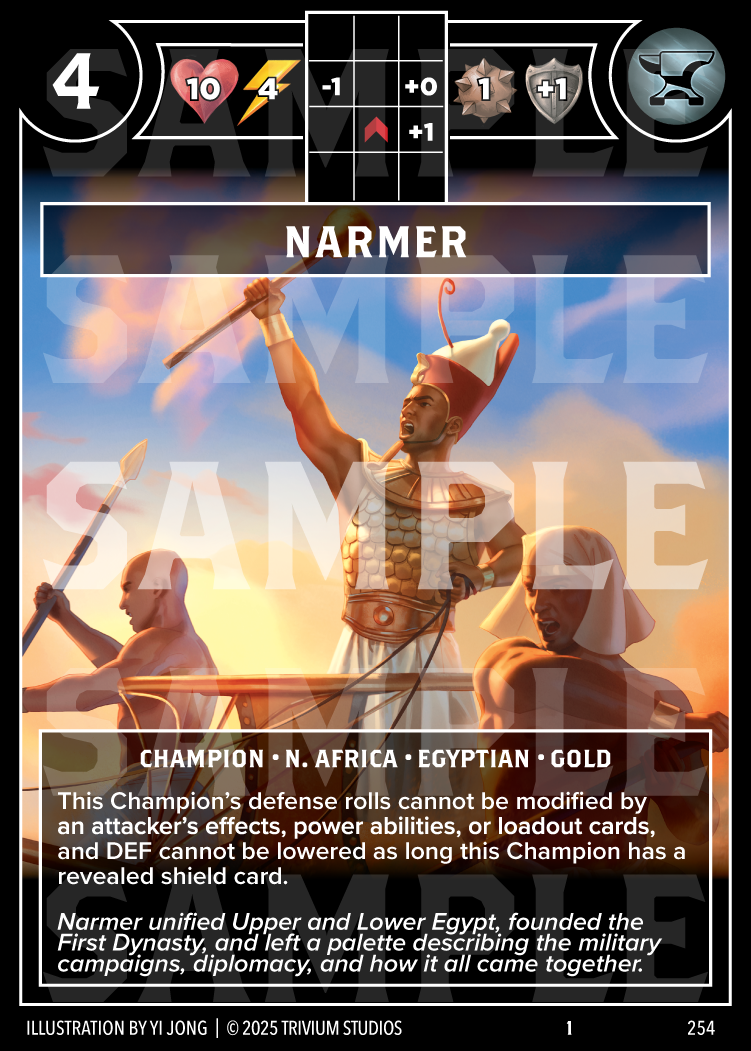
Champion
N. Africa
Egyptian
Gold
This Champion's defense rolls cannot be modified by an attacker's effects, power abilities, or loadout cards, and DEF cannot be lowered as long as this Champion has a revealed shield card.
Narmer unified Upper and Lower Egypt, founded the First Dynasty, and left a palette describing the military campaigns, diplomacy, and how it all came together.
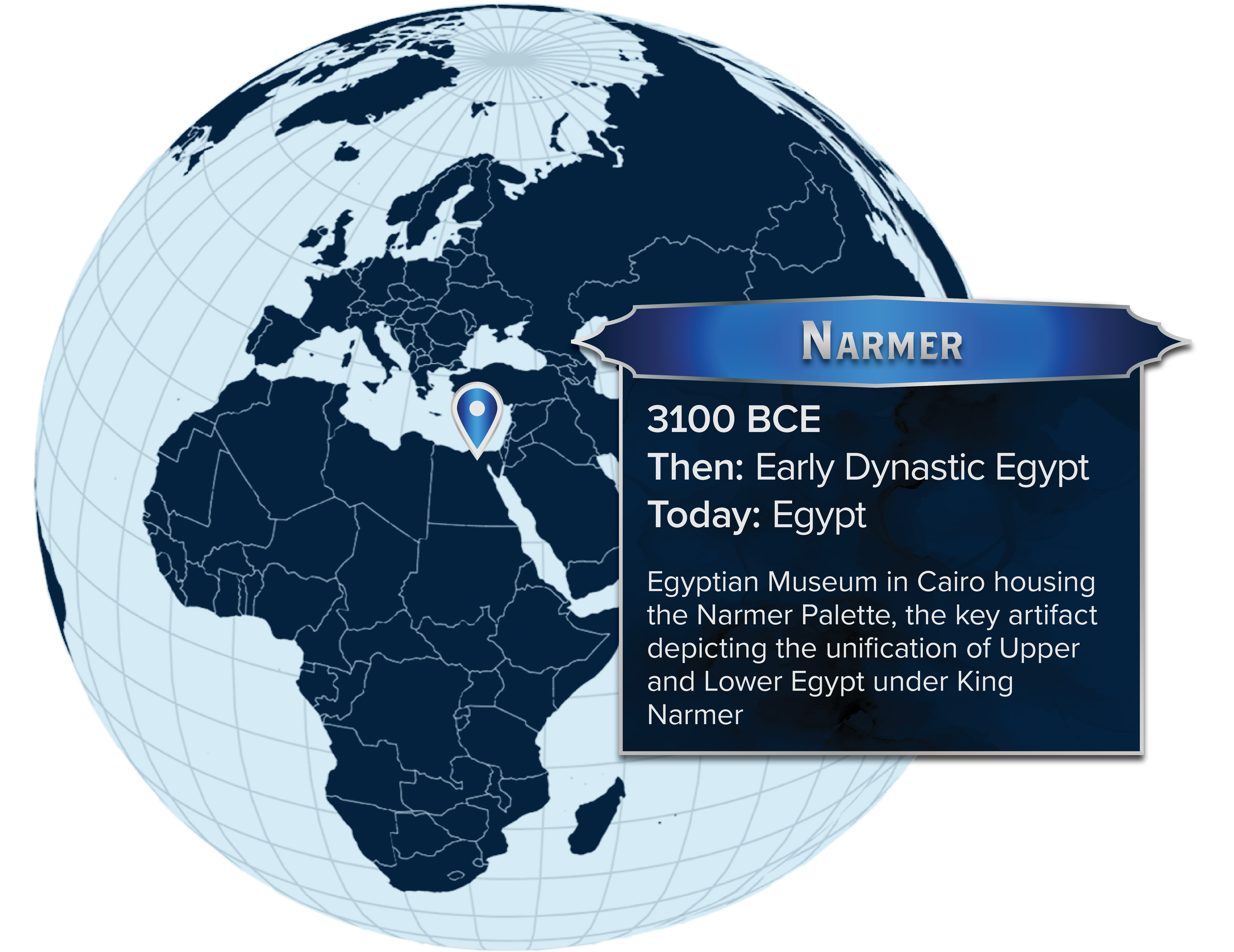
Even the greatest civilizations have a beginning, and for Egypt, that beginning has a name: Narmer.
Egypt is one of the best-documented ancient civilizations—we’ve got mummies we can CT-scan, DNA test, and the Rosetta Stone to crack their hieroglyphics. That means we can crosscheck their history better than almost anyone else’s. And standing at the dawn of it all is Narmer, the Number One, the founder of the 1st Dynasty of Egypt, the man who united Upper and Lower Egypt nearly 5,000 years ago.
His name is usually translated as “fierce catfish” (not chisel), but fierce he was. He carved his way into history on the Narmer Palette, one of the oldest surviving historical documents. On it, Narmer is shown in the classic smiting pose: one hand gripping an enemy by the hair, the other raising a war mace, about to smash his way into legend.
As pharaoh, Narmer wasn’t just a king—he was the living embodiment of Horus, the falcon god, ruling on earth. With divine swagger, he extended Egypt’s reach and archaeology shows his Egyptian presence in Canaan, suggesting Narmer’s armies or traders pushed into the Levant. He also campaigned south into Nubia, where enemies were crushed and captives displayed in brutal fashion.
To cement his rule, Narmer married Neithhotep, a powerful woman from Naqada. She may be the earliest woman in history whose name survives, thanks to inscriptions tied to Narmer’s reign. That marriage likely helped bind rival regions together, giving his new dynasty a firmer base.
Narmer’s monuments and ceremonial objects—like the Narmer Macehead—depict him as a conqueror and organizer. The macehead shows tribute in staggering numbers: thousands of animals and captives, though the exact figures (like “120,000 captives” and “1.4 million goats”) are almost certainly symbolic exaggerations. Still, the message was clear: Narmer was the man who could command the wealth of nations.
Once his power was secure, Narmer launched civil and religious projects that laid the groundwork for Egypt’s long pharaonic tradition. Temples, monuments, and inscriptions proclaimed his dominance and divine role. With Narmer’s unification, the First Dynasty was born. His foundation set Egypt on a path to nearly 3,000 years of pharaonic rule, making Egypt one of the most feared, respected, and influential civilizations of the ancient world. Narmer was the spark that lit the torch of Egyptian greatness.