Encyclopedia Anachronistica


Standard
Inspiration
Europe
Roman
Divinity
Combo - Spend 1 Action: Move one space, then make a base attack against each adjacent enemy.
Libertas, the Roman goddess of liberty, symbolizes freedom and embodies the spirit of independence. She was the patron of freedmen throughout the Roman Republic.
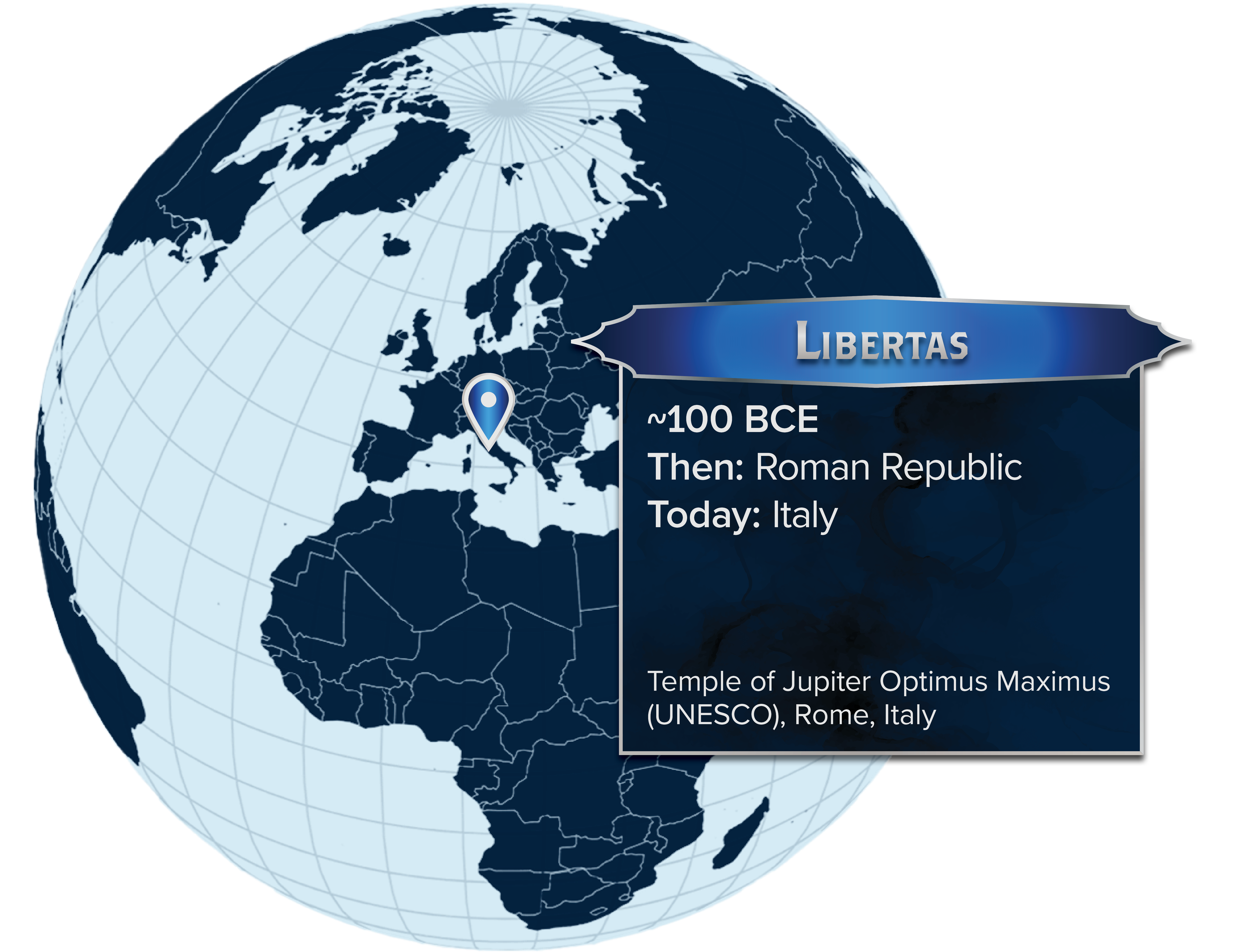
Libertas, the Roman goddess of liberty, was no passive symbol—she was a political force draped in divinity, a torchbearer of freedom whose legacy still echoes in marble, metal, and revolution. Born from the Roman Republic’s fierce pride in self-rule, Libertas embodied the ideal of libertas populi Romani—the freedom of the Roman people from tyranny, monarchy, and foreign domination. She wasn’t just a goddess of abstract ideals; she was a living emblem of civic identity, invoked in times of upheaval and triumph alike.
Her iconography was potent and unmistakable. Libertas was often depicted wearing a soft pileus, the cap traditionally given to freed slaves, and holding a rod or scepter—symbols of manumission and self-determination. In her presence, the line between divine favor and political messaging blurred. When Rome overthrew its kings and established the Republic, Libertas rose as a patroness of the new order. Her temples stood not just as places of worship, but as monuments to the people’s right to govern themselves.
But Libertas wasn’t just a Roman phenomenon. Her image—and her message—proved contagious. During the late Republic, she became a rallying point for reformers and revolutionaries. Coins minted by assassins of Julius Caesar bore her likeness, a bold declaration that they had struck for freedom. Centuries later, her spirit would be reborn in the Enlightenment, inspiring revolutionaries in France and America. The Statue of Liberty in New York Harbor? That’s Libertas in copper, torch raised high, still welcoming the huddled masses.
Yet Libertas was never a simple figure. Her name could be invoked to justify both rebellion and empire. Augustus, the first Roman emperor, claimed to restore libertas even as he consolidated power. Later emperors would continue to mint her image, even as they ruled with absolute authority. In this way, Libertas became a paradox: a goddess of freedom whose image could be used to mask control.
In mythic terms, Libertas stands among the rare deities who straddle the line between the sacred and the civic. She doesn’t command storms or love affairs—she commands allegiance to an idea. And that idea, once unleashed, is hard to contain.
So when you see her torch or her cap, remember: Libertas is not just a statue or a slogan. She’s a reminder that freedom is never static—it must be measured, defended, and reimagined with every generation.