Encyclopedia Anachronistica


Standard
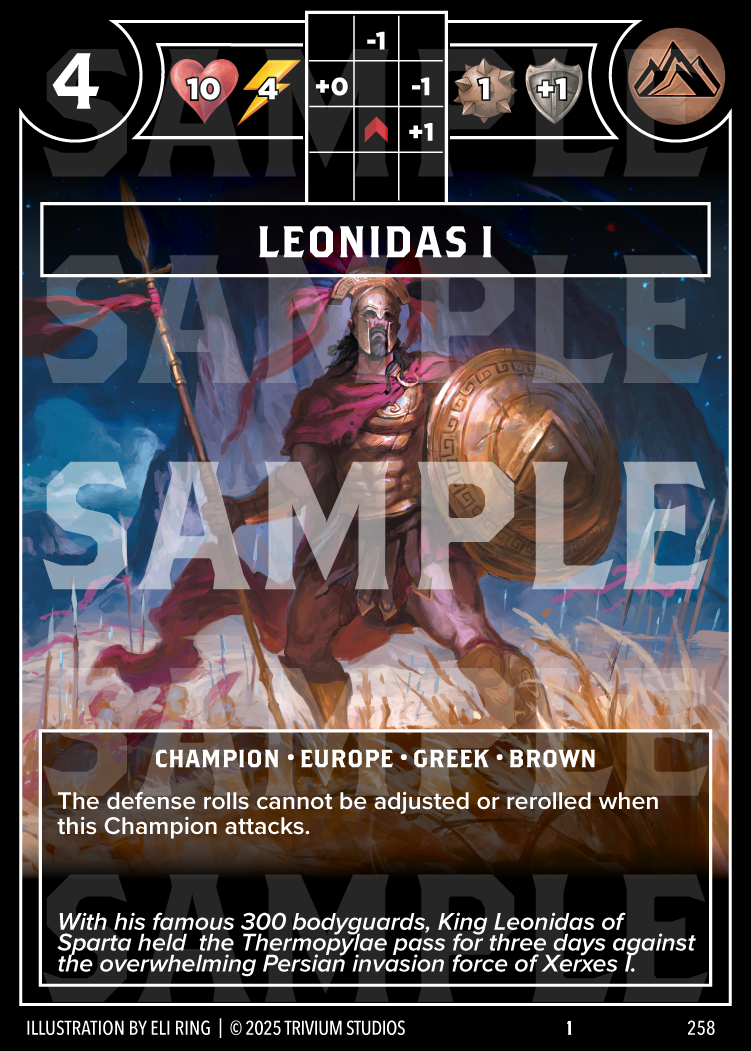
Champion
Europe
Greek
Brown
The defense rolls cannot be adjusted or rerolled when this Champion attacks.
With his famous 300 bodyguards, King Leonidas of Sparta held the Thermopylae pass for three days against the overwhelming Persian invasion force of Xerxes I.
Raised in the brutal agoge system from age seven, Spartan males were forged into juggernauts of discipline, endurance, and battlefield glory. Leonidas was the apex of this warrior caste—trained to suffer, fight, and die with honor.
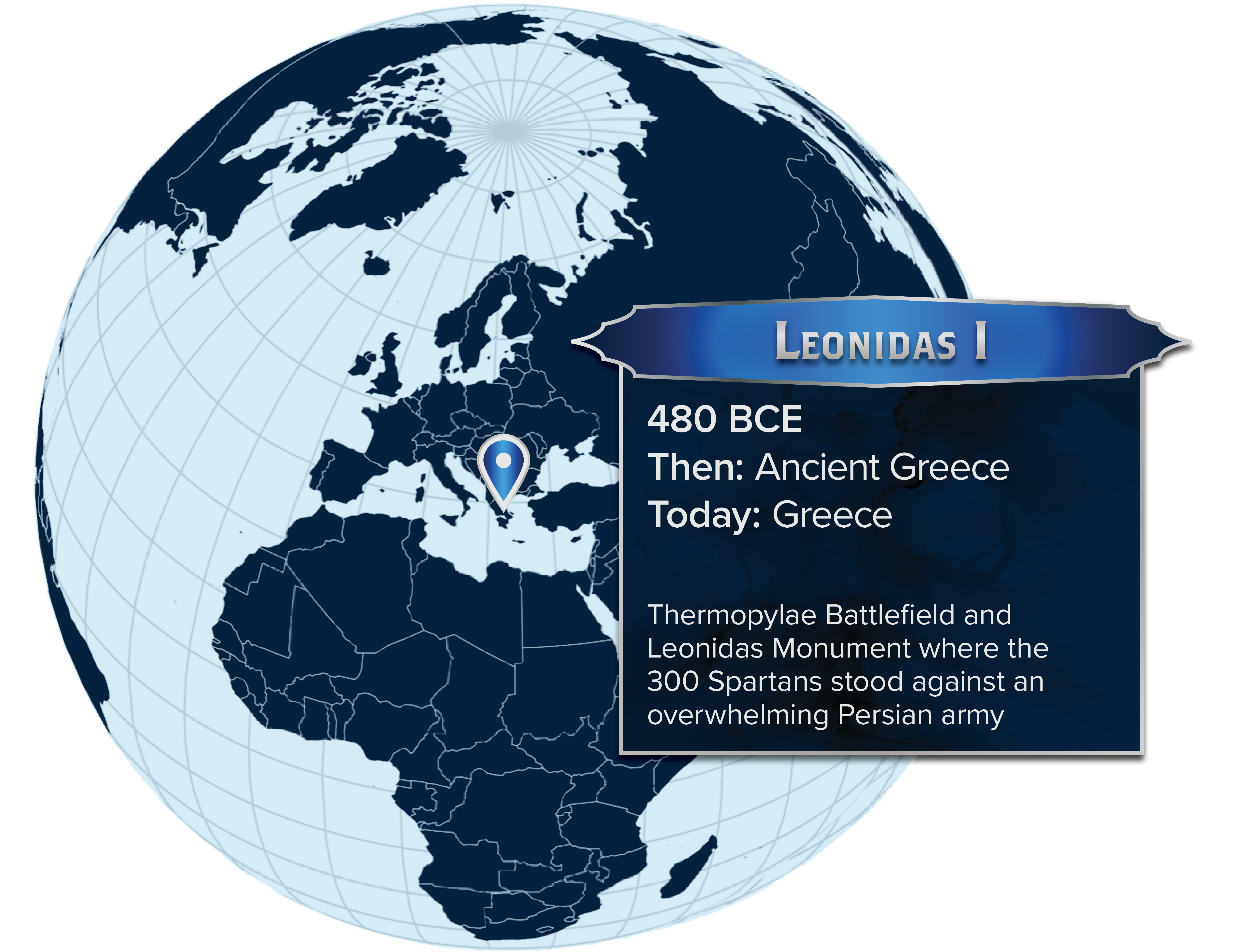
Enter Xerxes I, ruler of the largest empire on Earth. He sent envoys to Sparta requesting submission via a symbolic offering of “earth and water.” Leonidas tossed them down a well, inviting them to collect both at the bottom. At age 60, he rallied 300 of his royal guard—Spartan war-machines—and marched to the Gates of Hell: Thermopylae, a narrow pass just 100 meters wide, already fortified with a Phocian wall. Joined by 7,000 other Greek warriors, they bottled up the pass while wave after wave of Persian troops arrived.
When a Greek soldier remarked, “Because of the arrows of the barbarians it is impossible to see the sun,” Leonidas replied, “Won’t it be nice, then, if we shall have shade in which to fight them?” Xerxes tried to negotiate. Leonidas told him where to shove his army. When ordered to surrender his weapons, he famously replied, “Come and take them.”
The Battle of Thermopylae was a masterclass in terrain warfare and psychological defiance. For two days, Leonidas’ forces held the narrow pass against wave after wave of Persian assaults. The Spartans fought in disciplined rotations, their bronze shields locking into an unbreakable wall while their long spears turned the confined space into a slaughter corridor. Persian infantry, cavalry, and even the elite Immortals were funneled into the bottleneck and cut down in droves. The Greeks used the terrain to neutralize the Persians’ numerical advantage, turning Xerxes’ massive army into a liability. Despite overwhelming odds, the defenders inflicted staggering casualties—thousands dead for mere dozens lost. It wasn’t just a battle. It was a statement: Sparta would rather die than kneel.
Four days of psychological warfare followed as the Persian army swelled. Then came the assault: 5,000 archers launched volleys that bounced off bronze-coated Spartan shields, followed by 10,000 infantry. Shoulder to shoulder, Spartans formed an impervious wall, their 3-meter spears skewering enemies in a relentless meat grinder. They rotated fresh warriors to the front, cutting Persian ranks to ribbons. Even the elite Immortals—10,000 strong—were shredded.
Day two? Same carnage. Another 10,000 Persian corpses littered the battlefield. But betrayal struck. A Greek named Ephialtes revealed a mountain path to Xerxes, allowing a flanking maneuver. Leonidas, learning of the breach, dismissed most of the Greek allies and chose to make a final stand. At dawn, he charged the encircling Persians, inflicting maximum damage before falling to an arrow. His Spartans fought to the last man, guarding their king’s body until death.
Their sacrifice at Thermopylae became legend. Though the battle was lost, Leonidas and his 300 were immortalized as the embodiment of defiance against impossible odds.