Encyclopedia Anachronistica


Alt Art
Champion
Middle East
Caliphates
Purple
Heal: At the start of each round, roll 1d6. If the result is a /2/, /4/, or /6/ gain 1 life. If the result is a /1/, /3/, or /5/ gain 1 action.
Known as Sayf Allah al-Maslul "The Drawn Sword of Allah" al-Walid fought at Uhud against the Prophet, then embraced Islam and led the faithful to victory.
Khalid ibn al-Walid, the Sword of God, is the most formidable Muslim general of antiquity and one of history’s purest military tacticians. He launched his empire-shaping career by handing Muhammad his only battlefield defeat at Uhud, then flipped sides, converted, and became Muhammad’s personal war shield—ensuring the Prophet never lost another fight.
Khalid fought in over fifty battles, often outnumbered, never outmaneuvered. He was said to break swords mid-combat from the sheer force of his strikes, swapping blades like others swap arrows. His signature move? Charging straight through enemy lines to decapitate command structures. He believed generals couldn’t lead if they were dead or dodging a screaming, scimitar-wielding lunatic.
His battlefield genius wasn’t just about brute force—it was psychological warfare, terrain exploitation, and timing so precise it felt prophetic. He mastered the art of feigned retreat, baiting enemies into overextension before snapping shut with a flanking counterstrike. His cavalry formations were fluid, responsive, and terrifyingly fast, often appearing where no sane commander thought possible. He used terrain like a weapon—ravines, deserts, riverbanks—turning natural obstacles into kill zones. Khalid didn’t just win battles; he dismantled enemy morale, command cohesion, and logistical stability in a single campaign. His ability to read the battlefield and improvise under pressure made him less a general and more a force of nature.
His tactical masterpiece was the double envelopment—perfected during the Ridda Wars, where he crushed rebellious Arabian tribes and unified the peninsula under Islam. Resistance was met with conversion, subjugation, or execution. Then came Iraq, where he steamrolled Sasanian forces, and Syria, where he pulled off one of the most insane logistical feats in military history.
Instead of taking the safe route around the Syrian Desert, Khalid force-marched 500–800 men straight through it. Allegedly, camels were overhydrated, their mouths sealed to preserve water and then slaughtered one by one so the men could drink the brackish fluid from their stomachs. It worked. They reached the oasis, rehydrated, and hit Damascus like a thunderclap.
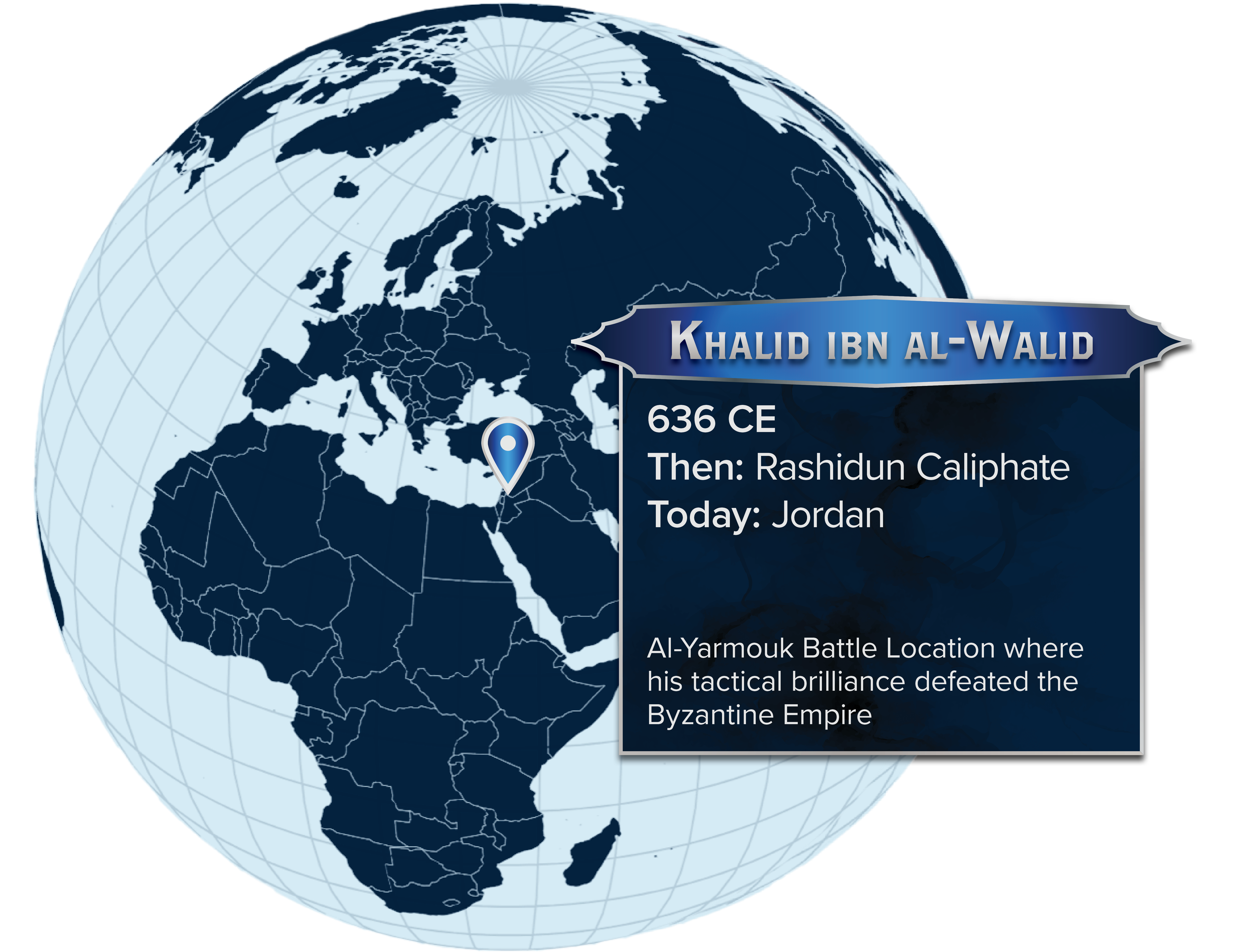
Khalid placed commanders at all six gates of the city, stormed the capital, and accepted its surrender. Then he faced a massive Byzantine force at Yarmouk. He baited them into a ravine and annihilated them by the thousands. It was one of the most decisive battles in medieval history.
And then—he got demoted. Some say it was jealousy. Some say it was politics. Others point to a Ridda Wars scandal where Khalid allegedly executed a prisoner and married the man’s widow the same day. He claimed it was a misunderstanding. Either way, the optics were brutal.
But none of it mattered. In just nine years, Khalid went from enemy of Islam to its most lethal champion, carving out the foundations of a world religion with steel, speed, and strategy.