Encyclopedia Anachronistica

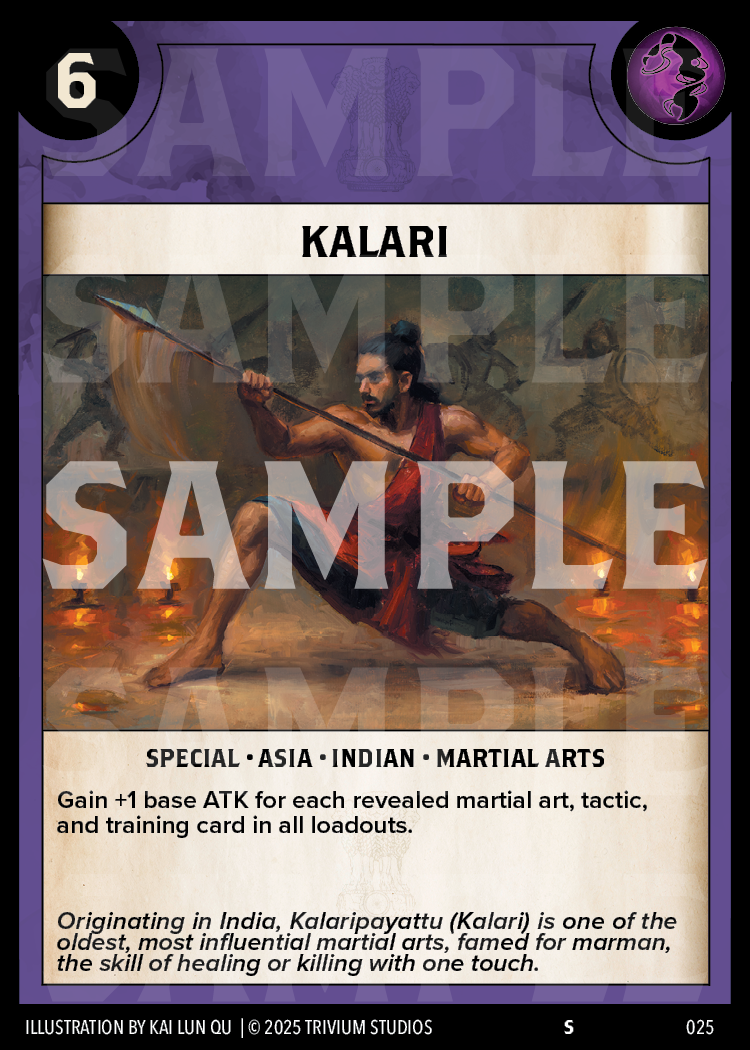
Chrono
Special
Asia
Indian
Martial Art
Gain +1 base ATK for each revealed martial art, tactic, and training card in all loadouts.
Originating in India, Kalaripayattu (Kalari) is one of the oldest, most influential martial arts, famed for marman, the skill of healing or killing with one touch.

Kalaripayattu, often called the “mother of all martial arts,” is a dynamic and ancient combat tradition from Kerala, India, that blends physical mastery, spiritual discipline, and healing wisdom into a single, holistic practice. More than a fighting system, it is a way of life—one that has shaped warriors, dancers, and healers for over a thousand years.
The name Kalaripayattu comes from the Malayalam words kalari (training ground or battlefield) and payattu (practice or fight), meaning “training in the arts of the battlefield.” According to legend, the art was founded by Parashurama, the warrior-sage and sixth avatar of Vishnu, who raised the land of Kerala from the sea and taught martial knowledge to its first inhabitants. While the mythic origins are rich with symbolism, historical evidence suggests that Kalaripayattu evolved from a fusion of Dravidian combat traditions and Vedic martial systems dating back to the Sangam period (circa 600 BCE–300 CE).
Training in Kalaripayattu takes place in a kalari, a sunken, sacred space aligned with cardinal directions and consecrated through ritual. Students begin with meipayattu—body conditioning exercises that develop flexibility, strength, and balance. These are followed by kolthari (wooden weapons), ankathari (metal weapons), and verumkai (unarmed combat). Each stage emphasizes fluidity, precision, and control, often accompanied by rhythmic breathing and meditative focus.
What sets Kalaripayattu apart is its integration of Ayurvedic healing and spiritual philosophy. Practitioners learn marma vidya, the knowledge of vital points in the body, which can be used for both healing and self-defense. Massage techniques using medicinal oils are part of the training, reinforcing the belief that a warrior must also be a healer.
The art also carries a deep philosophical core. As explored in contemporary scholarship, Kalaripayattu transcends the mind-body divide, treating the body as a vessel for spiritual cultivation. Movements are not just physical—they are ritual, performance, and meditation. This non-dualistic approach aligns with broader Indian philosophical traditions, where discipline and awareness are inseparable from action.
Kalaripayattu faced suppression during colonial rule but has seen a powerful resurgence in recent decades. Today, it influences Indian cinema, contemporary dance, and global martial arts communities. Its resurgence is not just a revival of technique, but a reawakening of cultural identity and embodied knowledge.
Whether practiced for combat, performance, or personal growth, Kalaripayattu remains a living tradition—one that continues to inspire awe with its blend of grace, power, and ancient wisdom.