Encyclopedia Anachronistica


Standard
Weapon
Asia
Chinese
Axe
This weapon gains +1 ATK if an enemy has taken damage or lost life this round.
Emperor Wu of Han centralized iron production through a state monopoly to fund military campaigns against the Xiongnu which enabled mass production of durable armor.
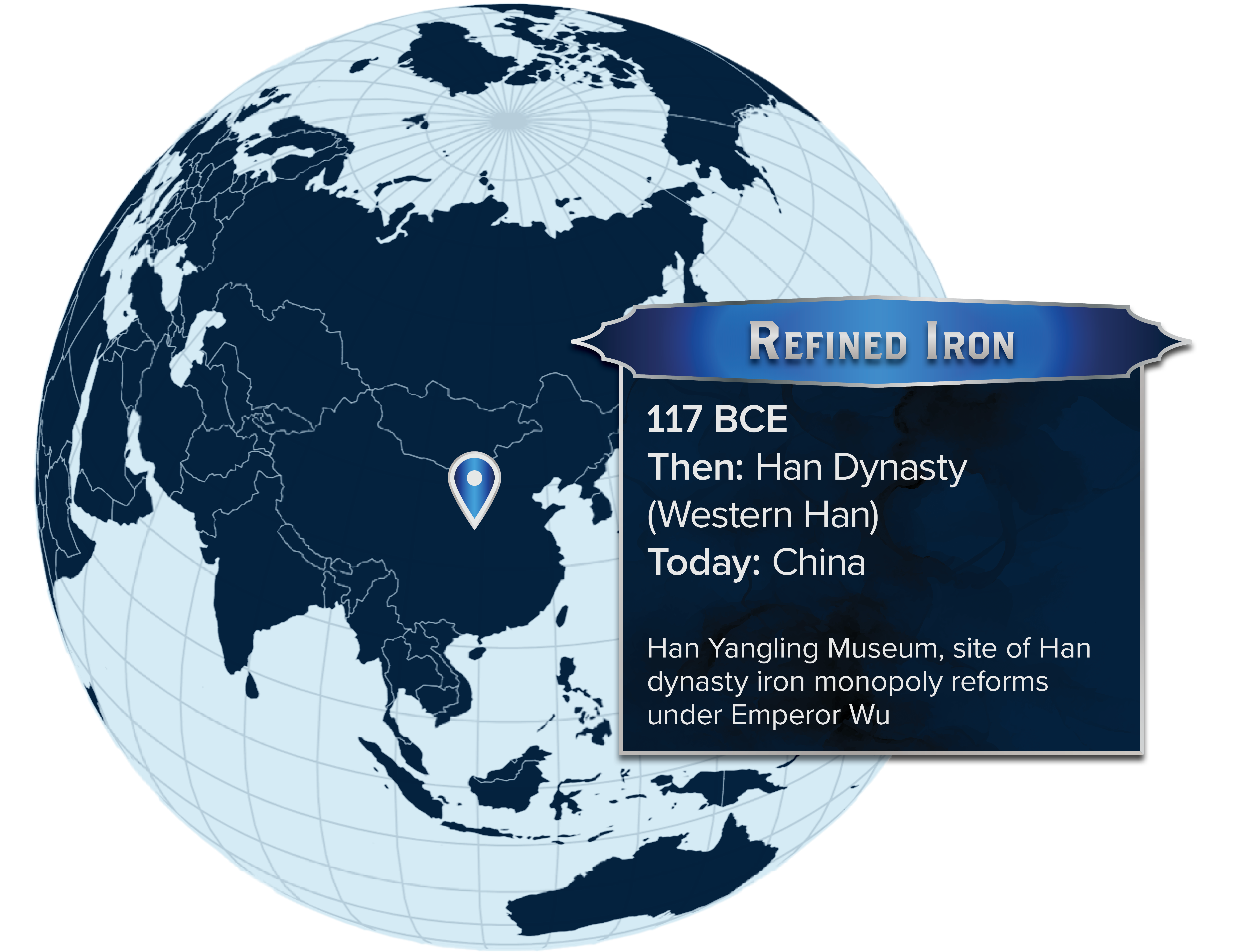
During the reign of Emperor Wu of Han (141–87 BCE), Chinese metallurgy underwent one of the most important transformations in ancient world history: the large-scale production of refined iron and early steel. Han artisans perfected techniques such as finery forging, decarburization, and repeated refining (“hundred-times-refined steel”), allowing them to convert brittle cast iron into tough, flexible wrought iron and steel. This innovation marked a decisive break from the earlier Bronze Age and enabled the Han state to equip its armies with stronger weapons, more durable armor, and standardized tools.
Refined iron was not merely a technological achievement — it was a strategic asset. Emperor Wu’s long campaigns against the Xiongnu required vast quantities of reliable military equipment. Iron armor, lamellar plates, spearheads, crossbow mechanisms, and agricultural tools for frontier colonies all depended on the empire’s ability to produce high-quality metal at scale. State-run iron foundries, established under Wu’s centralizing reforms, created an early form of military-industrial complex. Archaeological excavations at sites such as the Western Han armory in Chang’an and the iron-production centers of the Chengdu Plain reveal the sophistication and volume of this industry.
Refined iron also reshaped Han society. Iron ploughs, seed drills, and agricultural tools increased yields, supporting population growth and the expansion of imperial infrastructure. The spread of iron technology into frontier regions helped integrate them into the Han administrative system. Even critics of militarization, such as Confucian scholars, acknowledged the transformative economic impact of iron tools.
Today, refined iron from the Han dynasty is recognized as a milestone in global metallurgical history. Modern archaeometallurgy continues to analyze Han iron objects to understand ancient forging temperatures, carbon content, and production methods. Museums in China and abroad display Han iron armor and tools as evidence of the empire’s technological sophistication. The legacy of Han refined iron endures in the long arc of Chinese metalworking, which influenced East Asian metallurgy for centuries.