Encyclopedia Anachronistica

Standard
Weapon
Europe
Briton
Polearm
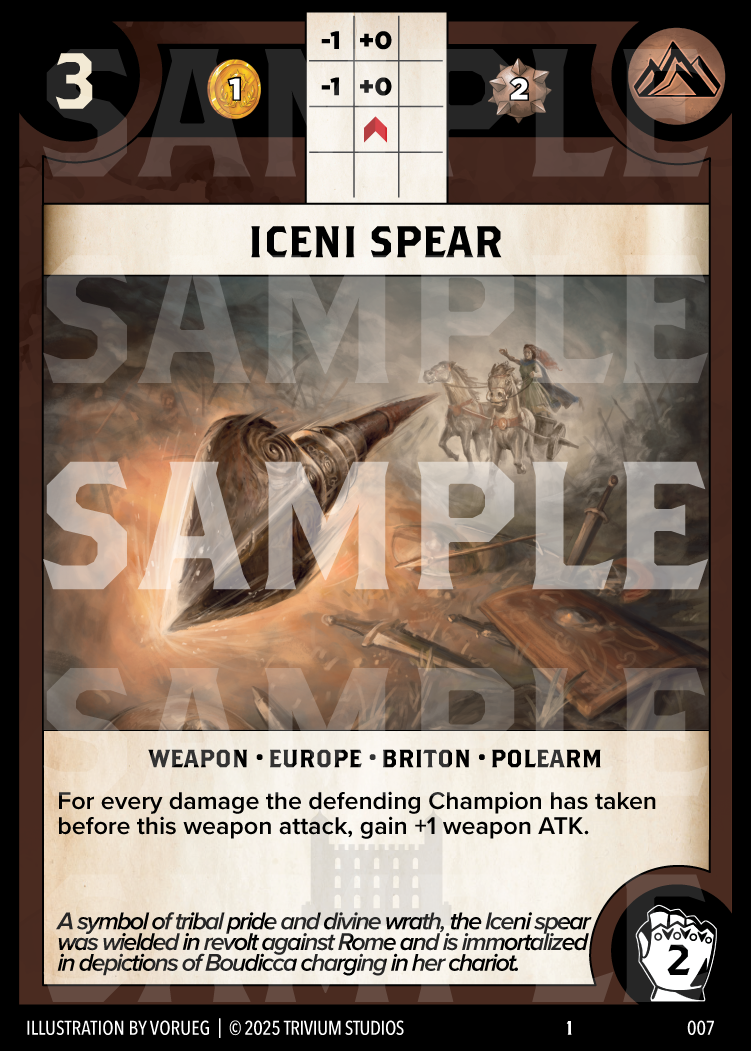
For every damage the defending Champion has taken before this weapon attack, gain +1 weapon ATK.
A symbol of tribal pride and divine wrath, the Iceni spear was wielded in revolt against Rome and is immortalized in depictions of Boudicca charging in her chariot.

The Iceni spear was the defining weapon of the warriors who followed Boudicca into revolt, a tool of both hunting and war that reflected the martial traditions of Iron Age Britain. While no single “Boudiccan spear” survives, archaeological finds from Norfolk and Suffolk — the heartland of the Iceni — reveal a consistent pattern: leaf-shaped iron spearheads, often socketed, mounted on ash shafts, and designed for both thrusting and throwing. These weapons were the backbone of tribal warfare long before Rome arrived in Britain, and they remained central to Iceni identity during the first century CE.
Spearheads from sites such as Saham Toney, Santon, and the wider East Anglian region show the craftsmanship typical of late Iron Age Britain. Many are forged with midribs for strength, narrow points for penetration, and sockets that allowed quick replacement of broken shafts. Some examples bear traces of decorative patterning or careful finishing, suggesting that high-status warriors carried spears that were as symbolic as they were functional. The Iceni were known for their metalworking skill, and their spears reflect a culture that valued both practicality and display.
Roman authors, though biased, offer glimpses of how Britons used these weapons in battle. Tacitus describes tribes fighting with “long spears” and javelins, often from chariots that darted across the battlefield. The Iceni were among the peoples who maintained this chariot tradition into the Roman period, using spears to harass enemy lines before closing in. The combination of mobility and reach made the spear an ideal weapon for the fast, shock-driven style of warfare practiced in eastern Britain.
During Boudicca’s revolt in 60/61 CE, thousands of Iceni and their Trinovant allies would have carried spears of this type. Although the archaeological record of the revolt itself is sparse, the destruction layers at Colchester, London, and St Albans — marked by burned debris and Roman military equipment — speak to the scale of the uprising. The spear was the most common weapon available to Boudicca’s followers, and it would have been present in every phase of the rebellion, from the initial mustering of tribal forces to the final confrontation with Suetonius Paulinus.
Today, Iceni spearheads are held in museums across Britain, including the Norwich Castle Museum and the British Museum, where they serve as tangible links to the world Boudicca fought to defend. They are not ornate relics of kings, but the everyday weapons of farmers, retainers, and tribal warriors — the people whose anger fueled one of the most dramatic uprisings in Roman Britain.