Encyclopedia Anachronistica

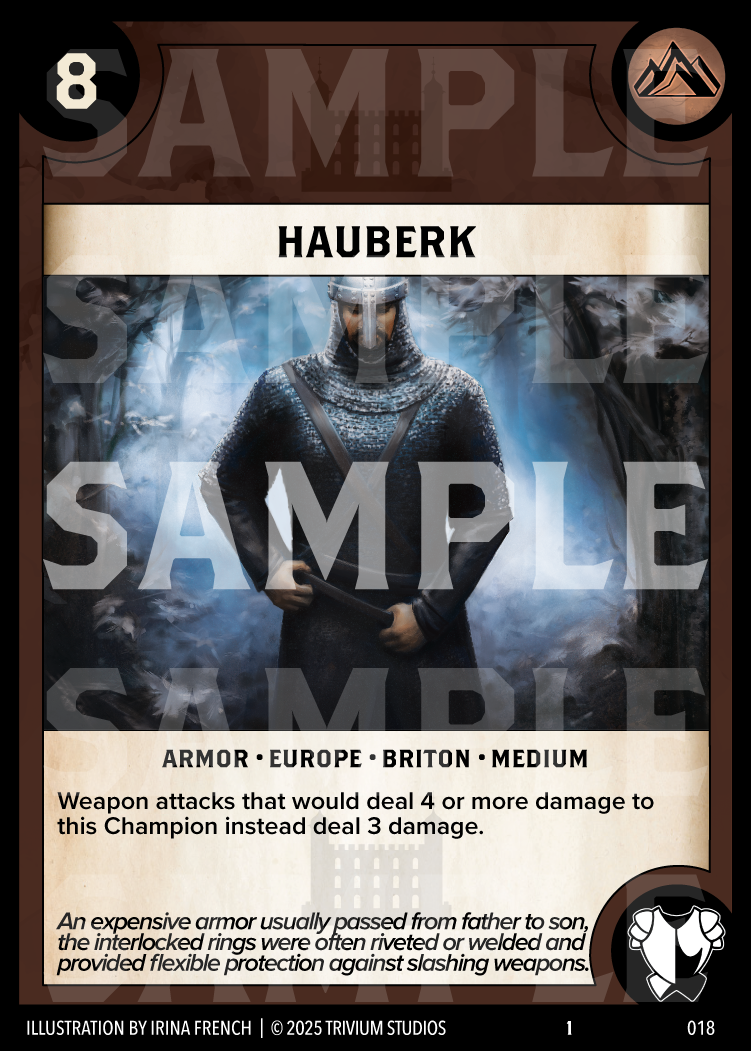
Standard
Armor
Europe
Briton
Medium
Weapon attacks that would deal 4 or more damage to this Champion instead deal 3 damage.
An expensive armor usually passed from father to son, the interlocked rings were often riveted or welded and provided flexible protection against slashing weapons.
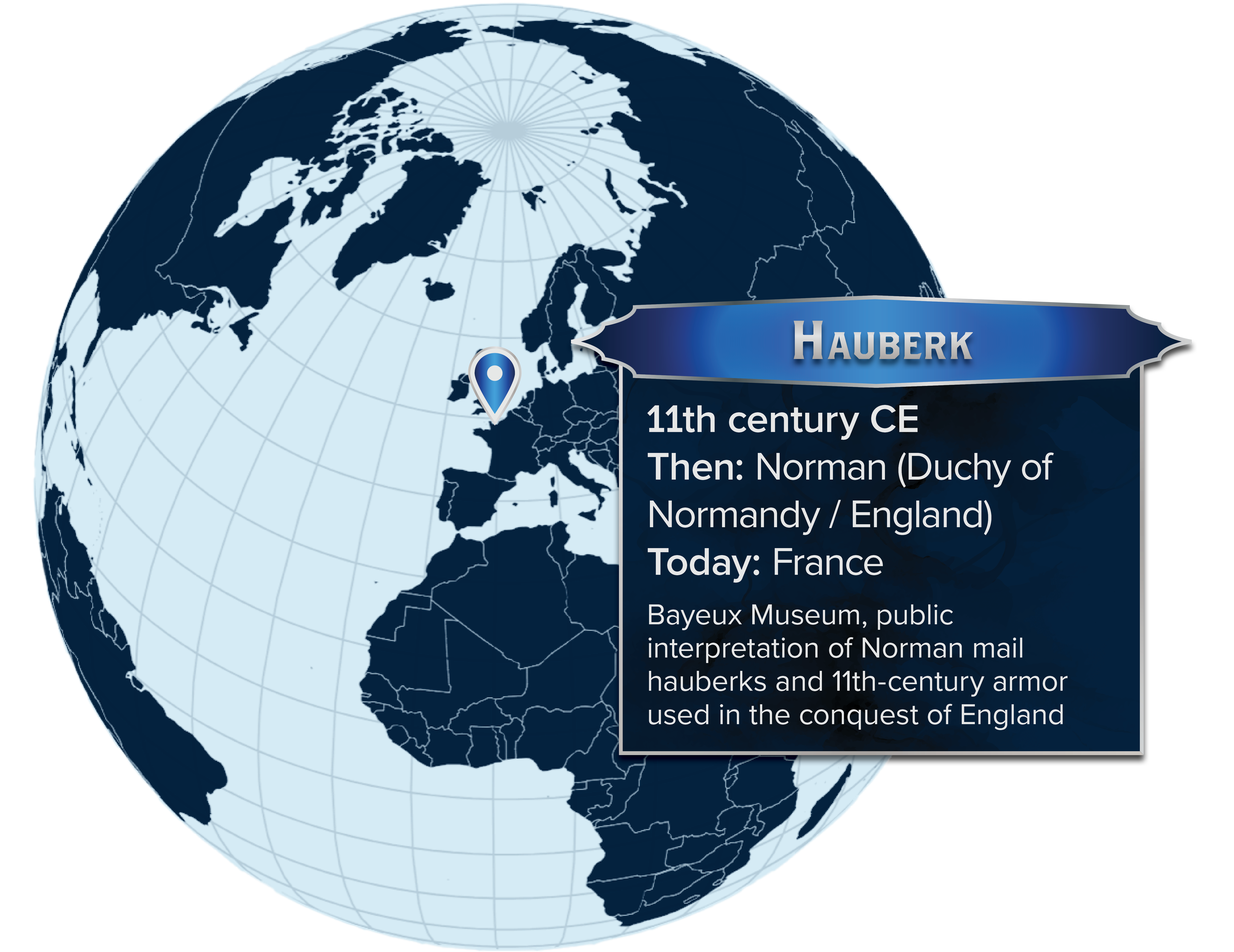
The hauberk was the foundational armor of the eleventh-century knight: a long shirt of interlinked iron rings forming a flexible mesh that protected the torso, arms, and often the head through an attached coif. Constructed from tens of thousands of riveted rings, a hauberk required immense labor and metallurgical skill. When worn over a padded gambeson, it provided effective defense against cutting blows and distributed the force of strikes from axes, maces, and spears. Its durability and adaptability made it the dominant form of elite armor in Western Europe for centuries.
In William the Conqueror’s era, the hauberk was inseparable from the identity of the Norman mounted warrior. The Bayeux Tapestry depicts William’s household knights uniformly clad in knee-length mail shirts with split skirts for riding, conical helmets, and kite shields. This visual consistency reflects a professionalized cavalry force whose equipment and training distinguished them from many contemporary armies. William himself is shown lifting his helmet mid-battle to reveal his face — a moment that underscores how thoroughly the hauberk and helmet concealed individual identity on the field.
The hauberk’s effectiveness lay in its engineering. Mail armor could absorb and disperse energy while allowing full mobility, a crucial advantage for cavalry who needed to maneuver, couch lances, and fight at close range. Surviving examples and modern reconstructions demonstrate that well-made mail could resist slashing attacks and significantly reduce the lethality of arrows and glancing blows. Its weaknesses — vulnerability to powerful thrusts and heavy concussive strikes — shaped the development of complementary weapons such as the mace and the evolution of later plate armor.
Today, the hauberk remains one of the most recognizable symbols of medieval warfare. Museums, reenactors, and experimental archaeologists use reconstructed mail to test historical combat techniques and understand the lived experience of armored soldiers. Modern protective gear, from shark-proof diving suits to industrial chain-mesh gloves, applies the same principles of flexible, distributed defense. The hauberk endures as both a cultural icon and a testament to the ingenuity of pre-industrial metallurgy.