Encyclopedia Anachronistica

Standard
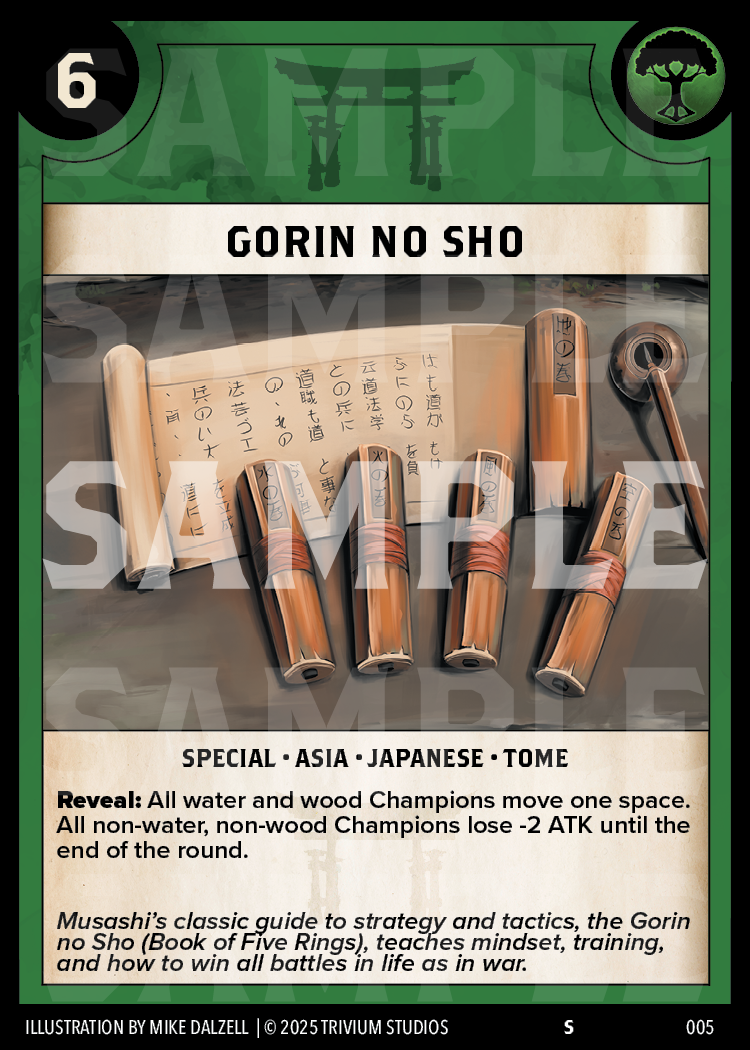
Special
Asia
Japanese
Tome
Reveal: All water and wood Champions move one space. All non-water, non-wood Champions lose -2 ATK until the end of the round.
Musashi's classic guide to strategy and tactics, the Gorin no Sho (Book of Five Rings), teaches mindset, training, and how to win all battles in life as in war.
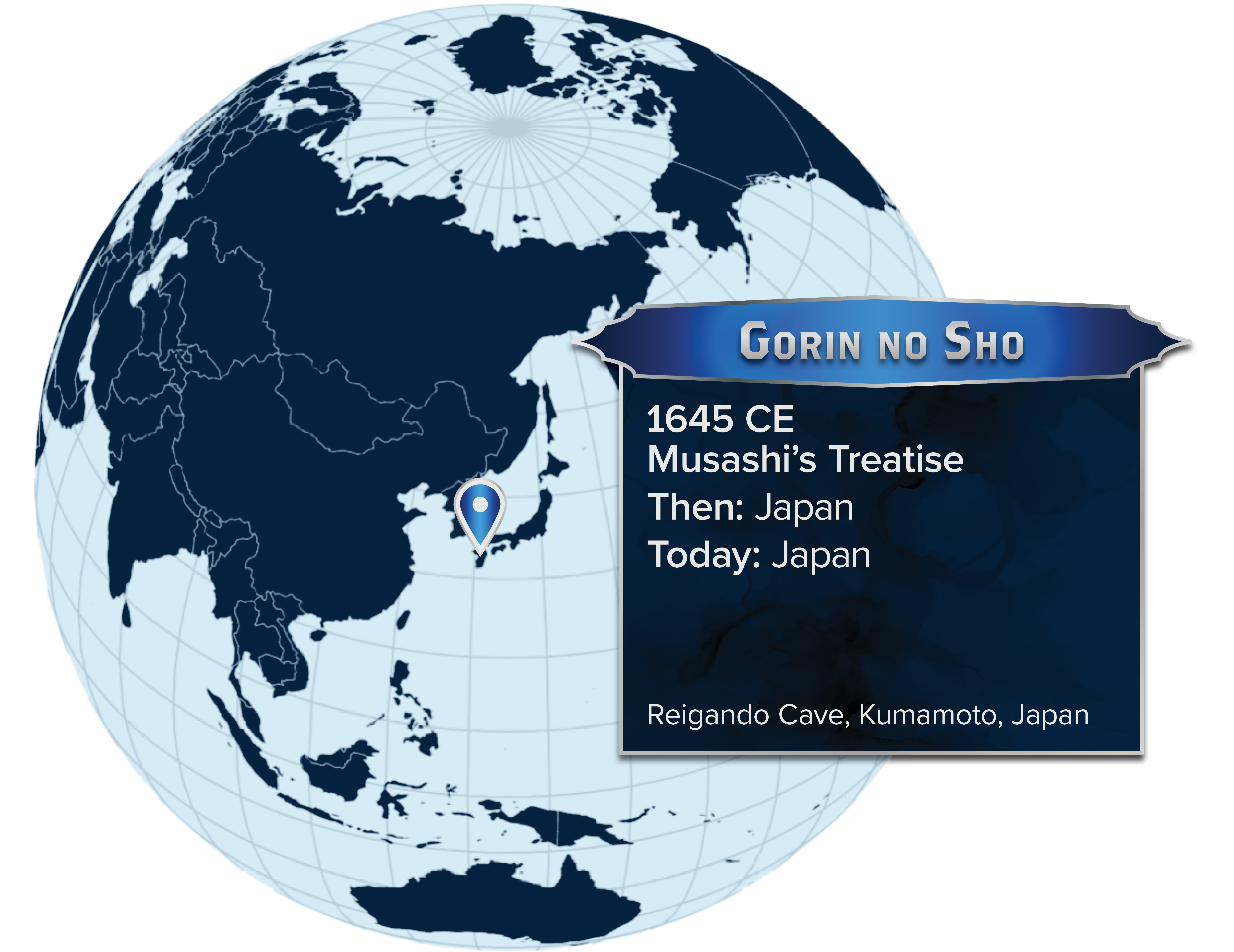
Miyamoto Musashi’s Gorin no Sho (The Book of Five Rings), written in 1645, is a legendary treatise on strategy, swordsmanship, and the mindset of mastery. Composed late in life while Musashi lived in seclusion at Reigandō cave, the work distills the wisdom of a warrior undefeated in over 60 duels. More than a manual for combat, it offers a philosophical guide to understanding conflict, perception, and disciplined living.
Structured around the five classical elements of Japanese esoteric Buddhism—Earth, Water, Fire, Wind, and Void—each section of the Gorin no Sho explores a different dimension of martial and mental strategy. The Book of Earth lays the foundation for Musashi’s school, Niten Ichi-ryū (“Two Heavens, One School”), which advocates wielding both the katana (long sword) and wakizashi (short sword) simultaneously. Earth represents grounding, fundamentals, and the idea that strategy is not a technique but a way of life.
The Book of Water emphasizes adaptability. Musashi teaches that a warrior must be fluid, adjusting to the opponent’s rhythm and terrain. Like water, one must flow through combat with clarity and responsiveness. He describes posture, timing, and the need to internalize technique until it becomes second nature—form without thought, action without hesitation.
In the Book of Fire, Musashi addresses the heat of battle. Fire symbolizes intensity, initiative, and tactical awareness. He urges warriors to remain calm under pressure, to read the enemy’s intent, and to strike with precision. Victory, he insists, comes not from brute force or emotion, but from control and decisiveness.
The Book of Wind critiques other schools of swordsmanship. Musashi warns against attachment to style or tradition for its own sake. Wind represents external influences and illusion—he encourages readers to look beyond surface techniques and seek the deeper principles that govern all combat. This section is both analytical and cautionary, urging practitioners to avoid being misled by appearances.
Finally, the Book of Void explores the realm beyond form. Void represents intuition, spontaneity, and enlightenment. Musashi writes, “By knowing things that exist, you can know that which does not exist.” This abstract section points toward a Zen-like state of awareness where thought and action merge, and mastery transcends technique.
Though rooted in 17th-century swordsmanship, The Book of Five Rings has found modern relevance in business, leadership, and personal development. Musashi’s voice is blunt and direct, often urging readers to “investigate this thoroughly.” His message endures: mastery is not about flair, but about clarity, discipline, and living with purpose.