Encyclopedia Anachronistica

Standard
Weapon
Europe
Briton
Ranged
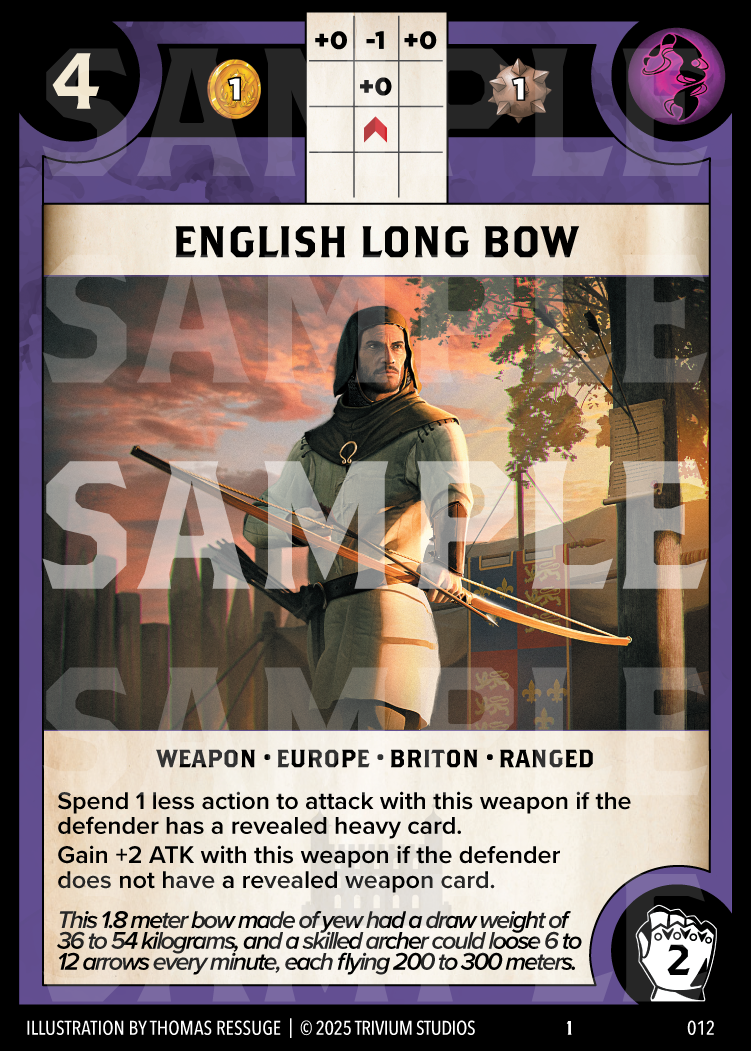
Spend 1 less action to attack with this weapon if the defender has a revealed heavy card. Gain +2 ATK with this weapon if the defender does not have a revealed weapon card.
This 1.8 meter bow made of yew had a draw weight of 36 to 54 kilograms, and a skilled archer could loose 6 to 12 arrows every minute, each flying 200 to 300 meters.

The English longbow was not just a weapon — it was a revolution in battlefield dynamics. By the time of Henry V’s reign, it had become the defining tool of English military power, forged from yew wood and trained into the muscle memory of thousands of archers. With a draw weight often exceeding 45 kilograms, the longbow was capable of penetrating armor at close ranges and remaining lethal at distances over 180 meters and deliver a rate of fire unmatched by crossbows or early firearms.
Its rise began in the 13th century, but it was under Edward III and then Henry V that the longbow became institutionalized. English law required regular archery practice, and villages held competitions to hone skill. By Agincourt in 1415, Henry’s army fielded thousands of longbowmen — lightly armored, mobile, and devastating. Their arrows broke cavalry charges, disrupted formations, and turned mud into massacre.
The longbow’s effectiveness wasn’t just technical. It was cultural. It democratized warfare, allowing commoners to kill knights. It reshaped tactics, forcing commanders to rethink frontal assaults. And it gave England a psychological edge — the “arrow storm” became a symbol of national defiance.
Henry V understood this. He didn’t just deploy longbowmen; he structured his campaigns around them. At Agincourt, he positioned archers behind sharpened stakes, flanking the narrow battlefield. When the French advanced, they were funneled into a killing zone. The longbowmen fired in disciplined volleys, cutting down armored knights and sowing chaos. It was not luck — it was logistics, terrain, and the longbow.
Today, the English longbow survives as a symbol of precision, endurance, and tactical ingenuity. Museums across Britain display surviving bows and arrowheads, including examples from the Mary Rose, Henry VIII’s warship. Archery clubs still teach longbow technique, and military historians cite its role in the evolution of ranged warfare.
For Henry V, the longbow was more than a weapon. It was a national asset, a strategic equalizer, and a tool of empire. It helped him win battles, shape identity, and leave a legacy that still echoes in military doctrine and cultural memory.