Encyclopedia Anachronistica

Alt Art
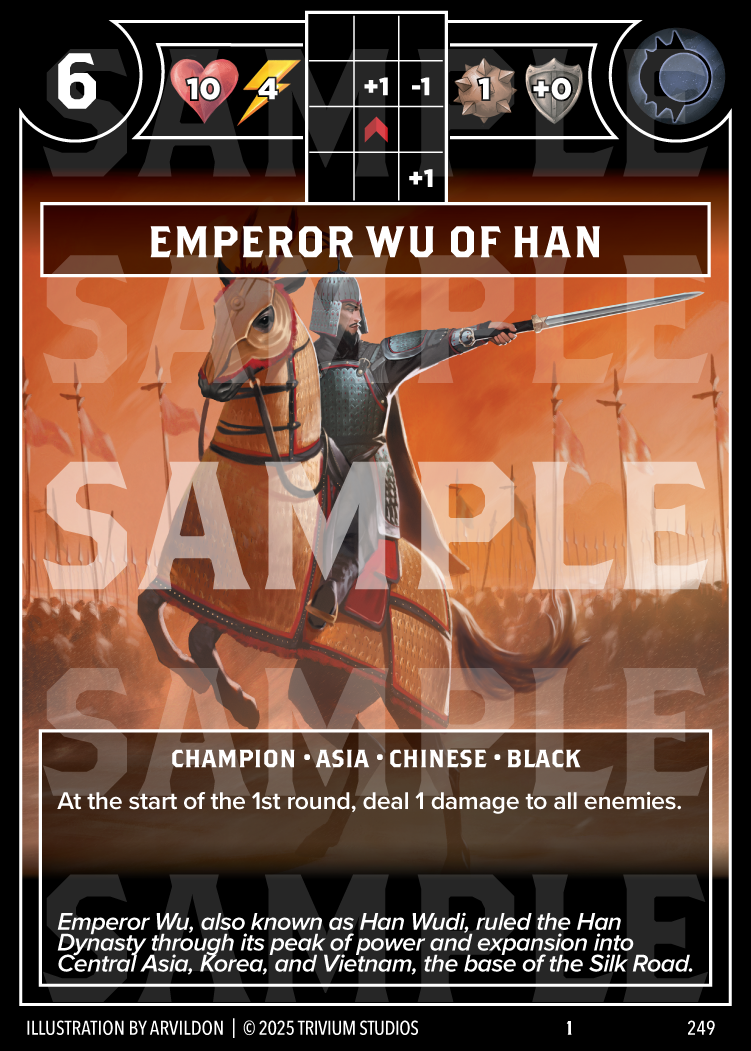
Champion
Asia
Chinese
Black
At the start of the 1st round, deal 1 damage to all enemies.
Emperor Wu, also known as Han Wudi, ruled the Han Dynasty through its peak of power and expansion into Central Asia, Korea, and Vietnam, the base of the Silk Road.
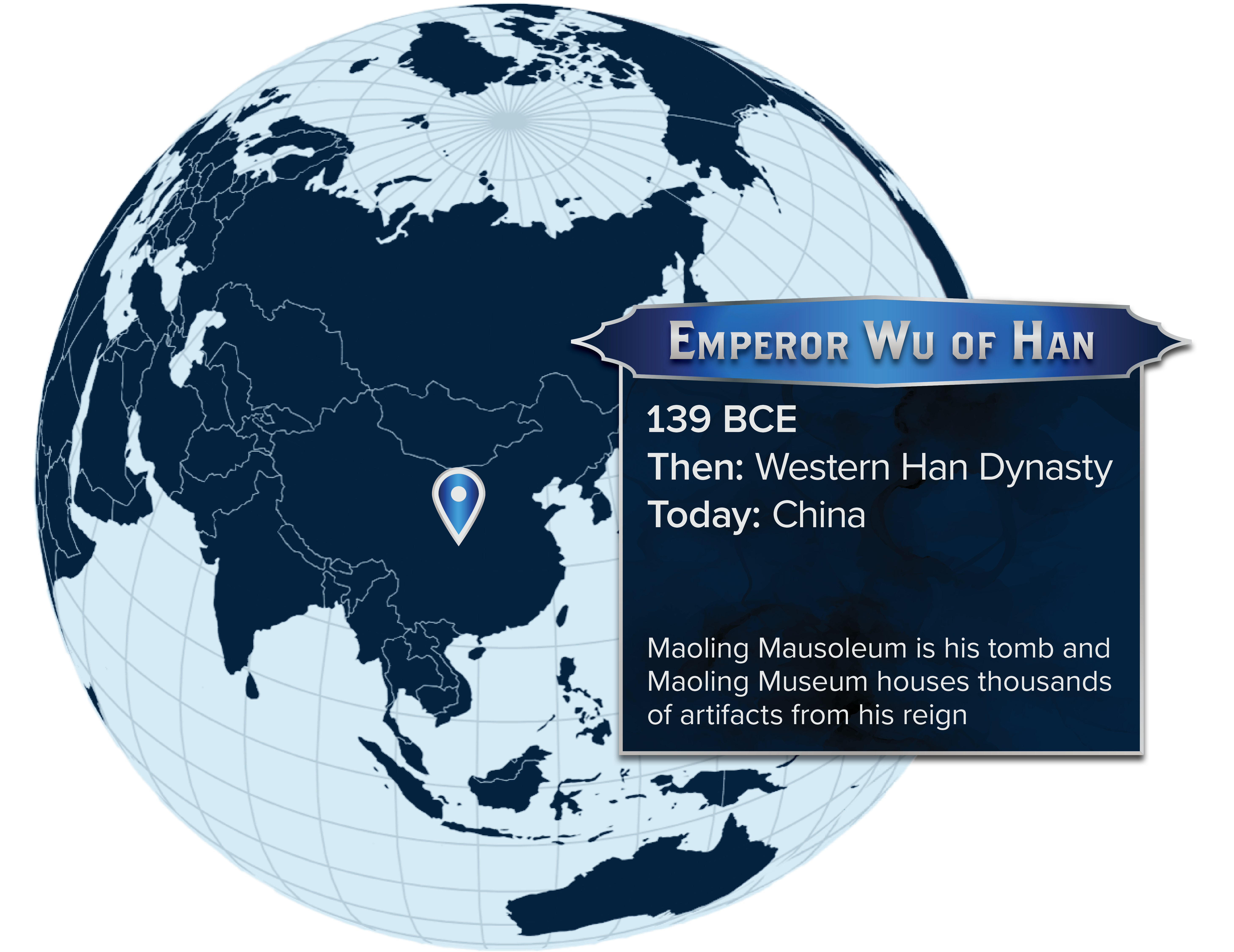
Liu Che, later known as Emperor Wu of Han—or just Emperor Wudi—is arguably more responsible for modern China than any other ruler. Think about that. In 4,000 years of dynasties, this guy was Numero Uno.
He took the throne at 15 and immediately rewired the empire. Legalism? Banned. Civil servants who didn’t follow Confucius? Fired. He built a government school around the Five Classics, ensuring every official shared a philosophy of service and self-sacrifice instead of scheming their way up the ladder.
Once his domineering grandmother died, Wudi purged the palace of useless aristocrats and replaced them with his own loyal youth. To weaken the provincial kings, he decreed their wealth be split evenly among all sons. These kings had lots of sons. Suddenly, their power fractured into manageable chunks—perfect for absorption into the imperial system.
Previous Han emperors had tried bribing the Xiongnu with women, silk, and alcohol to avoid war. Wudi said, “How about I kill you, take your land, move my people in, and write it off on my taxes?” He did. Generals who failed were executed. This do-or-die doctrine led to campaigns against the Tocharians, Yuezhi, Koreans, Xiongnu, and Vietnamese—nearly doubling China’s size.
Not one for criticism, Wudi had Grand Historian Sima Qian severely punished for defending a disgraced general. Meanwhile, conquest drained the treasury. So Wudi nationalized iron and salt—the empire’s most profitable industries—and raised taxes. On the plus side, this expanded steel technology, launched the Silk Road, and boosted China’s knowledge of foreign lands, philosophies, and religions.
Near the end of his reign, Wudi grew paranoid and obsessed with immortality. He threatened regional officials with execution if peasants revolted. But two years before his death, he issued the Repenting Edict of Luntai—a formal apology to the people. He rolled back taxes, ended wars, and acknowledged his mistakes while still in power.
How many rulers in history have done that?
Wudi’s reign lasted 54 years—a record that stood for 1,800 years. His policies, conquests, and reforms laid the foundation for imperial China and shaped the future of a quarter of the world’s population.