Encyclopedia Anachronistica


Alt Art
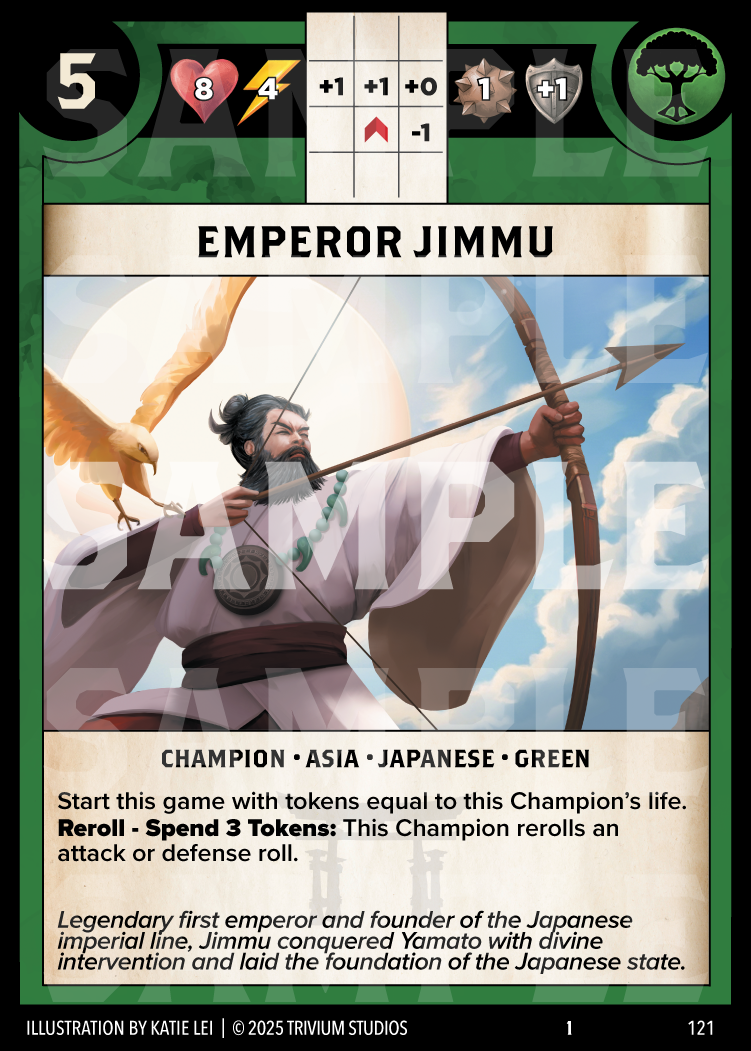
Champion
Asia
Japanese
Green
Start this game with tokens equal to this Champion's life. Reroll - Spend 3 Tokens: This Champion rerolls an attack or defense roll.
Legendary first emperor and founder of the Japanese imperial line, Jimmu conquered Yamato with divine intervention and laid the foundation of the Japanese state.
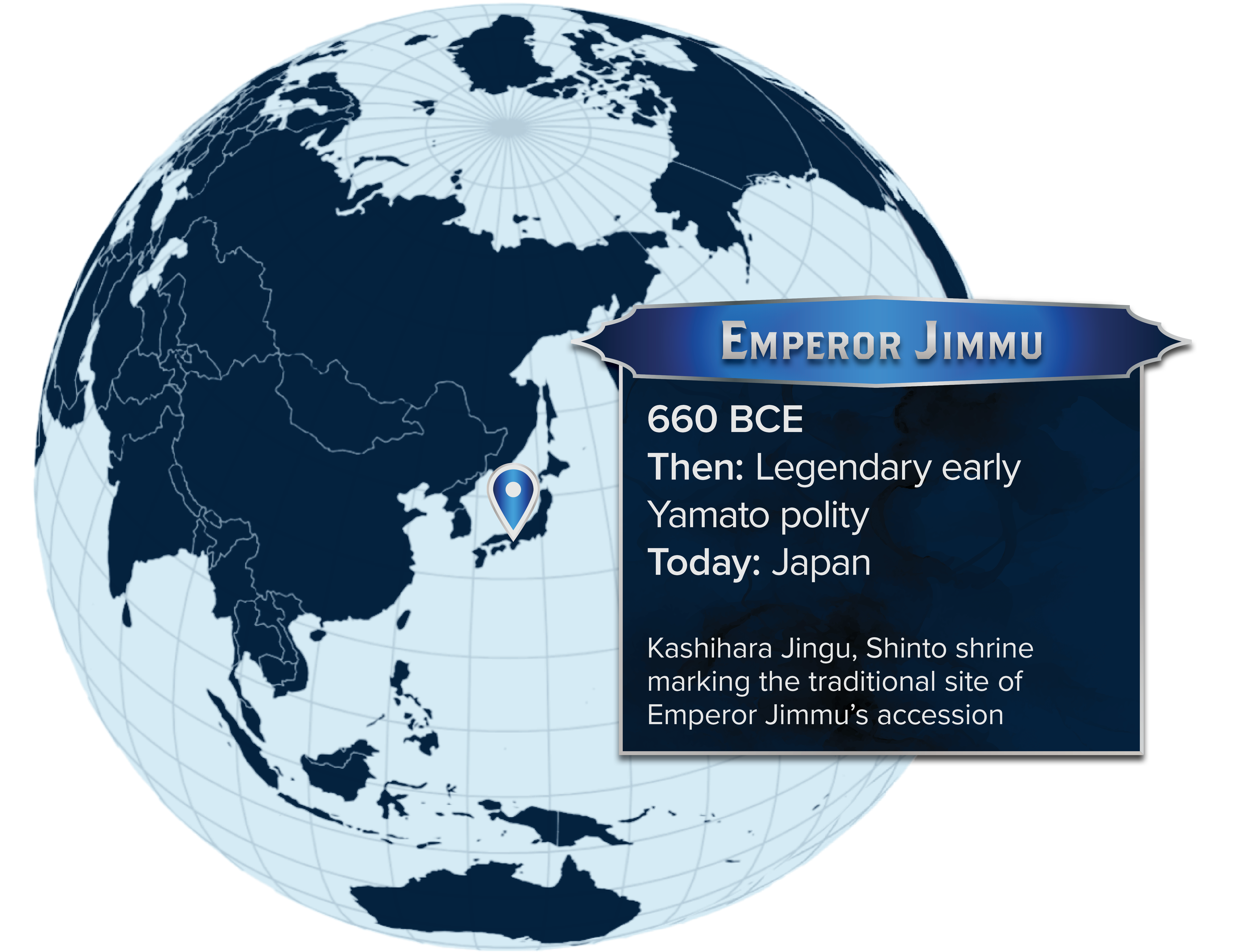
A demigod descended from Amaterasu the sun goddess and Susanoo the storm god (talk about cosmic royalty), Emperor Jimmu launched the longest-running monarchy in world history—over 125 emperors and counting. He’s the mythic founder of Japan, the first ruler in the imperial line, and a divine warlord who turned the “Age of Gods” into the age of conquest.
Born in Takachiho in southern Kyushu, Jimmu and his older brother Itsuse led their people eastward in search of a better seat of power. But when they clashed with a local chieftain named Nagasunehiko near modern Osaka, Itsuse caught a fatal blade and dropped into legend. Jimmu, now commander-in-chief, decided to flip the battlefield script. With the supernatural guidance of Yatagarasu—a divine three-legged crow sent by the gods—he swung his forces around to attack with the sun at his back, not in his eyes. The result? A bloodbath of mythic proportions. Arrows flew, limbs fell, and the ground drank deep.
Then came the divine twist. As the battle deadlocked, the sky darkened and a radiant golden kite descended from the heavens, blinding Nagasunehiko. Jimmu seized the moment, drew his longbow, and sent an arrow screaming through the stunned chieftain’s body. With Nagasunehiko out of the picture, Jimmu resumed subduing tribes like the Emishi, but tempered his rule with wisdom and care, earning respect as both conqueror and sovereign.
Jimmu’s campaign wasn’t just a military march—it was a divine assertion of cosmic order. His battles weren’t fought for territory alone, but to align the mortal realm with the will of heaven. Every arrow loosed, every tribe subdued, was part of a celestial mandate. His longbow wasn’t just a weapon—it was an extension of divine justice. As he consolidated power across Yamato, he didn’t just install governors or collect tribute; he laid the foundation for a sacred monarchy, one that would claim unbroken descent from the gods for over two millennia. In Jimmu’s hands, conquest became consecration, and Japan itself became a living extension of the divine.
His final challenge came from Nigihayahi, another divine claimant descended from the gods of Takamagahara (Japan’s Olympus). Protected by Nagasunehiko’s remaining forces, Nigihayahi sat on his own throne. Jimmu rode out to meet him—not with armies, but with ancestral swagger. After a celestial stare-down, Nigihayahi acknowledged Jimmu’s divine lineage and ceded the throne. Jimmu ascended as Emperor, god incarnate, and Japan’s first ruler.
To seal his legacy, Jimmu gave Japan its classical name. One day, a mosquito tried to steal a drop of his royal blood, but a dragonfly swooped in and killed it. Jimmu saw this as divine recognition of his sovereignty and named the land Akitsushima—the Dragonfly Islands.