Encyclopedia Anachronistica

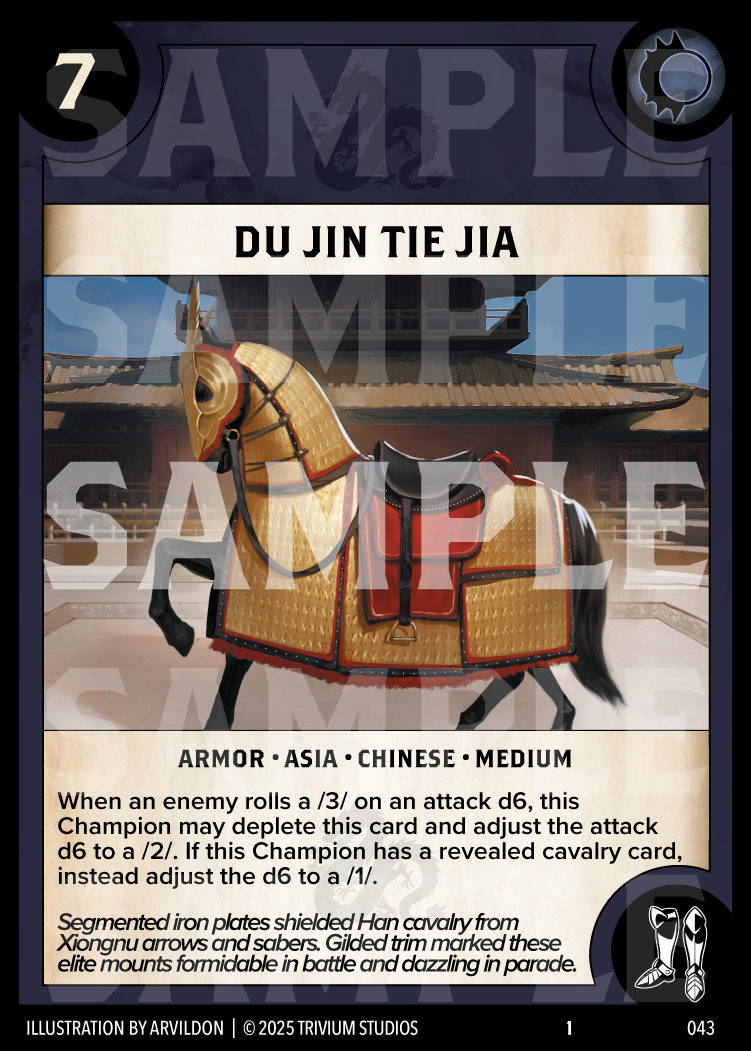
Standard
Armor
Asia
Chinese
Medium
When an enemy rolls a /3/ on an attack d6, this Champion may deplete this card and adjust the attack d6 to a /2/. If this Champion has a revealed cavalry card, instead adjust the d6 to a /1/.
Segmented iron plates shielded Han cavalry from Xiongnu arrows and sabers. Gilded trim marked these elite mounts formidable in battle and dazzling in parade.

Gilded iron barding — protective armor for warhorses decorated with gold leaf or gold-plated fittings — represents the fusion of military necessity and imperial display during the Han dynasty. While full horse armor would not become widespread in China until later periods, archaeological finds from Western Han tombs, including gilded iron lamellae and ornate bronze-gilt horse masks, show that elite cavalry units and ceremonial mounts were equipped with protective and decorative gear far earlier than once believed.
Under Emperor Wu of Han, cavalry became the backbone of Chinese military strategy. Campaigns against the Xiongnu demanded fast, resilient horses and equipment that could withstand long-range expeditions. Iron barding offered limited but meaningful protection against arrows and blades, especially for the chest and neck — the most vulnerable areas in steppe warfare. The addition of gilding served a dual purpose: it signaled imperial prestige and reinforced the divine aura surrounding the emperor’s cavalry, particularly elite units under generals like Huo Qubing.
Gilded fittings also appear in funerary contexts, where they symbolize rank, wealth, and martial virtue. Tombs in Hebei, Guangdong, and the Nanyue Kingdom contain gilded iron plates, bronze-gilt harness ornaments, and decorative horse masks (danglu), demonstrating the spread of luxury horse equipment across the empire. These artifacts reflect both the economic power of the Han state and the cultural importance of the horse as a symbol of military authority.
Today, gilded iron barding from the Han dynasty provides crucial evidence for the early development of Chinese cavalry equipment. Museums and archaeological institutes continue to study these finds to understand manufacturing techniques, trade networks for precious metals, and the ceremonial role of horses in imperial ideology. Modern reconstructions highlight the craftsmanship involved in combining iron protection with gold ornamentation — a reminder that even in warfare, the Han court valued splendor alongside strength.