Encyclopedia Anachronistica


Standard
Special
Europe
Briton
Tome
Reroll: This earth, void, or wood Champion may reroll a defense roll, and all enemies lose -1 ATK until the end of the round.
William ordered a tally of every manor, ox, and serf creating a two volume document that was the unchangeable legal catalog of property in most of England and Wales.
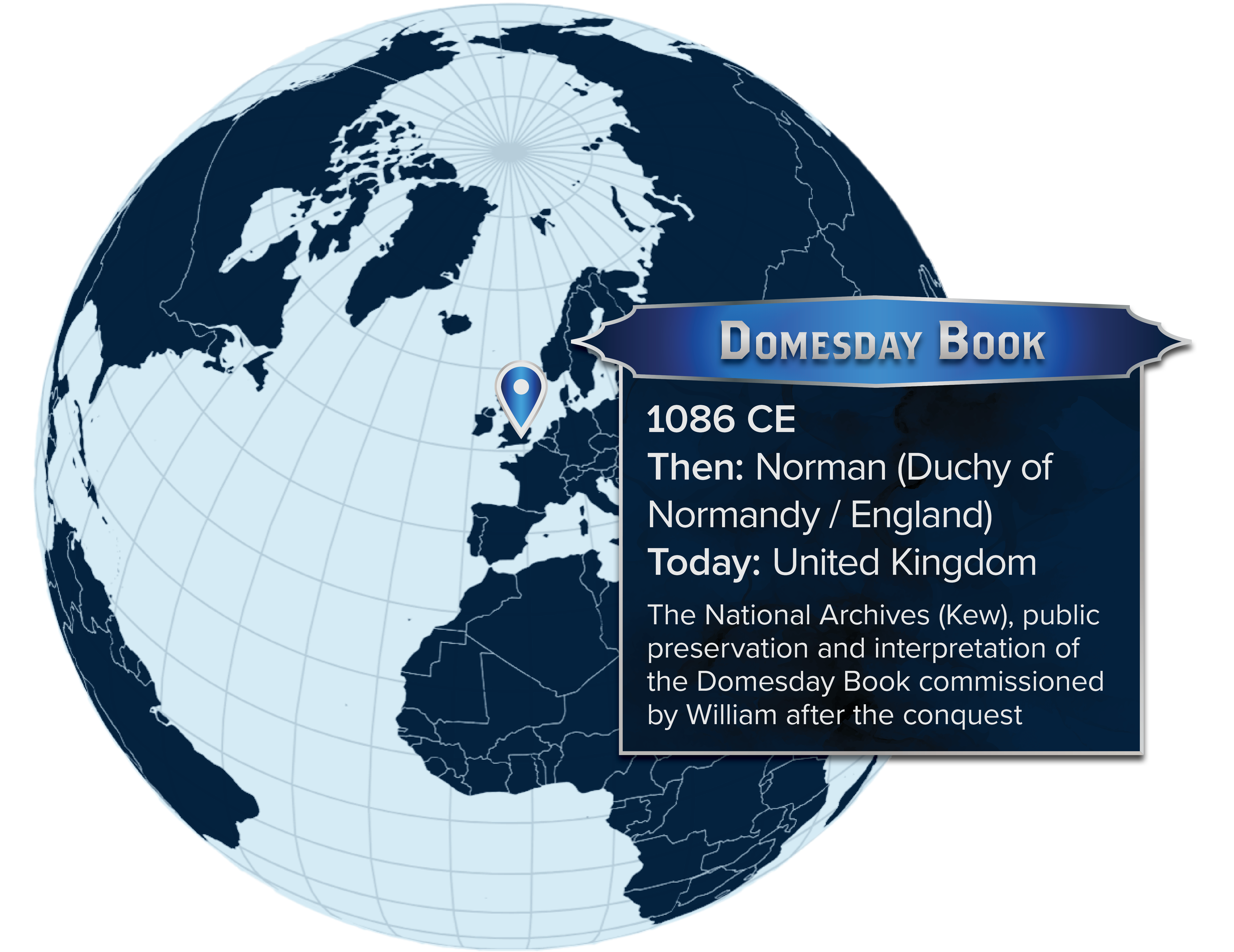
The Domesday or Doomsday Book is one of the most remarkable administrative documents of the medieval world. Commissioned by William the Conqueror in 1085 and completed in 1086, it records landholdings, resources, population, and obligations across most of England. Compiled through sworn testimony from local juries and organized by shire and hundred, it provided the crown with a comprehensive assessment of wealth and authority in a kingdom transformed by conquest. No comparable survey exists from the period in Europe, and its level of detail remains extraordinary.
For William, the Domesday survey served multiple purposes. It clarified who held what land before and after the conquest, enabling the crown to confirm grants, resolve disputes, and enforce feudal obligations. It strengthened royal authority by demonstrating that all land ultimately derived from the king. Its nickname, “Domesday,” reflects the perceived finality of its judgments — like the Last Judgment in Christianity, its findings were not to be appealed. The book thus stands as a testament to William’s administrative ambition and his determination to impose order on a newly reshaped realm.
The Domesday Book also provides a snapshot of eleventh-century English society. It records villages, mills, fisheries, plough teams, woodland, and livestock, offering insight into agricultural capacity and settlement patterns. It reveals the redistribution of land to Norman lords and the persistence of some Anglo-Saxon structures under new rule. For historians, it is a foundational source for understanding the economic and social landscape of medieval England.
Today, the Domesday Book remains a vital resource for scholars, genealogists, and the public. Digitized by the UK National Archives, it is accessible worldwide and continues to inform research on land use, population, and governance. Modern cadastral surveys and property registries descend conceptually from William’s inquest, reflecting the enduring influence of systematic recordkeeping. As both a historical artifact and a tool for understanding the past, the Domesday Book stands as one of the most significant legacies of the Norman Conquest.