Encyclopedia Anachronistica

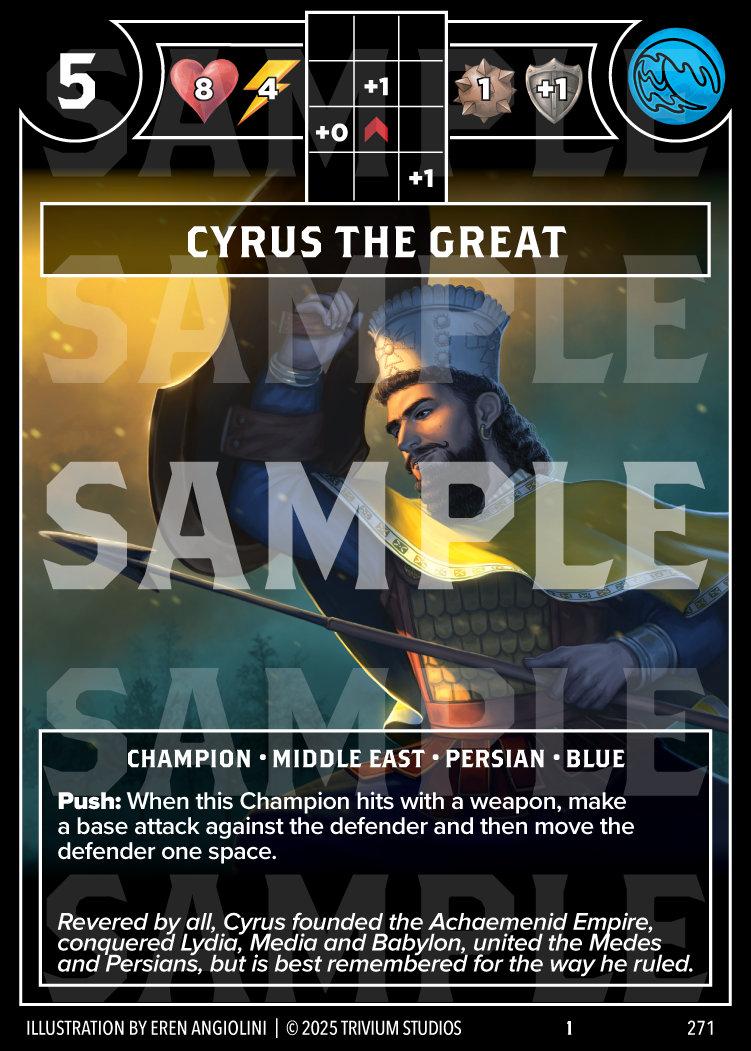
Alt Art
Champion
Middle East
Persian
Blue
Push: When this Champion hits with a weapon, make a base attack against the defender and then move the defender one space.
Revered by all, Cyrus founded the Achaemenid Empire, conquered Lydia, Media and Babylon, united the Medes and Persians, but is best remembered for the way he ruled.
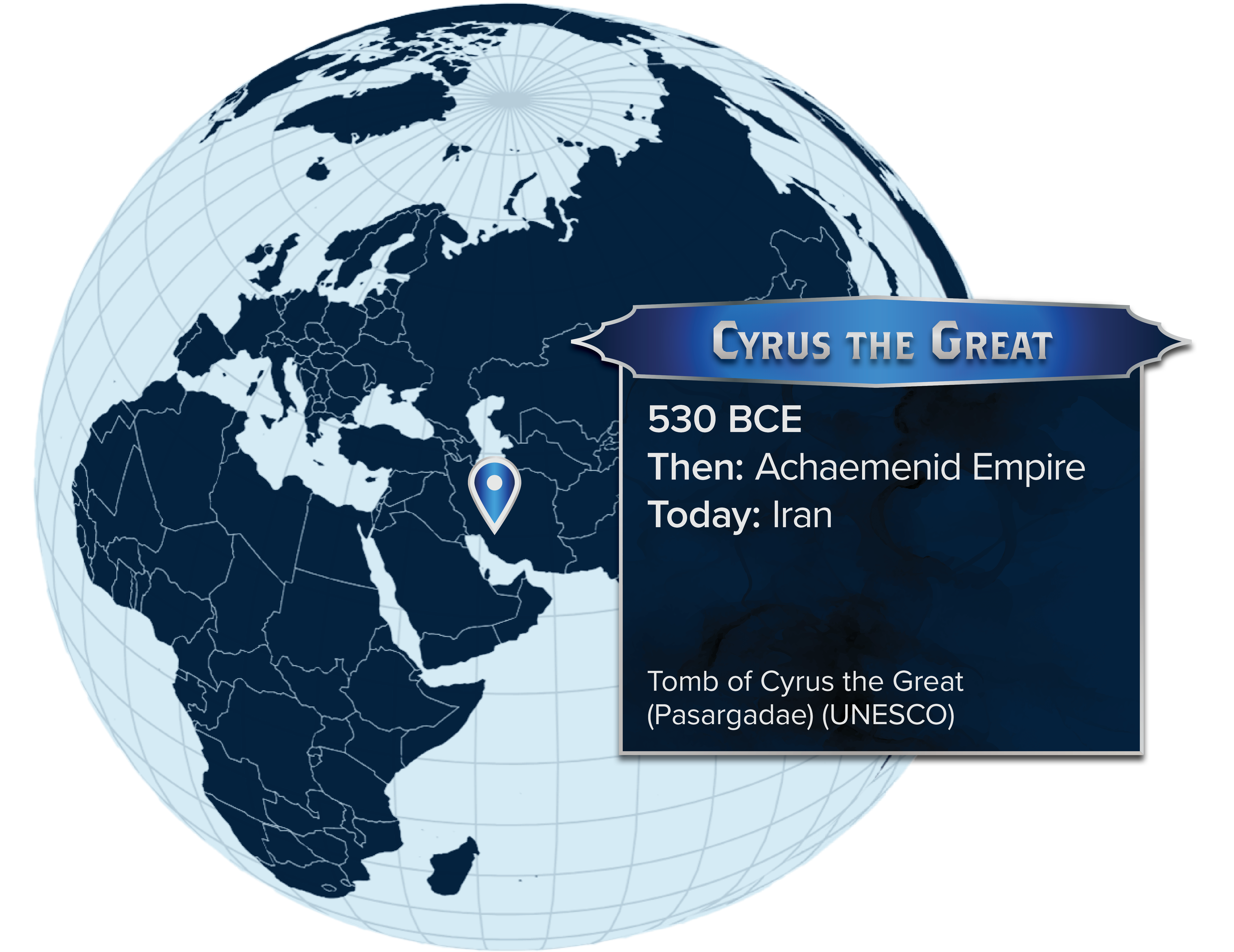
Let’s turn our attention to Cyrus the Great, founder of the first Persian Empire. There are a few figures in history from whom entire civilizations ripple outward—and Cyrus is one of them. Raised either by a poor shepherd or by Cambyses I, a minor king of Anshan, Cyrus took the throne after his father’s death and was immediately attacked by his overlord, the Median Empire. That was a mistake.
Cyrus, a tactical savant, crushed the Median army with chariots and cunning, spared their king Astyages, and married his daughter. That victory triggered another: Croesus of Lydia, Astyages’ half-brother, invaded from the west. Cyrus responded with lethal precision. Along the way, he recruited 10,000 elite warriors from across the Middle East, forming the legendary Immortals—so named because whenever one died, another took his place, keeping their numbers eternally intact.
Cyrus invited the Ionian Greeks to revolt against Croesus. They refused, setting the stage for future Persian-Greek clashes involving names like Leonidas and Themistocles. At the Battle of Pteria, both sides suffered heavy losses. Croesus retreated and, assuming winter meant safety, disbanded his mercenaries. Cyrus disagreed. He launched a winter offensive using camels—because cavalry horses freaked out at the sight of them. The camels broke the Lydian lines, and Cyrus’s infantry finished the job. Croesus was captured, and Lydia fell.
Next stop: Babylon. Cyrus had built a reputation as a liberator—not a tyrant. He returned stolen property, respected local governments, and let people worship freely. Babylon, fed up with its unpopular king Nabonidus, practically begged Cyrus to take over. But Babylon was a fortress: 80-foot walls, moats fed by the Euphrates, and a reputation for being impregnable.
Cyrus didn’t flinch. He diverted the ENTIRE EURAPHRATES RIVER, drained the moat so low that his army could march into the city during a festival. No siege. No bloodbath. Just a masterclass in strategy. Nabonidus was captured, and Babylon fell and rejoiced.
Then came the act that echoed through history. Cyrus freed the Jews from Babylonian exile, sent them home with resources to rebuild the Temple in Jerusalem, and was hailed in the Book of Isaiah as “God’s anointed”—the only non-Jew ever given the title of messiah. Without Cyrus, Judaism might have vanished. And without Judaism, there’s no Christianity or Islam.
Cyrus’s policies of tolerance and protection of religious freedom were revolutionary. The Cyrus Cylinder, inscribed with his decrees, is considered the world’s first charter of human rights. A replica sits at the United Nations Headquarters today.
Cyrus didn’t just conquer. He united. He didn’t just rule. He inspired. His empire stretched from the Aegean Sea to the Indus River and lasted for 200 years. It would take the fury of a man named Alexander to tear it down.