Encyclopedia Anachronistica


Standard
Champion
N. Africa
Egyptian
Black
Fear: When this Champion hits with a base attack, the defender loses -1 ATK and -1 DEF until the end of the round.
Cleopatra allied with Julius Caesar and Mark Antony to preserve her kingdom against Roman expansion. She died the last ruler of the Ptolemaic Kingdom of Egypt.
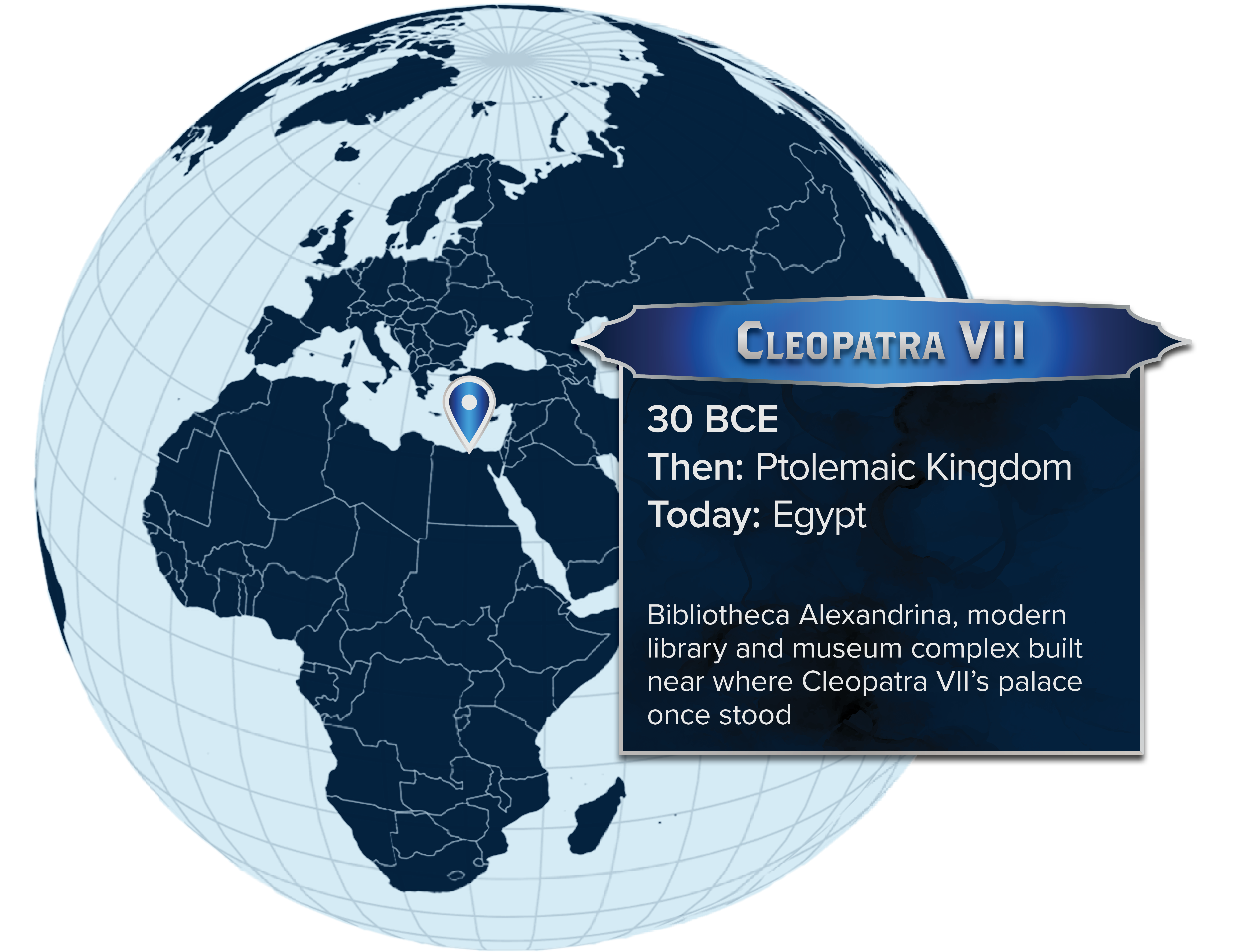
Before she became a legend of seduction and strategy, Cleopatra VII was a scholar, a linguist, and the last pharaoh of ancient Egypt. Born in 69 BCE in Alexandria, she traced her lineage not to Egyptian royalty, but to Macedonian Greece. Her ancestor, Ptolemy I Soter, was one of Alexander the Great’s generals, and the Ptolemaic dynasty had ruled Egypt for nearly three centuries and it was now a powder keg that she inherited.
Unlike her predecessors, Cleopatra embraced Egypt. She was the only Ptolemaic ruler known to speak Egyptian, and she reportedly spoke as many as a dozen languages. She was educated in mathematics, philosophy, astronomy, and oratory, and Egyptian sources later described her as a ruler “who elevated the ranks of scholars and enjoyed their company”. Her beauty was legendary, but her intellect and charisma were her true weapons.
She ruled first with her father, then with her brothers—both of whom were also her husbands, as per dynastic custom. But Cleopatra didn’t share power easily. She had a hand in the deaths of both brothers and her sister Arsinoe IV, who had once tried to usurp her throne.
When civil war broke out between Cleopatra and her brother-husband Ptolemy XIII, she needed Roman support. Knowing his forces would block her entry, Cleopatra had herself smuggled into Julius Caesar’s quarters—wrapped in a carpet, or possibly a linen sack. Caesar was dazzled. The two became allies and lovers. She bore him a son, Caesarion, and ruled Egypt with Roman backing.
Years later, she met Mark Antony. Her entrance was theatrical: a golden barge with purple sails, silver oars, and Cleopatra dressed as Aphrodite beneath a gilded canopy. Attendants dressed as cupids fanned her and burned incense. Antony was enthralled. Together, they formed the “Inimitable Livers,” a drinking society that hosted nightly feasts, wine binges, and elaborate pranks on Alexandria’s citizens.
But their alliance drew the wrath of Octavian, Caesar’s heir. Cleopatra and Antony led a fleet against him at the Battle of Actium in 31 BCE. It was a disaster. Their forces were defeated, and the lovers fled to Egypt. As Octavian closed in, Antony fell on his sword. Cleopatra followed suit, reportedly using a poisoned “sharp implement” or the bite of an asp.
With her death, Egypt fell to Rome. Cleopatra’s son Caesarion was executed. The Ptolemaic dynasty ended. But Cleopatra’s legend endured. Roman historians painted her as a femme fatale who seduced great men and brought empires to ruin. Yet modern scholars see her as a brilliant ruler who played a dangerous game—and nearly won.