Encyclopedia Anachronistica


Standard
Weapon
Asia
Chinese
Sword
This weapon gains +1 ATK against enemies with a revealed weapon card.
Legend says Liu Bang slew a serpent with a rusty rod. The rod then transformed into a gleaming sword with the inscription "Chi Xiao," symbolizing divine rebellion.
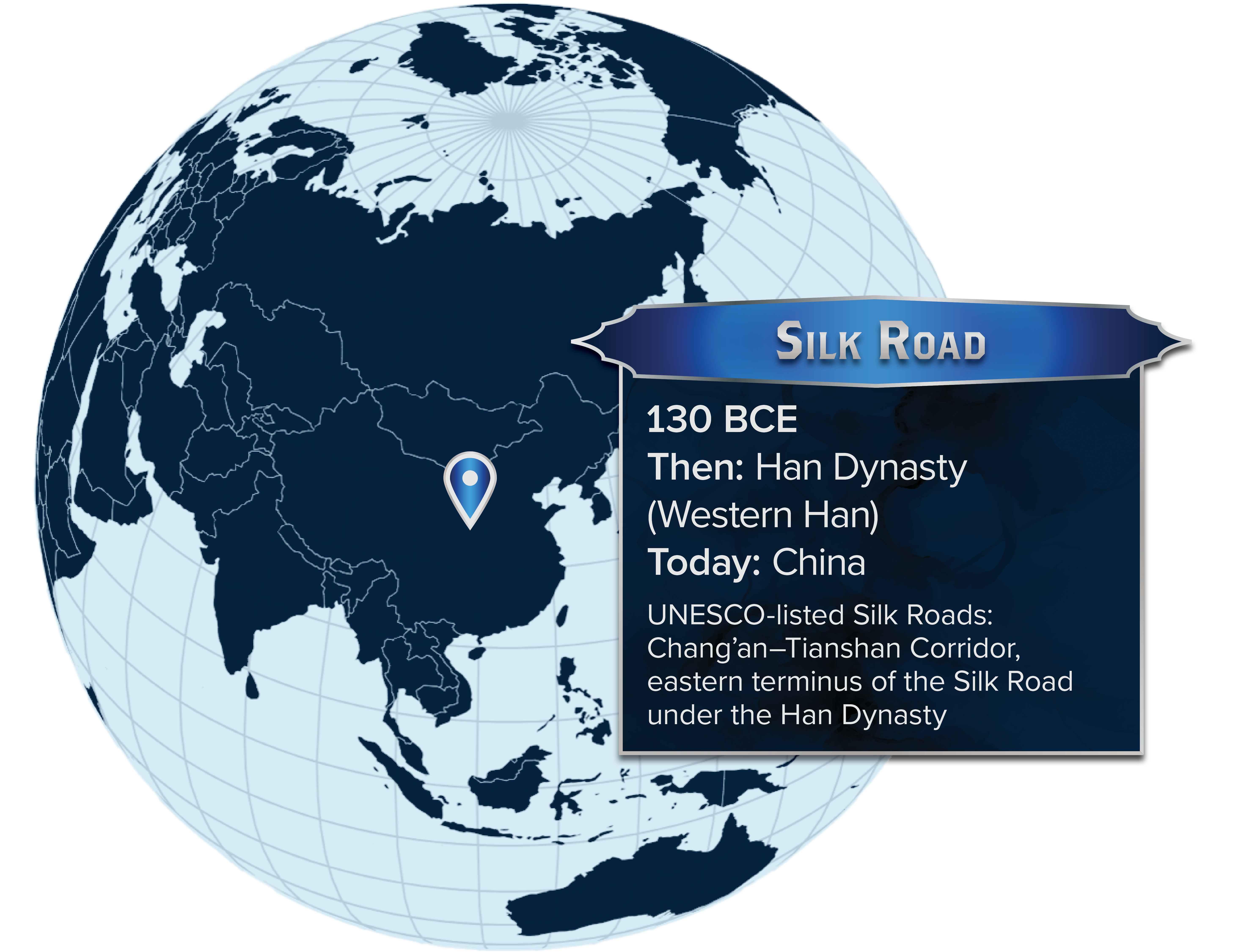
The Silk Road was not a single road but a vast network of overland and oasis routes linking China with Central Asia, Persia, and the Mediterranean world. Its formal opening is traditionally dated to the missions of Zhang Qian, dispatched by Emperor Wu of Han around 138 BCE. Zhang’s reports on the peoples, states, and trade goods of Central Asia convinced Emperor Wu to establish diplomatic and military presence in the region, laying the foundation for trans-Eurasian exchange.
Under Emperor Wu, the Han dynasty expanded into the Hexi Corridor, secured the Gansu oases, and established commanderies that protected caravans and facilitated long-distance trade. Silk, lacquerware, and iron goods traveled westward, while horses, jade, glassware, and exotic plants moved east. The Silk Road also carried ideas: Buddhism entered China along these routes during or shortly after Wu’s reign, reshaping Chinese religious life for centuries.
The Silk Road’s significance extended beyond commerce. It was a geopolitical instrument. Control of the western regions allowed the Han to counter the Xiongnu confederation, forge alliances with states such as Dayuan and the Wusun, and project imperial influence deep into Central Asia. The road became a conduit for diplomacy, espionage, and cultural exchange, transforming China’s relationship with the wider world.
Today, the Silk Road is recognized as one of the most influential trade networks in human history. UNESCO has designated major segments as World Heritage Sites, and modern initiatives such as China’s Belt and Road Initiative consciously evoke its legacy. Museums, historians, and archaeologists continue to study Silk Road artifacts — textiles, coins, manuscripts, and ceramics — to understand the complex interactions that shaped Eurasian civilization.