Encyclopedia Anachronistica

Standard
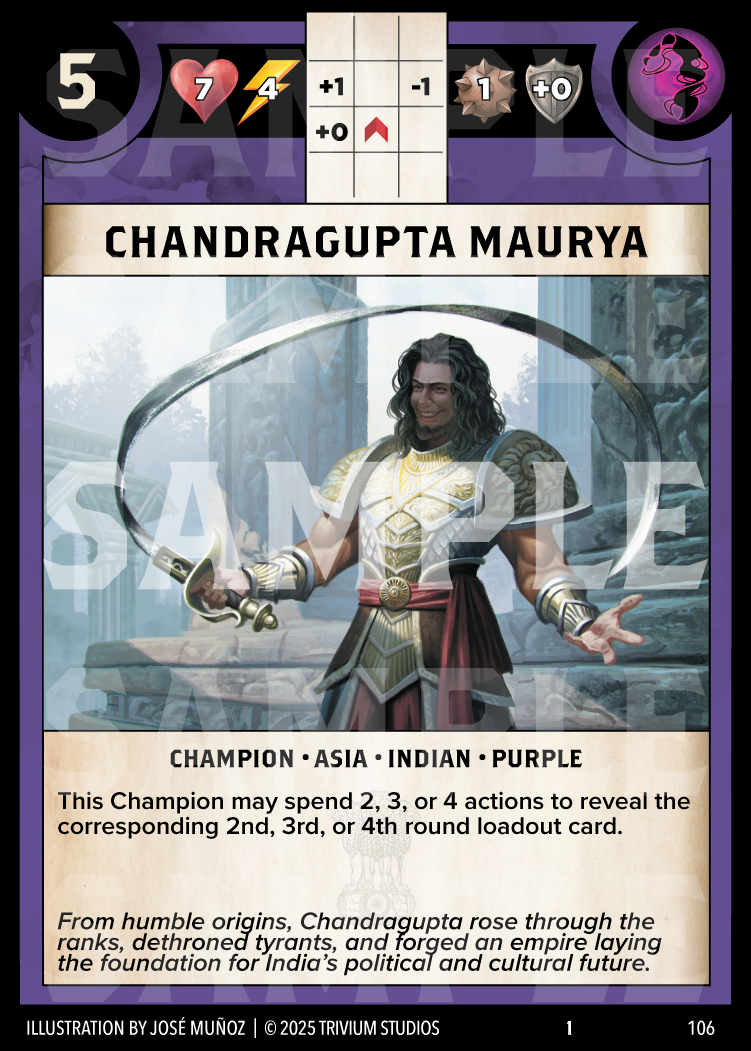
Champion
Asia
Indian
Purple
This Champion may spend 2, 3, or 4 actions to reveal the corresponding 2nd, 3rd, or 4th round loadout card.
From humble origins, Chandragupta rose through the ranks, dethroned tyrants, and forged an empire laying the foundation for India's political and cultural future.
Sometimes a ruler hits the scene so fast and so hard, history barely has time to ask where they came from before they’ve built an empire. That’s Chandragupta Maurya—military prodigy, master tactician, empire-builder, and the ultimate nobody who came from nowhere. His origin story? A haze of conflicting legends. Some say he was born into poverty or sold off by desperate relatives or raised by a cowherd. Others claim noble blood. Doesn’t matter. What’s clear is that he had no throne, no army, no birthright—just raw talent and a fire to rule.
Enter Kautilya (aka Chanakya), a Brahman political mastermind who spotted greatness in the boy, bought him, and sent him to military school. Chandragupta may have trained near Alexander the Great’s forces, possibly met the man himself, and had to flee for reasons lost to time. What he didn’t lose was the tactical brilliance—he absorbed Greek warfare like a sponge and weaponized it for Indian terrain.
Kautilya lit the fuse: a vision of a unified Indian empire, free from foreign invaders and internal corruption. First target? The Nanda Empire, ruled by Danananda—a tax-hiking tyrant hated by his people. Chandragupta took him down with a triple threat: counterfeit currency to destabilize the economy, a Greek-trained army to crush resistance, and psychological warfare to turn Danananda’s own officials against him. The king was ousted or killed, and just like that, the Mauryan Empire was born.
Then came the expansion. Chandragupta built a war machine of 600,000 infantry, 30,000 cavalry, 9,000 elephants, and 8,000 chariots. He steamrolled smaller kingdoms, pushed west to the Indian Ocean, north to the Himalayas, and south into the Deccan. For dessert, he faced off against the Seleucid satraps left behind by Alexander, married a Seleucid princess, and took a chunk of their territory without breaking a sweat.
But Chandragupta wasn’t just a conqueror—he was a builder. He divided power among ministers, trained royal family members to govern, and set up sanitation systems, trade regulations, birth and death registries, and standardized weights and measures. He built a bureaucracy that could run an empire without collapsing under its own weight.
And then, in a move that defies every playbook in history, he walked away. Chandragupta renounced power, became a Jain ascetic, and when a famine struck his people, he refused to eat while they starved. He fasted to death in solidarity. He conquered with brilliance, ruled with precision, and in the end, chose sacrifice over supremacy—Chandragupta didn’t just build an empire, he became its conscience.