Encyclopedia Anachronistica

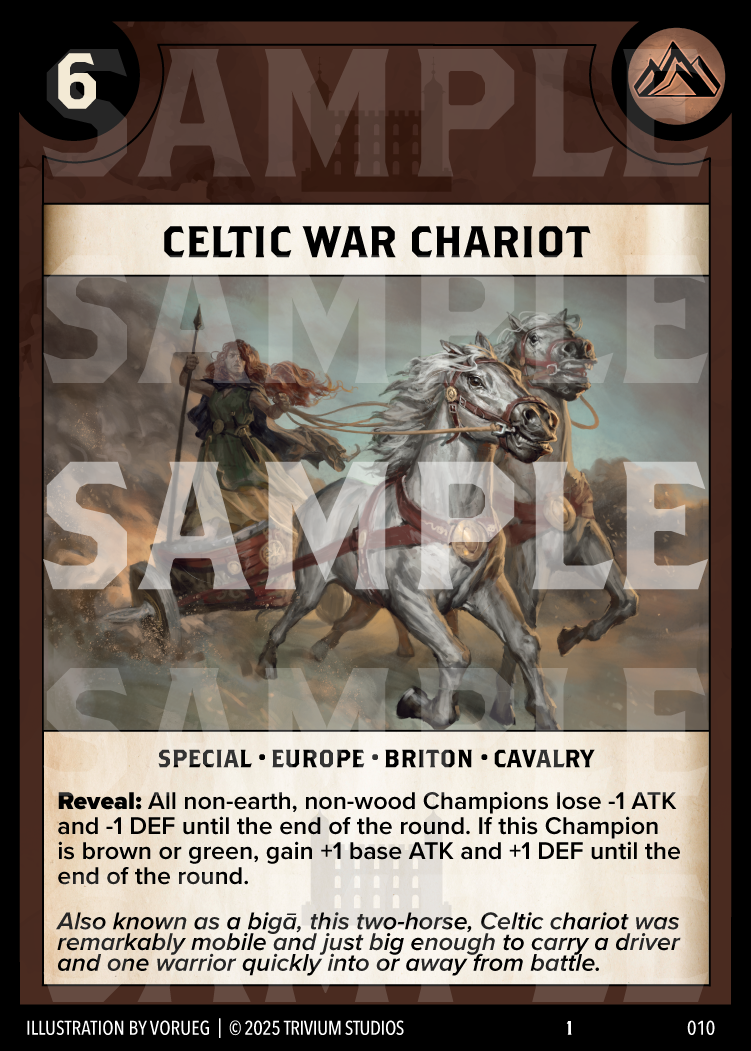
Standard
Special
Europe
Briton
Cavalry
Reveal: All non-earth, non-wood Champions lose -1 ATK and -1 DEF until the end of the round. If this Champion is brown or green, gain +1 base ATK and +1 DEF until the end of the round.
Also known as a biga, this two-horse, Celtic chariot was remarkably mobile and just big enough to carry a driver and one warrior quickly into or away from battle.

The Celtic war chariot was one of the most distinctive weapons of Iron Age Britain — a fast, rattling platform of wood, iron, and raw nerve. Long before Rome arrived, Britons used chariots for both warfare and prestige, and the Iceni were among the tribes who kept the tradition alive into the first century CE. Archaeological finds from East Anglia, including linchpins, yokes, and wheel fittings, show that these vehicles were lightweight, two-wheeled, and pulled by a pair of small but powerful ponies.
Julius Caesar, who fought Britons a century before Boudicca, gives the most detailed description of their use. He writes that charioteers drove at high speed, hurling javelins, then leapt down to fight on foot while the driver maneuvered the chariot nearby for rapid extraction. This hit-and-run style made British chariots unpredictable and intimidating, especially on open terrain. Tacitus confirms that chariots were still in use during Boudicca’s revolt, describing their noise, speed, and the way they disrupted Roman formations.
Iceni chariots were not heavy, scythed machines like those of the Near East. They were agile platforms designed for mobility and shock. The craftsmanship involved — from iron-shod wheels to decorated harness fittings — reflects a culture that blended practicality with display. High-status warriors likely used chariots as symbols of rank as well as tools of war.
During Boudicca’s uprising, chariots played a crucial role in mustering and moving tribal forces. They allowed leaders to travel quickly, coordinate attacks, and maintain visibility on the battlefield. While they could not break disciplined Roman infantry, they were ideal for the fast, decentralized warfare practiced by the Iceni and their allies.
Today, the Celtic war chariot matters because it shows how technology shapes identity. The Romans saw the Celtic chariots as primitive; the Britons saw them as tradition, mobility, and pride. In a modern world where technology often defines power, the chariot reminds us that innovation isn’t always about new inventions — sometimes it’s about using what you have in ways your enemies don’t expect.