Encyclopedia Anachronistica


Alt Art
Champion
Europe
Russian
Purple
At the end of each round, this Champion may switch the order of their unrevealed loadout cards.
Enlightened yet autocratic, Catherine expanded Russia, reformed the government, and built a cultural empire from the throne she seized from her husband Peter III.
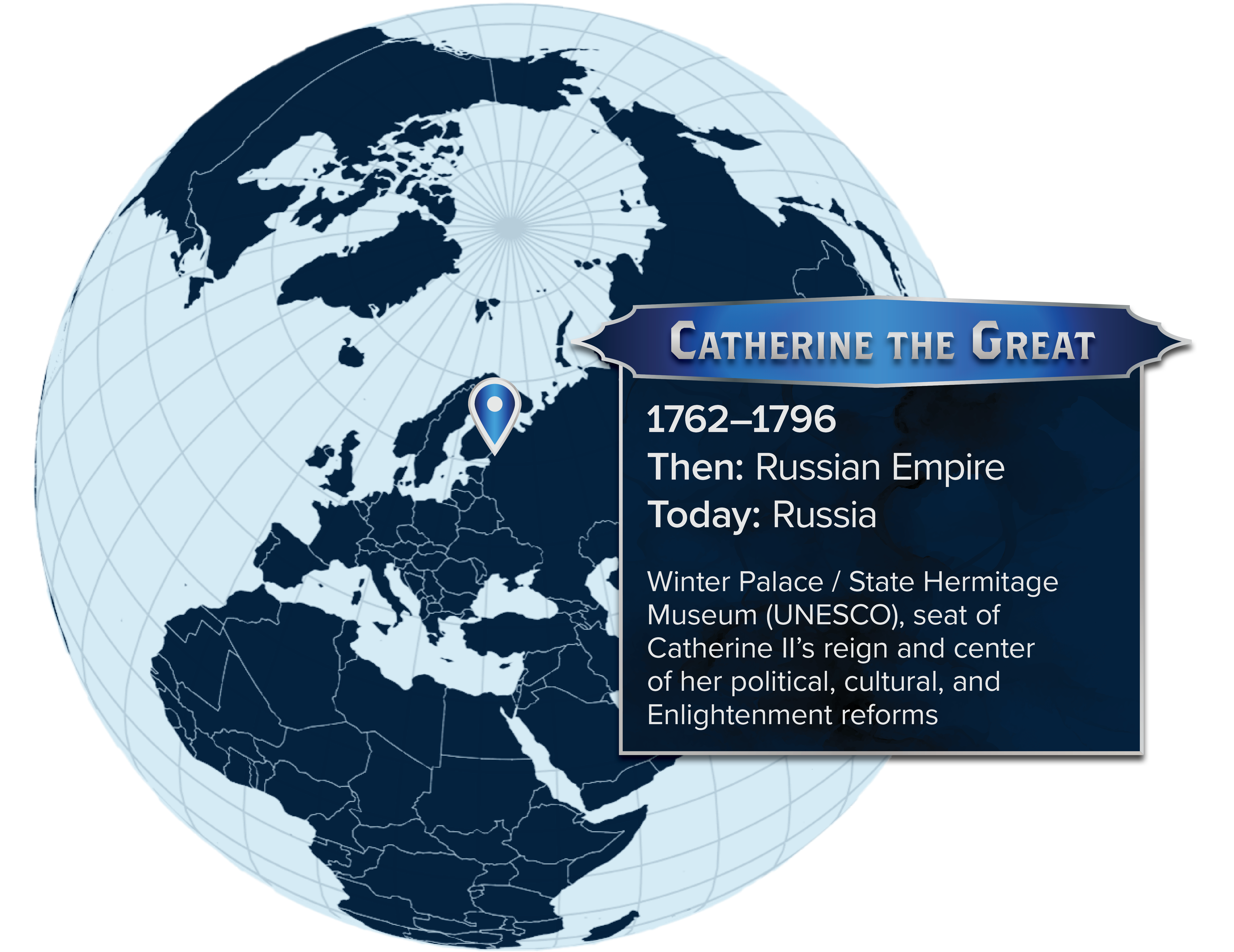
Before she became a legend of enlightened autocracy, Catherine II of Russia was a foreign-born princess with a plan. Born Sophie of Anhalt-Zerbst in 1729, she arrived in Russia at age 14 to marry the heir to the throne, Peter III. He was erratic, neurotic, foolish, and obsessed with Prussia. She was brilliant, ambitious, shrewd, and obsessed with Russia.
In 1762, Peter III took the throne—and promptly alienated the army, the court, and the Orthodox Church. He praised Frederick the Great, insulted Russian traditions, and made it clear he preferred Germany to the empire he ruled. Catherine, by contrast, had spent years cultivating loyalty. She studied Russian, converted to Orthodoxy, and built alliances. When the moment came, she struck. With the support of the military and the nobility, she overthrew her husband in a bloodless coup. Eight days later, Peter was dead—likely murdered by conspirators, though not on her orders.
Catherine became Empress and ruled from 1762 to 1796—during the entire span of the American Revolution. Her reign was one of the longest in Russian history, and one of the most transformative. Inspired by Enlightenment ideals, she launched a cultural renaissance. She founded new cities, universities, and theatres, welcomed European thinkers, and corresponded with Voltaire and Diderot.
In 1767, she drafted the Nakaz, a proposed constitution for Russia. It was so liberal—calling for equality before the law, the abolition of torture, and civic rights—that the French censors refused to publish it. But Catherine was no revolutionary. She believed in reform from above, not revolt from below.
She crushed uprisings with ruthless efficiency. When a pretender named Yemelyan Pugachev led a massive peasant rebellion, Catherine sent her generals to annihilate him. She defeated the Ottoman Empire, annexed Crimea, expanded Russia’s borders, and put down more than a dozen revolts. She genuinely wanted to free the serfs—but her policies backfired and ended up tightening the nobility’s grip, deepening rural inequality.
Catherine’s reign matters today because it marks one of the earliest attempts to fuse autocracy with Enlightenment ideals. She showed that a ruler could champion education, science, and legal reform while still wielding absolute power—a paradox that continues to shape debates about modernization and governance. She also reshaped Russia’s identity on the global stage, elevating it as a cultural and intellectual force and laying the groundwork for its emergence as a European power. Her legacy remains a study in how vision, charisma, and ruthless pragmatism can redefine a nation’s place in history.