Encyclopedia Anachronistica

Chrono
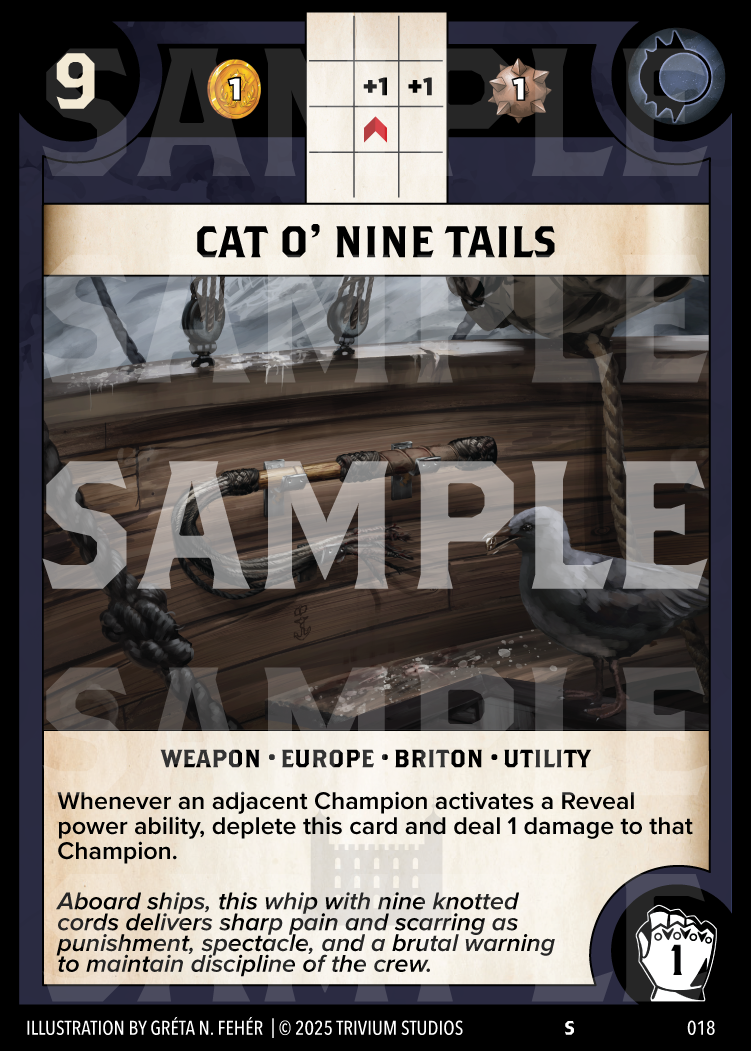
Weapon
Europe
Briton
Utility
Whenever an adjacent Champion activates a Reveal power ability, deplete this card and deal 1 damage to that Champion.
Aboard ships, this whip with nine knotted cords delivers sharp pain and scarring as punishment, spectacle, and a brutal warning to maintain discipline of the crew.
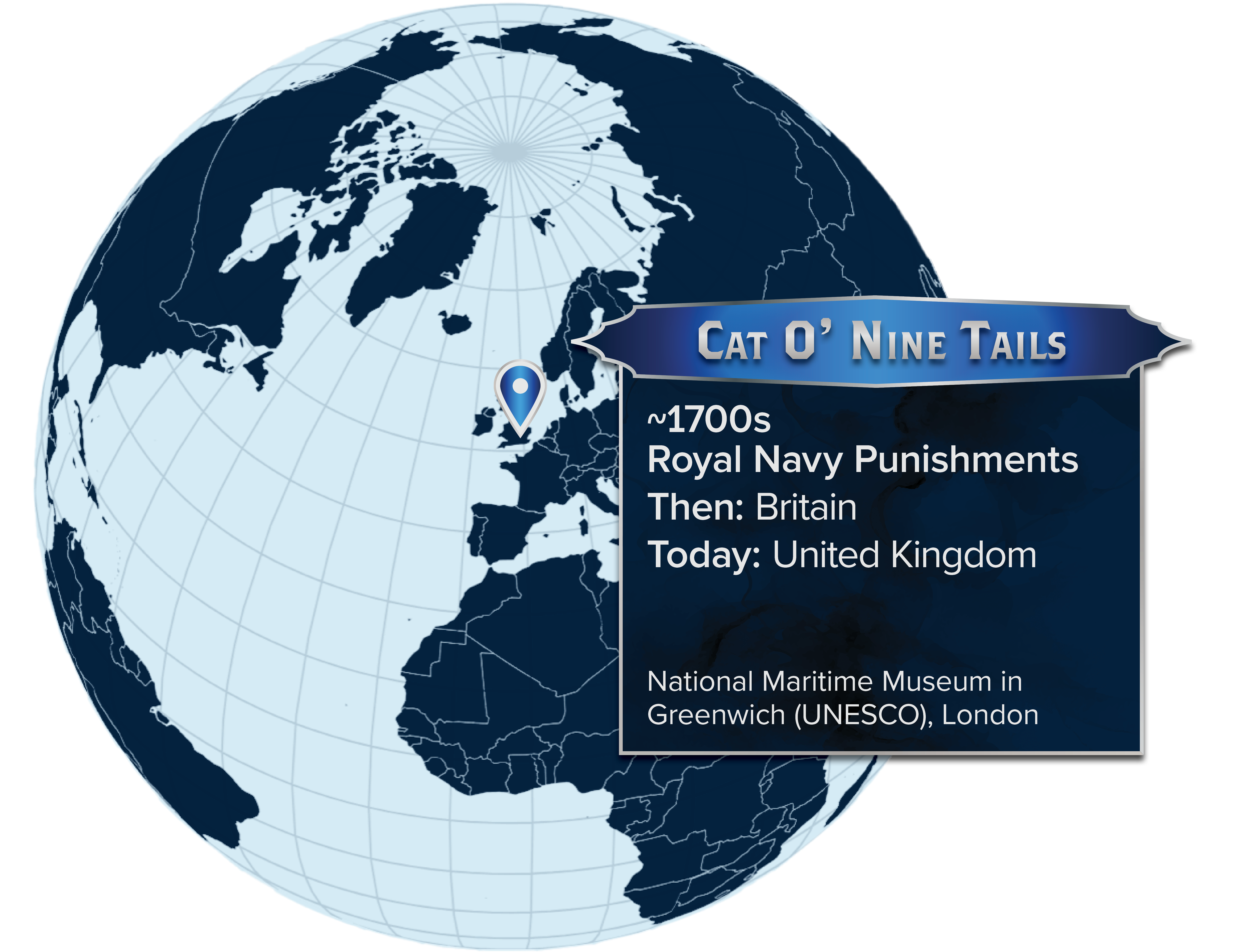
Today, the cat o’ nine tails is remembered not as a celebration of punishment, but as a historical artifact that reflects the challenges of maintaining order in isolated, high-stakes environments, where even minor lapses in discipline could have serious consequences for the crew and ship. Its legacy invites reflection on authority, discipline, and the lived experience of sailors in Britain’s maritime past.
Used aboard ships of the British Royal Navy from the 17th through the 19th centuries, the cat o’ nine tails was a disciplinary implement designed to enforce obedience in a setting where conventional law was distant and command structures had to be upheld. Its use was formalized within naval procedure, administered under strict supervision and often witnessed by the entire crew as part of a ritualized process intended to deter misconduct.
Constructed from nine knotted cords—typically tarred hemp or whipcord—the cat was engineered for durability and visibility. Each cord was braided and knotted to ensure it would not fray under repeated use. The handle was often made of wood, and the entire instrument weighed approximately 370 grams (13 ounces). Its design reflected traditional rope-making techniques, where strands were unraveled and rebraided to form multiple cords. This made the cat both practical and symbolic—a tool derived from the sailor’s own craft.
Punishments involving the cat were typically ordered by a ship’s captain or by court martial. Infractions ranged from drunkenness and insubordination to theft or neglect of duty. The standard punishment was twelve strokes, though more severe offenses could result in higher counts. By the mid-18th century, regulations limited the number of lashes per offense, though some captains circumvented this by dividing a sailor’s infractions into separate charges. The punishment was carried out by the boatswain’s mate, who combed out the tails before each stroke to ensure they did not stick together.
Floggings were public events. The crew was summoned to “witness punishment,” and the offender was tied to a secure part of the ship—often the grating or mast. This visibility was deliberate: the spectacle served as a warning to others and reinforced the authority of the ship’s command structure. While the physical consequences were severe, the psychological impact was equally significant. The threat of the cat was often enough to maintain discipline without its actual use.
Though not unique to the Royal Navy, the cat o’ nine tails became emblematic of British maritime tradition. Over time, as naval discipline evolved and corporal punishment declined, the cat was phased out. By the late 19th century, its use had largely ceased, replaced by other forms of regulation and accountability.