Encyclopedia Anachronistica

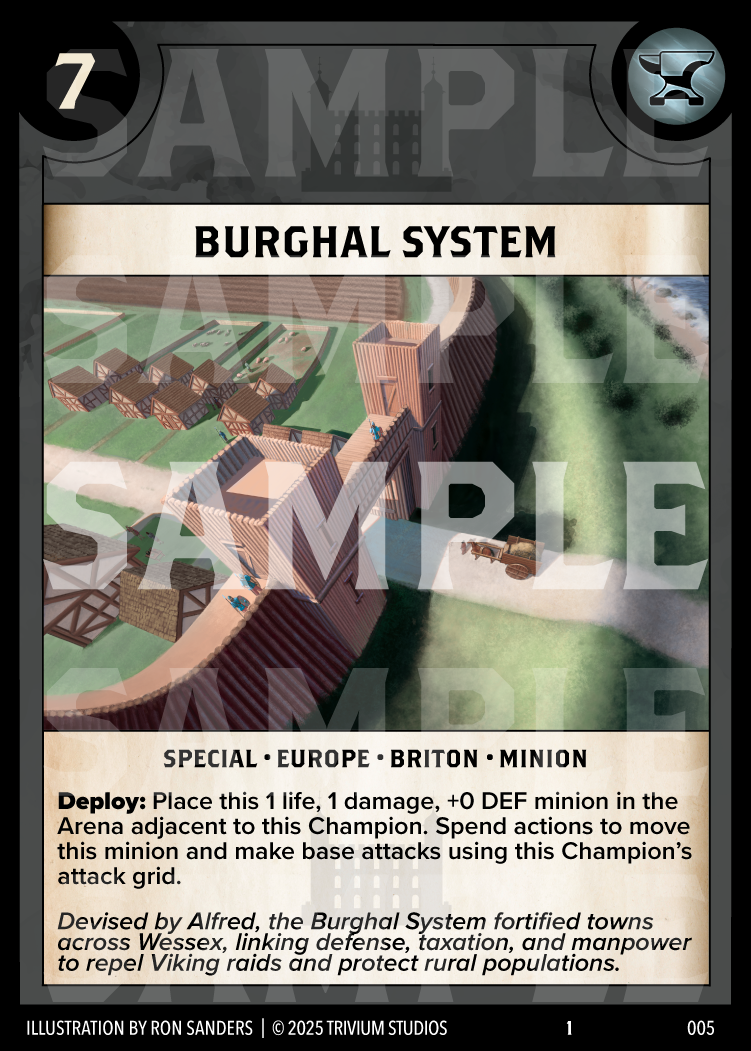
Standard
Special
Europe
Briton
Minion
Deploy: Place this 1 life, 1 damage, +0 DEF minion in the Arena adjacent to this Champion. Spend actions to move this minion and make base attacks using this Champion's attack grid.
Devised by Alfred, the Burghal System fortified towns across Wessex, linking defense, taxation, and manpower to repel Viking raids and protect rural populations.
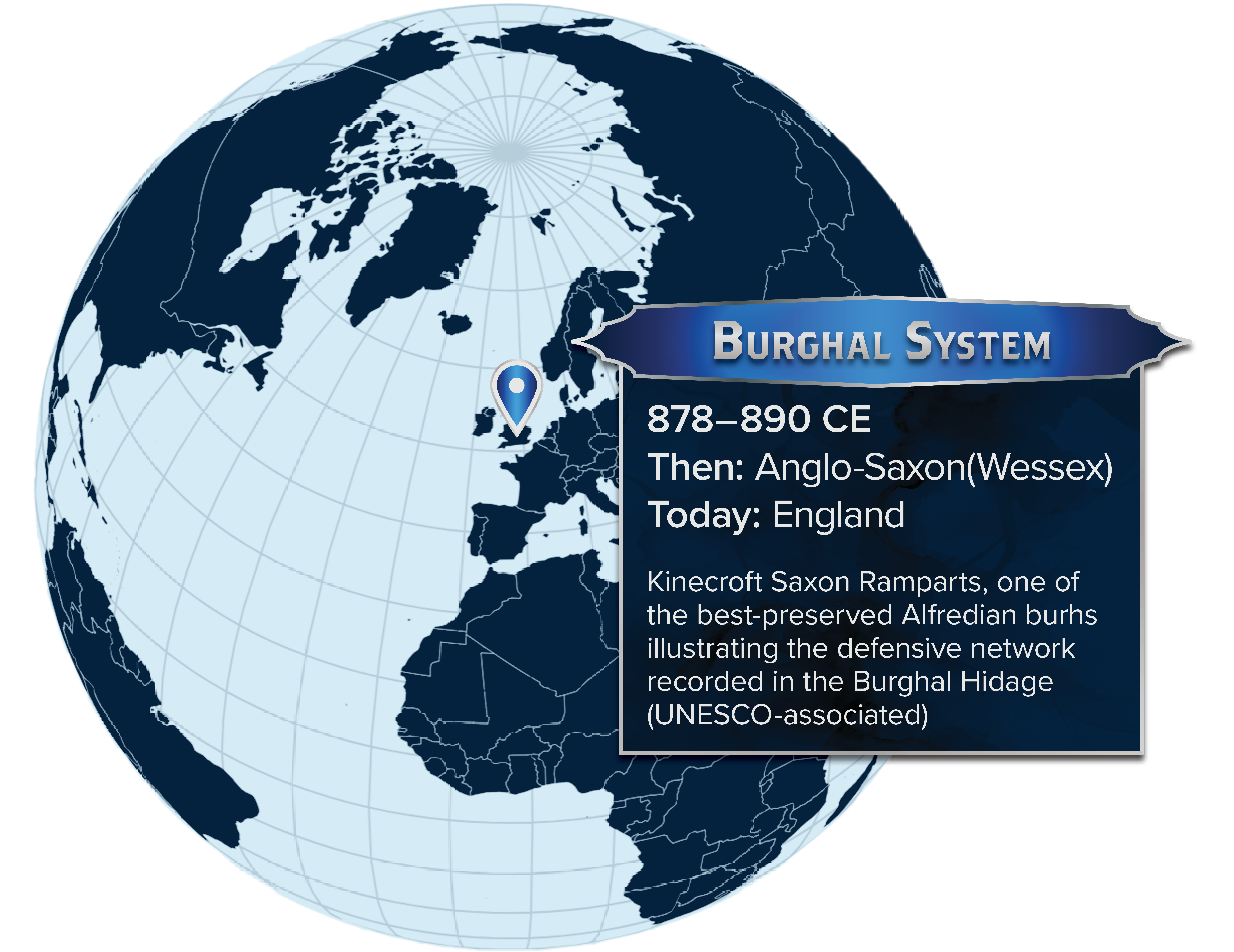
The Burghal System was Alfred the Great’s answer to a terrifying problem: how do you stop Viking armies who move faster than your troops, strike wherever they want, and vanish before you can respond? Most kings of the ninth century tried to chase the raiders. Alfred did something different. He built a network — a coordinated, kingdom-wide defensive grid that looks startlingly modern in its logic.
After Alfred’s victory at Edington in 878, he knew the Vikings would return. They always did. So instead of relying on a single royal army, he created a chain of fortified towns called burhs, each placed so that every person in Wessex lived within roughly a day’s travel of a defensible stronghold. These were not random forts. They were a system — a strategic web designed to slow, trap, and exhaust fast-moving raiders. In modern terms, Alfred didn’t build walls; he built infrastructure.
The Burghal Hidage, a document listing over thirty of these burhs, shows how meticulously the system was planned. Each burh was assigned a number of hides — units of land taxation — that determined how many men were responsible for maintaining and defending its walls. The math was precise: sixteen hides supported one acre of fortification, and every pole of wall (about five meters) required four men to defend it. This wasn’t guesswork. It was organization, resource allocation, and public-works engineering on a kingdom-wide scale.
Some burhs were built from scratch. Others repurposed old Roman towns, repairing stone walls that had stood abandoned for centuries. Places like Winchester, Oxford, and Wallingford were transformed into fortified hubs with gridded streets, garrisons, and markets. These burhs became more than military sites — they evolved into economic engines, minting coinage, hosting trade, and anchoring regional administration. In many cases, the modern English towns that dominate maps today exist because Alfred planted a burh there over a thousand years ago.
The system worked. When Viking armies returned in 892, they found a kingdom that could respond quickly, shelter its people, and deny them easy plunder. Alfred’s son Edward the Elder and daughter Æthelflæd expanded the network, using burhs as launchpads for campaigns that eventually absorbed the Danelaw and unified England.
Seen through a modern lens, the Burghal System resembles a blend of Federal Emergency Management Agency disaster-response zones, interstate highway planning, and cybersecurity architecture. It decentralizes risk, distributes responsibility, and ensures that no single point of failure can collapse the entire system. Alfred wasn’t just building forts — he was building resilience.
Today, the earthworks of places like Wallingford, Wareham, and Cricklade still trace the outlines of Alfred’s vision. They are the physical remains of one of the earliest coordinated national defense networks in European history — a system so effective that it helped create the political entity we now call England.