Encyclopedia Anachronistica


Chrono
Champion
Europe
Roman
Yellow
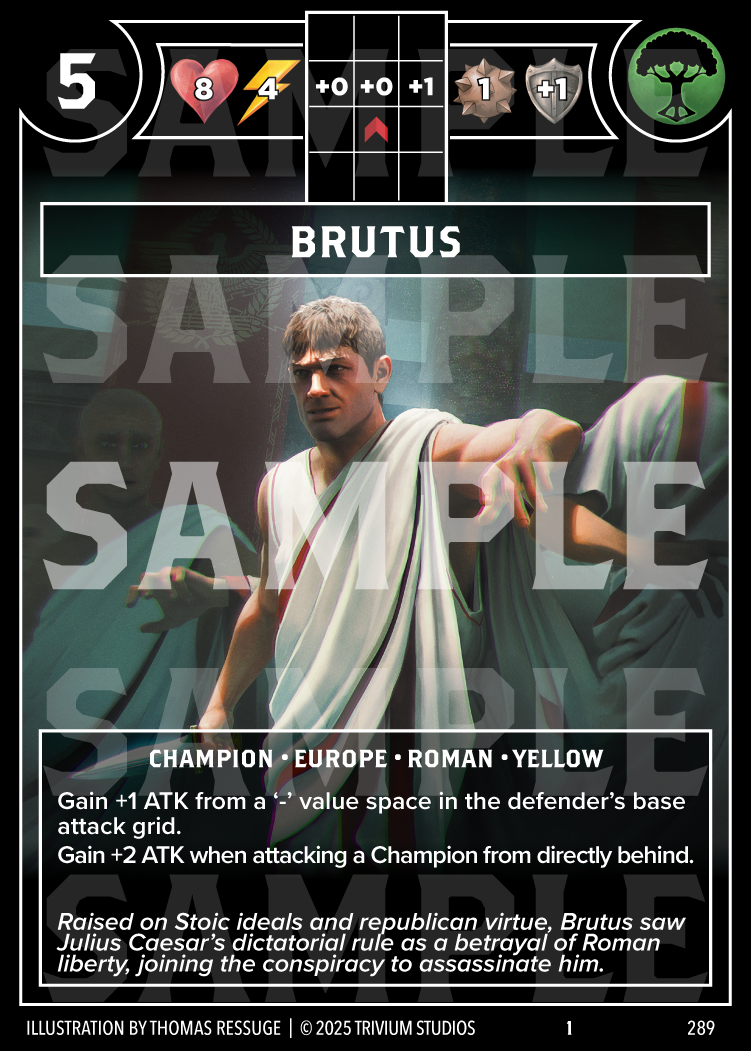
Gain +1 ATK from a '-' value space in the defender's base attack grid. Gain +2 ATK when attacking a Champion from directly behind.
Raised on Stoic ideals and republican virtue, Brutus saw Julius Caesar's dictatorial rule as a betrayal of Roman liberty, joining the conspiracy to assassinate him.
Before he became a symbol of betrayal, Marcus Junius Brutus was a philosopher, an orator, and a politician shaped by the ideals of the Roman Republic. Born in 85 BCE to a powerful family, he was raised in the shadow of resistance—his uncle was Cato the Younger, the stoic senator who defied Julius Caesar to the bitter end. Brutus inherited that fire, but also a deep love for law, virtue, and the idea that no man should rule as king.
He studied philosophy in Athens and admired the teachings of Plato and the Stoics. He believed in reason, civic duty, and the supremacy of the Senate. Ironically, he was once pardoned by Caesar after fighting against him at Pharsalus in 48 BCE. Caesar not only forgave him—he elevated him, making Brutus governor of Gaul and later a praetor in Rome. Some ancient sources even suggest Caesar may have been Brutus’s biological father.
But Caesar’s growing power alarmed the Senate. His attempts to bypass legal accountability and rule by decree pushed Rome toward monarchy. When Caesar was declared “dictator for life,” Brutus joined a conspiracy of senators led by Cassius Longinus. They called themselves the liberatores—liberators of the Republic. The date they chose for the assassination, March 15—the Ides of March—was symbolic: it was the day consuls assumed office.
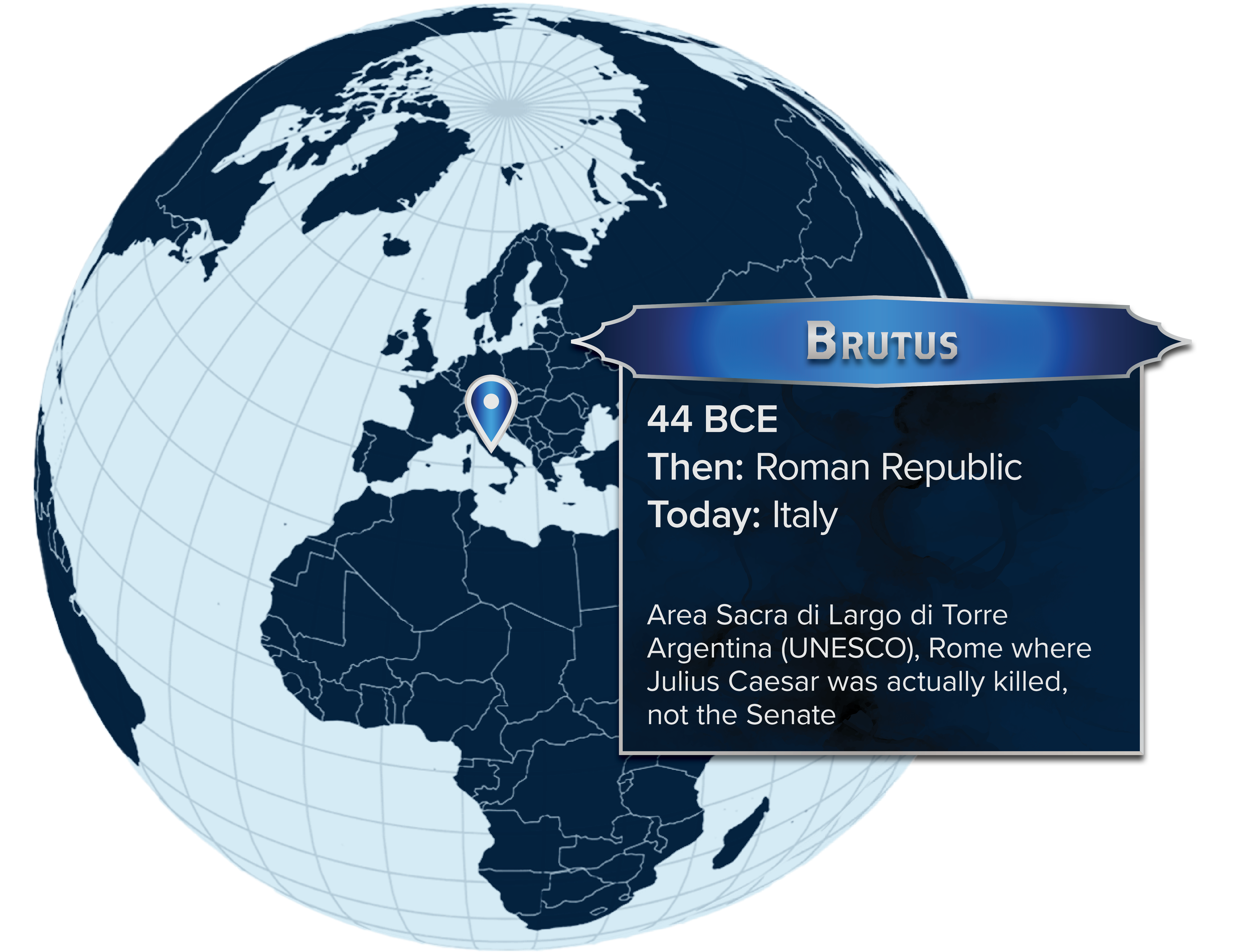
Caesar entered the Curia of Pompey (not the Senate like Shakespeare wrote), one of several named meeting halls. The conspirators surrounded him. Brutus was among the last to stab. According to Suetonius, Caesar’s final words may have been “You too, child?”. The assassination was meant to restore liberty. Instead, it plunged Rome into chaos.
In the aftermath, a fragile settlement granted amnesty to the assassins while upholding Caesar’s acts for two years. But Octavian—Caesar’s adoptive son—soon made himself consul and passed a law retroactively declaring Brutus and the others murderers. This led to a second civil war. Brutus and Cassius raised armies in the east and faced Mark Antony and Octavian at Philippi in October 42 BCE. Though Brutus won the first engagement, Cassius was defeated and took his own life. Brutus lost the second and followed suit, falling on his sword.
Among his final words, according to Plutarch, were: “By all means must we fly, but with our hands, not our feet”. He also reportedly quoted Euripides’ Medea: “O Zeus, do not forget who has caused all these woes”.
Brutus wasn’t just a killer—he was a tragic idealist. He believed in law over loyalty, in principle over power. Plutarch wrote that “Brutus was driven by the noblest motives”—but also that he was “too philosophical for the rough business of politics”.
He didn’t just stab a man. He stabbed a moment in history. And when the dust settled, Rome chose empire over liberty.