Encyclopedia Anachronistica

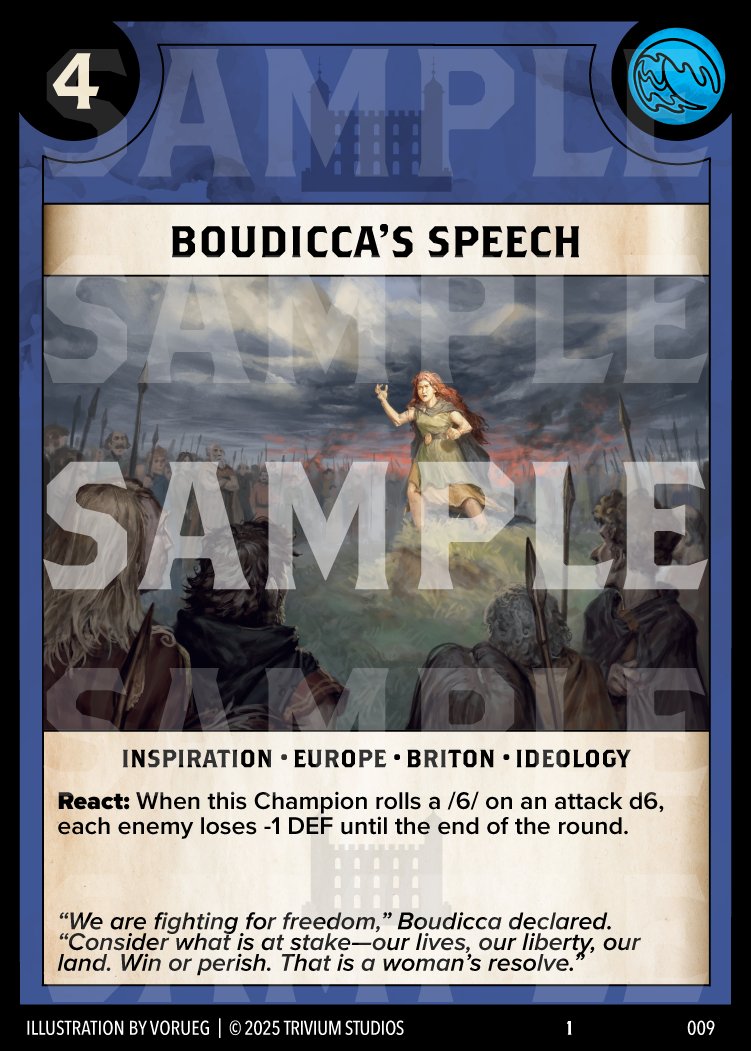
Standard
Inspiration
Europe
Briton
Ideology
React: When this Champion rolls a /6/ on an attack d6, each enemy loses -1 DEF until the end of the round.
"We are fighting for freedom," Boudicca declared. "Consider what is at stake-our lives, our liberty, our land. Win or perish. That is a woman's resolve."
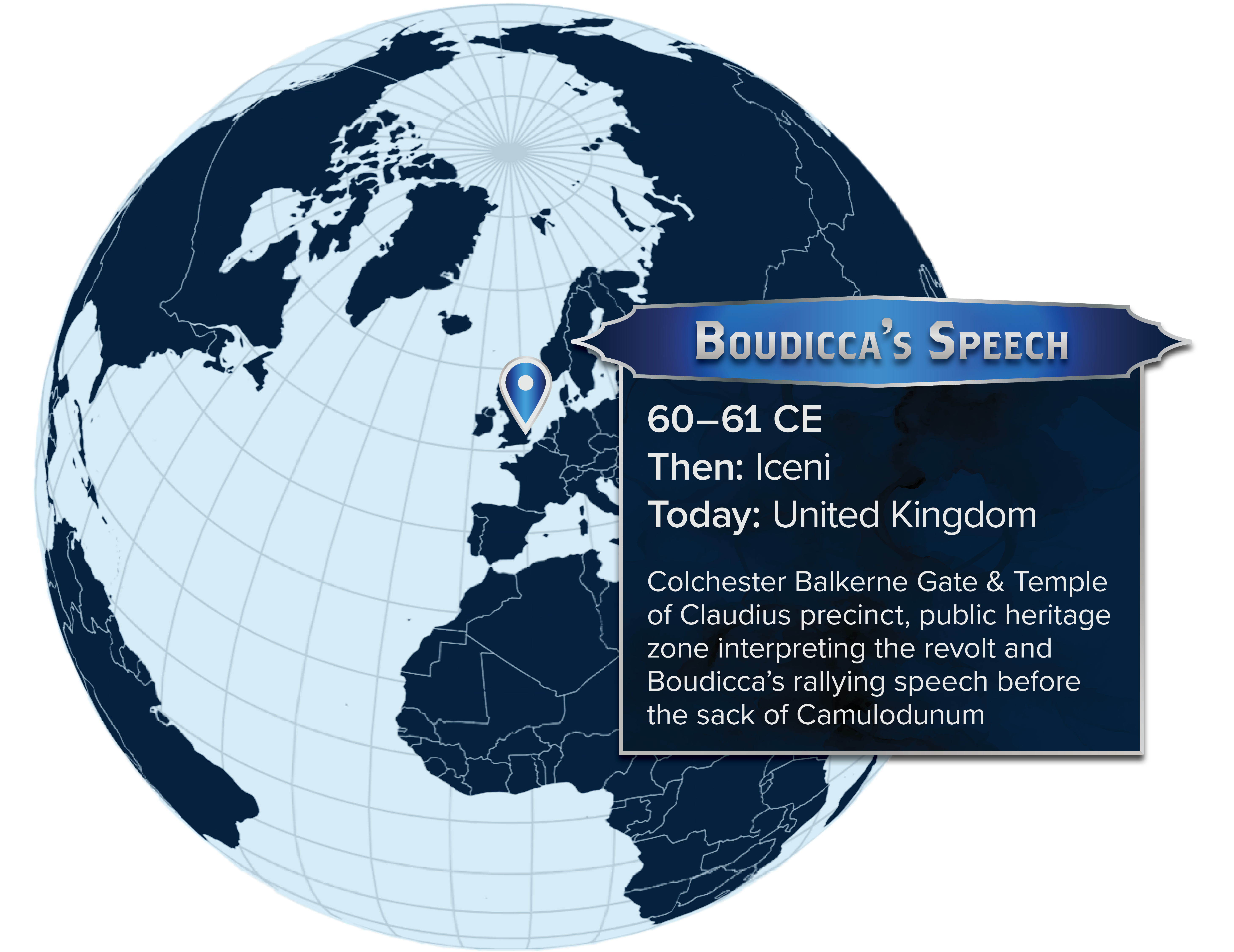
The speech attributed to Boudicca before her revolt is one of the most powerful pieces of rhetoric to survive from Roman Britain — not because we can trust every word, but because it reveals how later generations understood the fury that drove an entire people to war. The versions we have come from Tacitus and Cassius Dio, Roman historians writing decades after the uprising of 60/61 CE. Their accounts differ in tone and detail, but both portray Boudicca as a leader who transformed personal outrage into a national call to arms.
Tacitus gives a concise, sharp-edged speech. He presents Boudicca as a queen who refuses to accept Roman brutality, telling her warriors that she fights “not as a woman of royal lineage, but as one of the people,” and that Rome’s abuses had left Britons with only two choices: victory or death. Tacitus emphasizes justice, vengeance, and the shared suffering of the tribes — themes that would have resonated deeply among the Iceni and Trinovantes, whose lands had been seized and whose leaders had been humiliated.
Cassius Dio, writing in a more theatrical style, gives Boudicca a longer, blistering denunciation of Roman exploitation. In his account, she stands before her assembled warriors and asks:
“Have we not been robbed entirely of most of our possessions, and those the greatest, while for those that remain we pay taxes? … Do we not pay a yearly tribute for our very bodies? How much better it would be to have been sold to masters once for all than, possessing empty titles of freedom, to have to ransom ourselves every year!”
Dio’s Boudicca does not stop there. She condemns Roman greed with a fury that borders on prophetic:
“Among the rest of mankind death frees even those who are in slavery to others; only in the case of the Romans do the very dead remain alive for their profit. … Why should the Romans be expected to display moderation as time goes on, when they have behaved toward us in this fashion at the very outset, when all men show consideration even for the beasts they have newly captured?”
Whether or not Boudicca spoke these exact words, the sentiment behind them is unmistakable. The Iceni had been stripped of their lands, their queen had been flogged, and her daughters assaulted. Roman financiers demanded tribute from people who had nothing left to give. The revolt that followed — the burning of Colchester, London, and St Albans — was fueled by the anger captured in these speeches.
Today, Boudicca’s speech endures because it speaks to universal themes: resistance to injustice, the refusal to accept humiliation, and the power of a single voice to ignite collective action. Through Tacitus and Dio, her words — real or reconstructed — remain one of the most vivid expressions of defiance in the ancient world.