Encyclopedia Anachronistica

Standard
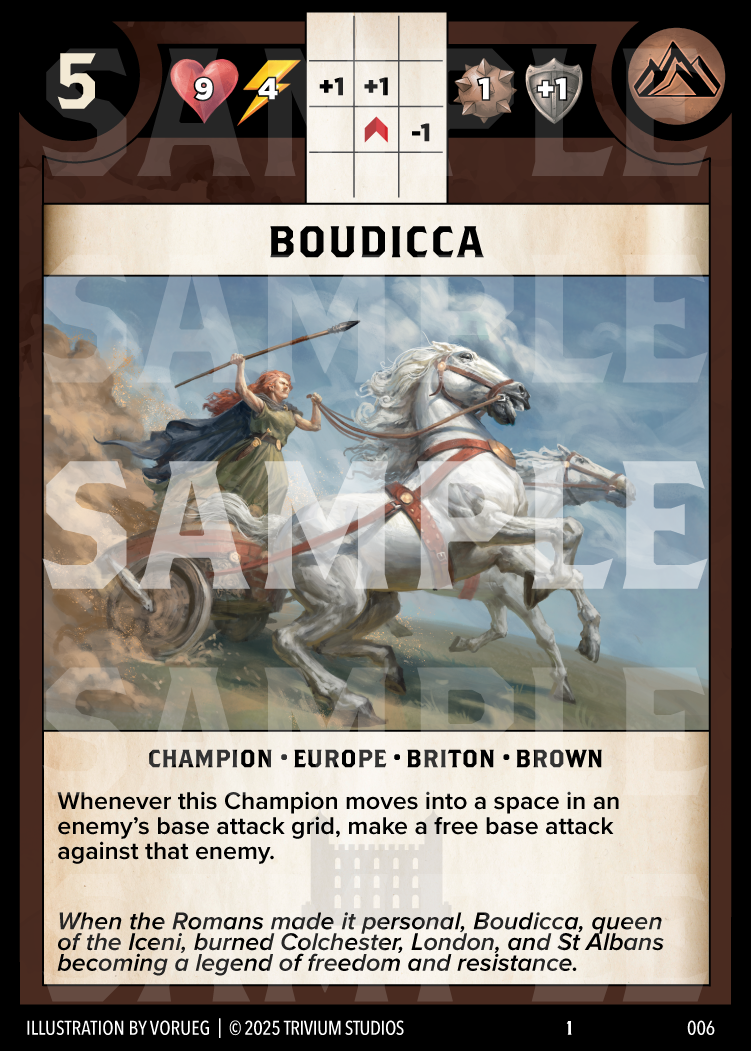
Champion
Europe
Briton
Brown
Whenever this Champion moves into a space in an enemy's base attack grid, make a free base attack against that enemy.
When the Romans made it personal, Boudicca, queen of the Iceni, burned Colchester, London, and St Albans becoming a legend of freedom and resistance.
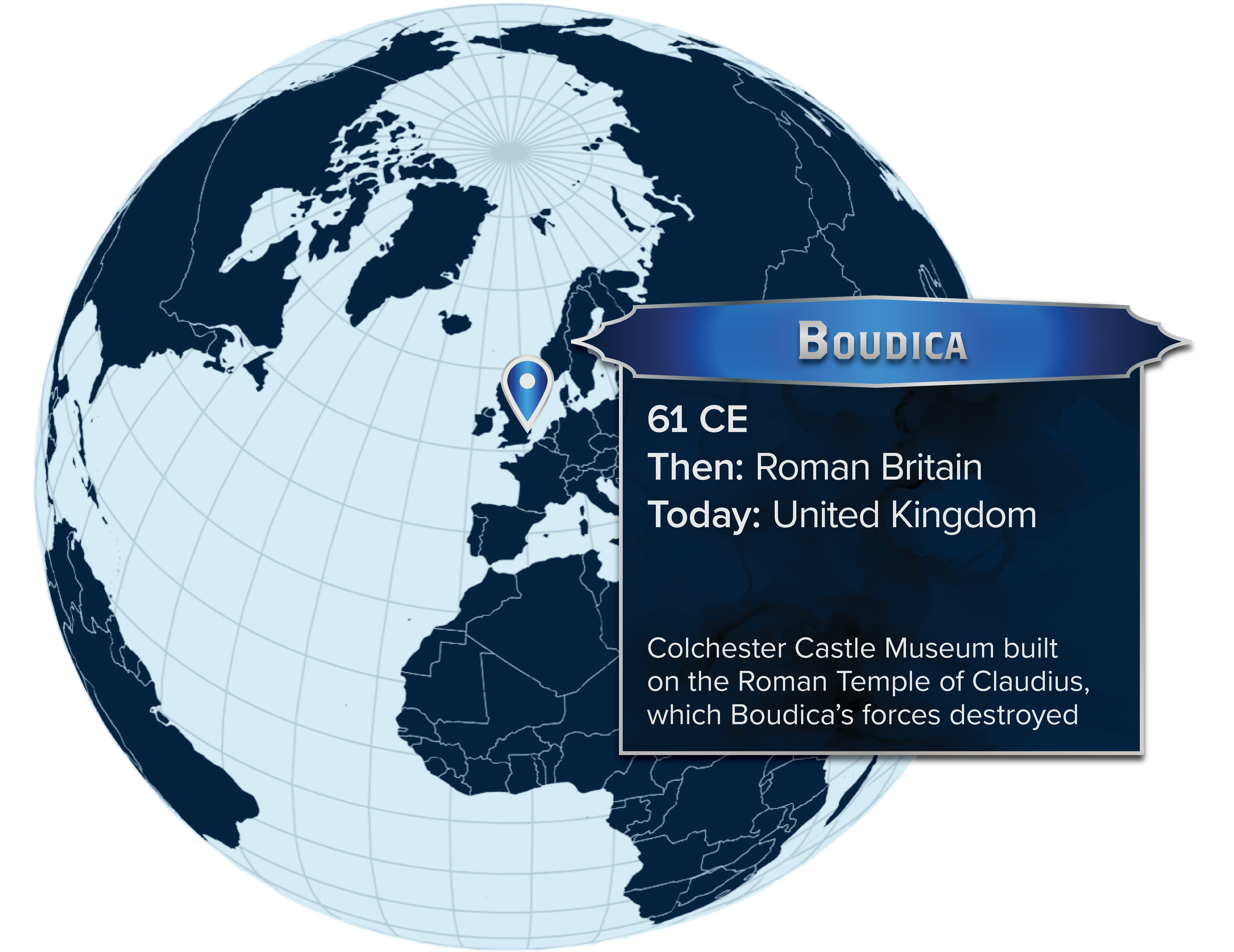
Boudica’s story is a blazing reminder that some people are simply not to be crossed. And the Romans crossed her—hard. She was a fierce mother, a rallying queen, a cunning warrior, a brilliant strategist, and nearly drove Rome out of Britain. Her legend ignites the day her husband, King Prasutagus of the Iceni tribe, died. Though his kingdom was a Roman client state, Prasutagus had arranged for his daughters and Emperor Nero to be joint heirs. Rome trashed the agreement, invaded, looted, enslaved, and lied claiming they were collecting a debt.
When Queen Boudica protested, Roman soldiers stripped her, flogged her publicly, and assaulted her daughters. They thought that would silence her. Instead, it lit the fuse on one of the most explosive uprisings in Roman Britain.
Boudica rallied her tribe and allied with others who’d suffered similar abuse. With Roman governor Suetonius Paulinus campaigning in Wales, she led a rebellion of tens of thousands—possibly over 100,000—against Roman strongholds. First target: Camulodunum (Colchester), a veteran Roman colony. Her forces razed it to the ground. Archaeological layers confirm the destruction: scorched earth, shattered buildings, and mass graves.
Catus Decianus, the Roman procurator, sent a laughable 200 auxiliaries—likely slaves or poorly armed troops. They were wiped out. Catus fled. Boudica then turned her fury on Londinium (London), which was evacuated and burned. Excavations show a thick layer of ash and debris from the firestorm. Next came Verulamium (St Albans), which met the same fate. In total, ancient sources estimate 70,000–80,000 Roman civilians and collaborators were killed.
Before the final battle at Watling Street, Boudica gave a speech that still echoes through history. She called out Roman greed and brutality, urging her warriors to fight for justice, freedom, and vengeance. Her words weren’t just a rallying cry, they were a declaration that tyranny would be met with fury, even if the odds were impossible.
Then came the final showdown. Suetonius returned with around 10,000 Roman troops and chose terrain that protected his flanks and rear. Boudica’s massive force—possibly over 100,000—charged head-on. The Romans held formation, and the Celts were funneled into a slaughter. Roman casualties: around 400. Celtic casualties: up to 80,000. The rebellion was crushed.
Boudica died shortly after—possibly by suicide or illness. Though her revolt failed, her legacy didn’t. She became a symbol of resistance and justice, inspiring generations, including Queen Victoria and Elizabeth I, who saw her as a national icon.