Encyclopedia Anachronistica


Standard
Champion
Middle East
Persian
Red
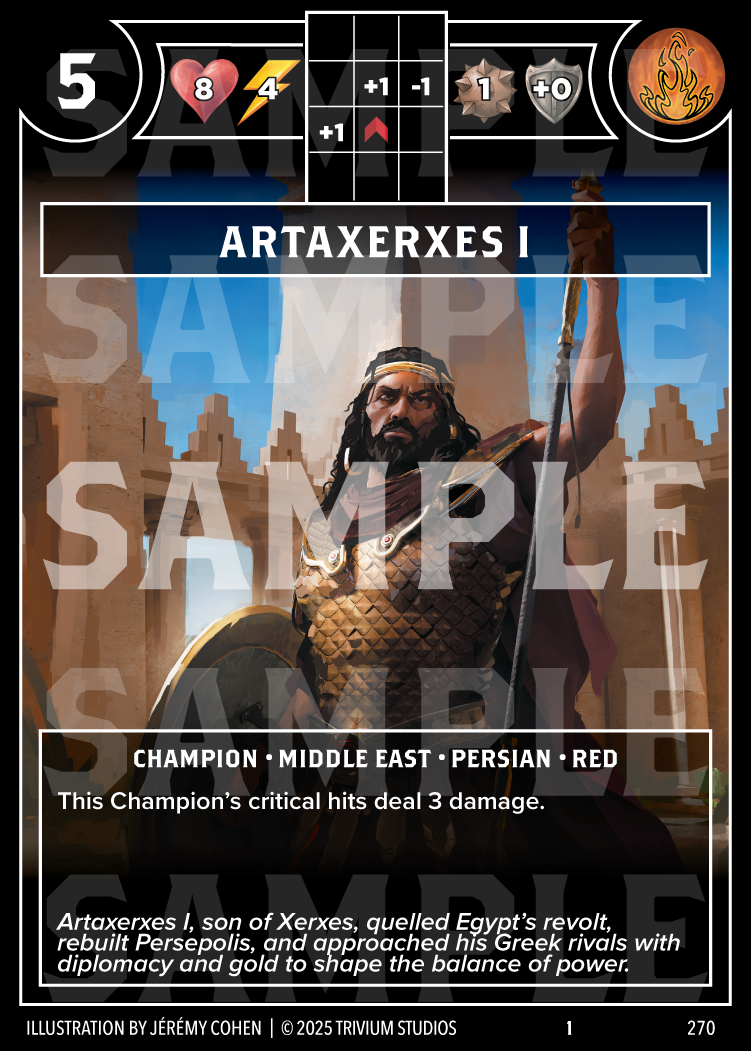
This Champion's critical hits deal 3 damage.
Artaxerxes I, son of Xerxes, quelled Egypt's revolt, rebuilt Persepolis, and approached his Greek rivals with diplomacy and gold to shape the balance of power.

He wasn’t supposed to be king. He wasn’t even the eldest son. But when Xerxes I was murdered in 465 BCE, palace intrigue cleared the way for Artaxerxes to seize the throne. Known to the Greeks as Macrocheir and to the Romans as Longimanus—“the Long-Handed”—he ruled the Achaemenid Empire for over forty years, steering it through rebellion, diplomacy, and cultural renewal.
Artaxerxes was the son of Xerxes I and Queen Amestris, grandson of Darius the Great. His rise was bloody. Xerxes was assassinated by Artabanus, commander of the royal guard, who then tried to manipulate the succession. Accounts differ, but Artaxerxes eventually killed Artabanus in single combat or execution, securing his throne in a blaze of palace violence.
His reign was marked by challenges. Early on, his brother revolted in Bactria. More dangerous was the rebellion in Egypt led by Inaros II, who allied with Athens. For nearly six years, Persian forces fought to reclaim the Nile. In 454 BCE, his general Megabyzus crushed the revolt, capturing Inaros and restoring Egypt to Persian control. It was a brutal reminder that the empire’s far-flung provinces were always restless.
Against Greece, Artaxerxes preferred gold to spears. Rather than risk another Marathon massacre or Salamis slaughter, he funded Sparta to weaken Athens, exploiting Greek rivalries. This strategy helped fuel the Peloponnesian Wars, bleeding the city-states dry while Persia watched from the sidelines. By 449 BCE, the so‑called Peace of Callias ended open hostilities, though historians debate whether a formal treaty ever existed.
Artaxerxes also played host to exiles. When the Athenian general Themistocles—hero of Salamis—was ostracized, he fled to Persia. Artaxerxes welcomed him, granting him estates and wealth. It was a symbolic victory: the man who once saved Greece from Persia now lived on Persian bread and wine.
At home, Artaxerxes left his mark on stone. He completed the Hall of 100 Columns at Persepolis, one of the largest hypostyle halls in the world. He rebuilt the palace of Darius at Susa after a devastating fire. He favored Susa as his capital, filling it with temples and monuments. His tomb still stands at Naqsh‑e Rustam, carved into the cliff face beside his ancestors.
Artaxerxes is also remembered in Jewish tradition. The biblical books of Ezra and Nehemiah describe him as a benefactor who allowed the Jews to return to Jerusalem, rebuild the temple, and restore Mosaic law. Greek historians described him as gentle and thoughtful, more inclined to diplomacy than conquest.
He wasn’t a conqueror like Cyrus. He wasn’t a builder like Darius. He was a survivor—holding the empire together with patience, coin, and cunning. He didn’t just fight wars. He bought peace. He didn’t just inherit an empire. He kept it alive.