Encyclopedia Anachronistica


Standard
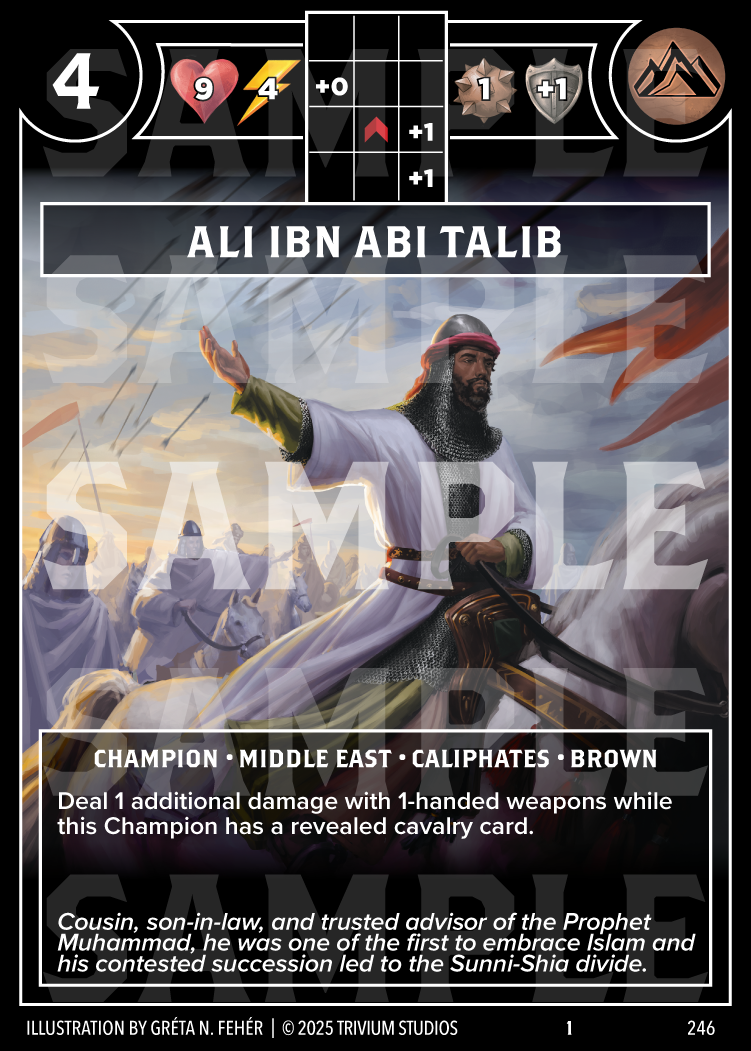
Champion
Middle East
Caliphates
Brown
Deal 1 additional damage with 1-handed weapons while this Champion has a revealed cavalry card.
Cousin, son-in-law, and trusted advisor of the Prophet Muhammad, he was one of the first to embrace Islam and his contested succession led to the Sunni-Shia divide.
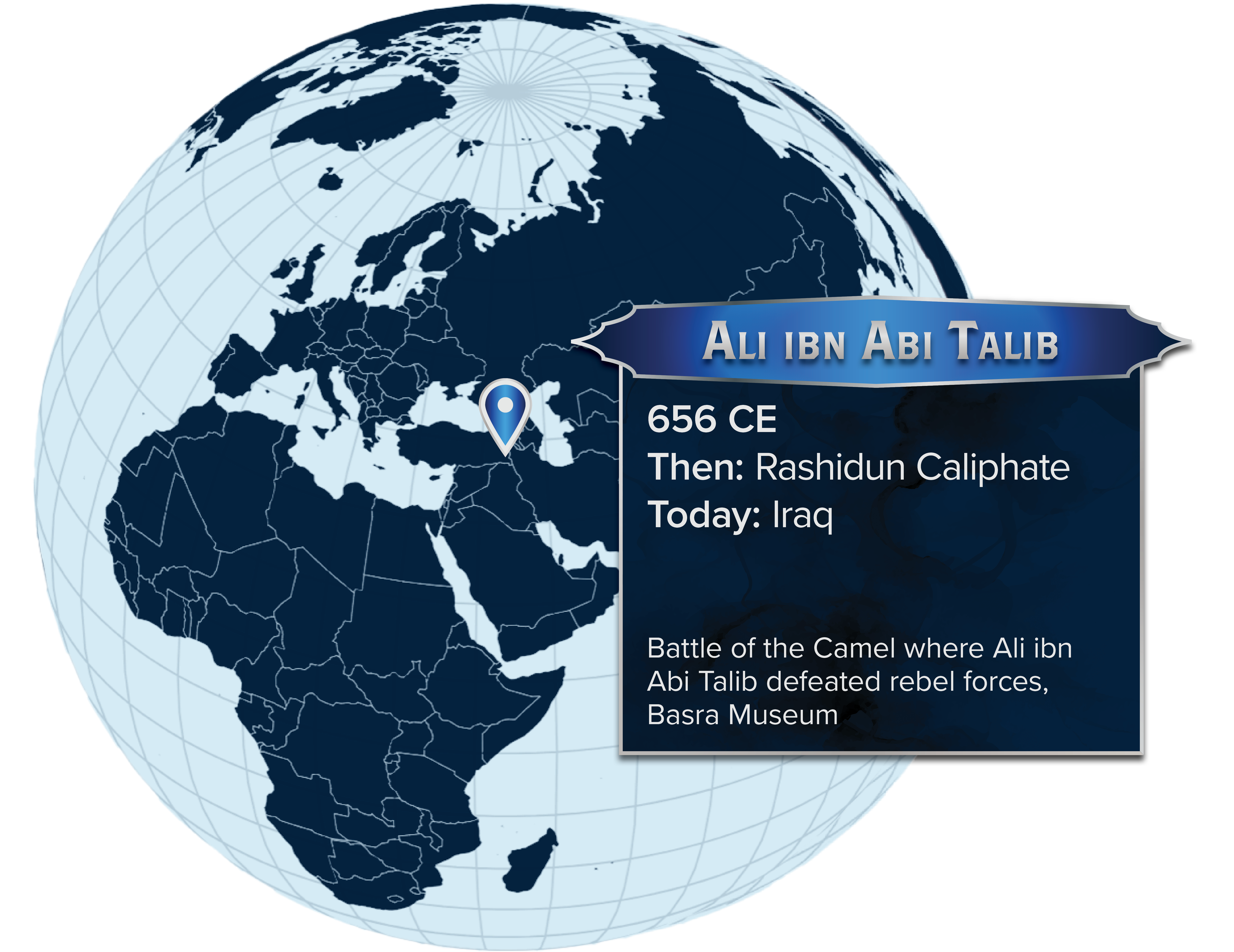
He is the “Lion of God,” the “Prince of the Faithful,” the “Father of Dust,” the fourth Caliph of Islam—Ali ibn Abi Talib, cousin and son-in-law of the Prophet Muhammad. Ali was chivalrous, wise, powerful, and valiant, a man whose courage in battle and devotion to justice made him one of the most revered figures in Islamic history.
Raised in Muhammad’s household, Ali was among the very first converts to Islam—some traditions say the second person after Khadijah. He married Muhammad’s daughter Fatimah and became one of the Prophet’s closest companions, serving as envoy, deputy, and defender of the faith.
Ali’s fame rests heavily on his battlefield exploits. Wielding the legendary bifurcated sword Zulfiqar, he fought in nearly every major battle of the early Muslim community. At the Battle of Badr (624), he distinguished himself in single combat. At Uhud (625), when Muhammad was wounded, Ali is said to have shielded him and fought off attackers. His reputation as a fearless warrior and protector of the Prophet only grew.
At Khaybar (628), during the siege of a Jewish stronghold, tradition holds that Ali tore the gate from its hinges and used it as a shield, leading the Muslims to victory. Stories of his strength and valor became legendary, and Zulfiqar itself became a symbol of justice and divine favor.
Ali’s life was not only about war. He worked to establish justice, fight corruption, and promote peace. His sermons and sayings, later collected in works like the Nahj al-Balagha, emphasize humility, wisdom, and fairness. Yet when diplomacy failed, Ali was ready to fight. At Nahrawan (658), he crushed the Kharijites, a radical faction that had turned violently against the Muslim community.
And if you think Ali’s legend stopped at the edge of the battlefield, think again. His words cut as deep as his sword. The same man who could split helmets with Zulfiqar could also split falsehood with a single line of wisdom. He was the warrior-scholar who told his followers that “the most complete gift of God is a life based on knowledge,” then turned around and rode into combat like a thunderclap. To his enemies, he was a nightmare in steel; to his people, he was a shield of justice. Ali didn’t just fight wars—he defined what it meant to fight for truth itself. That’s why centuries later, his name still makes zealots tremble, poets sing, and warriors wish they had half his fire.
As caliph (656–661), Ali faced immense challenges: civil war, rebellion, and the first great schism in Islam. Despite his desire for peace and righteousness, his reign was marked by conflict, culminating in his assassination in Kufa in 661 by a Kharijite. Revered by Sunnis as the fourth “Rightly Guided Caliph” and by Shia as the first Imam, Ali remains a towering figure of courage, justice, and faith.