Encyclopedia Anachronistica

Standard
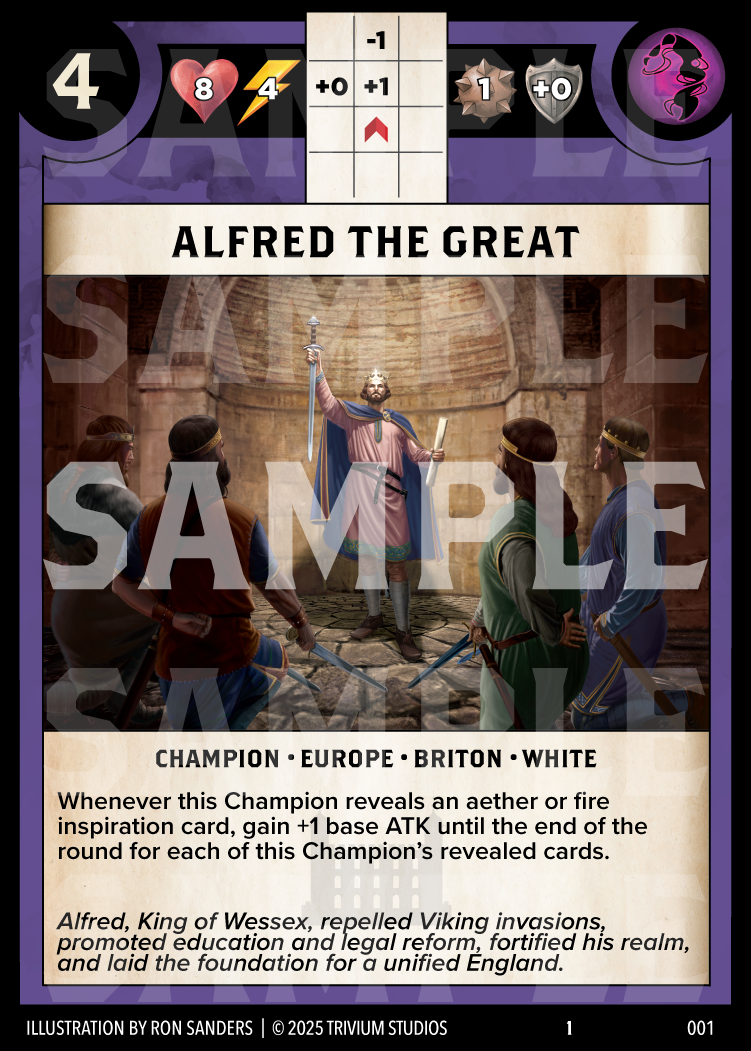
Champion
Europe
Briton
White
Whenever this Champion reveals an aether or fire inspiration card, gain +1 base ATK until the end of the round for each of this Champion's revealed cards.
Alfred, King of Wessex, repelled Viking invasions, promoted education and legal reform, fortified his realm, and laid the foundation for a unified England.
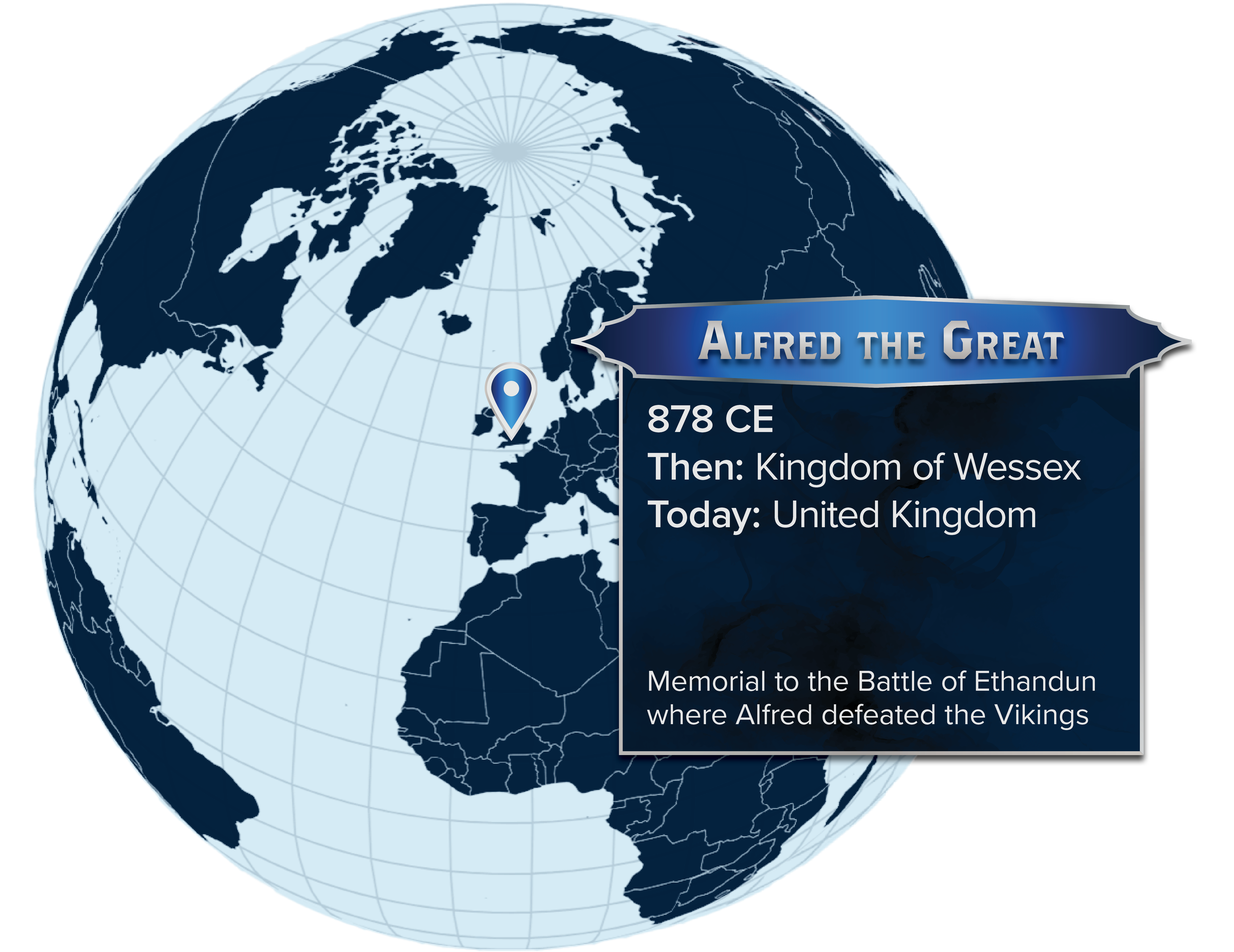
Alfred the Great. It’s one thing for a king to slap “Great” on their own name. It’s another when historians centuries later look back and say, “Yeah, that guy earned it.” Alfred I didn’t just rule—he reshaped the blueprint for monarchy, warfare, education, and national identity. He laid the groundwork for England to become the first country ever labeled a superpower, stitching together fractured kingdoms into something that could punch back. His son Aethelstan would ride that momentum to become the first official King of England.
Born into a world where Viking raids were the daily special, Alfred had to wait his turn behind two older brothers before becoming King of Wessex. Once crowned, he went full war-mode, smashing Guthrum’s Viking army at the Battle of Edington in 878, then forced the survivors to convert to Christianity just so he could get a moment of peace to start rebuilding England.
Alfred believed kingship was a divine responsibility—especially to the common folk. Break your oath, lose your land. That kind of accountability made it hard for lords to abuse power. Then he got to work: founded public schools, taught kids English, personally translated Latin texts into the vernacular, hired scholars to keep the knowledge flowing, and reformed the military from the ground up. He didn’t just build a navy—he leveled it up to god-mode, designing ships to shred Viking longboats before they could even land.
He laid down just laws, built a culture of literacy and respect, and forged a shared identity that made England a nightmare to invade. The Vikings kept trying for another 170 years, but Alfred’s reforms were the beginning of their end. He took London back from Viking control, unified the English states, and built a network of 33 burhs—fortified towns spaced so that help could arrive from any other burh within a single day. Roads were maintained by the army, making hit-and-run raids obsolete. The burhs weren’t just defense—they were civilization incubators.
Alfred’s military genius wasn’t just about brute force—it was about systematized resilience. He turned Wessex into a fortress, with every town a node in a defensive web. His reforms meant that even when Viking armies landed, they couldn’t break through. They were blocked, beaten, and besieged until they gave up. By the end of his reign, Viking incursions were failing not because of luck, but because Alfred had made England unbreakable.
Today, Alfred is remembered as the founder of the future British Empire, a champion of the people, and one of only two English monarchs to earn the title “Great.” He didn’t just rule—this scholar-king built the foundation for a thousand years of defiance, identity, and empire.