Encyclopedia Anachronistica

Standard
Armor
Europe
Briton
Jewelry
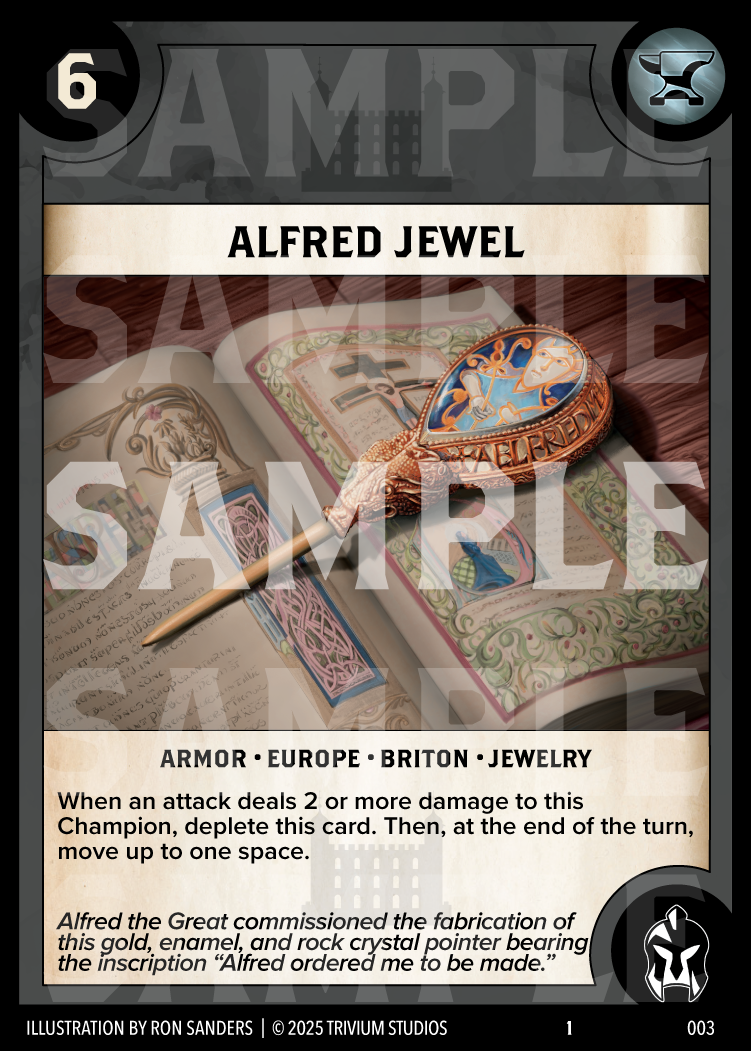
When an attack deals 2 or more damage to this Champion, deplete this card. Then, at the end of the turn, move up to one space.
Alfred the Great commissioned the fabrication of this gold, enamel, and rock crystal pointer bearing the inscription "Alfred ordered me to be made."
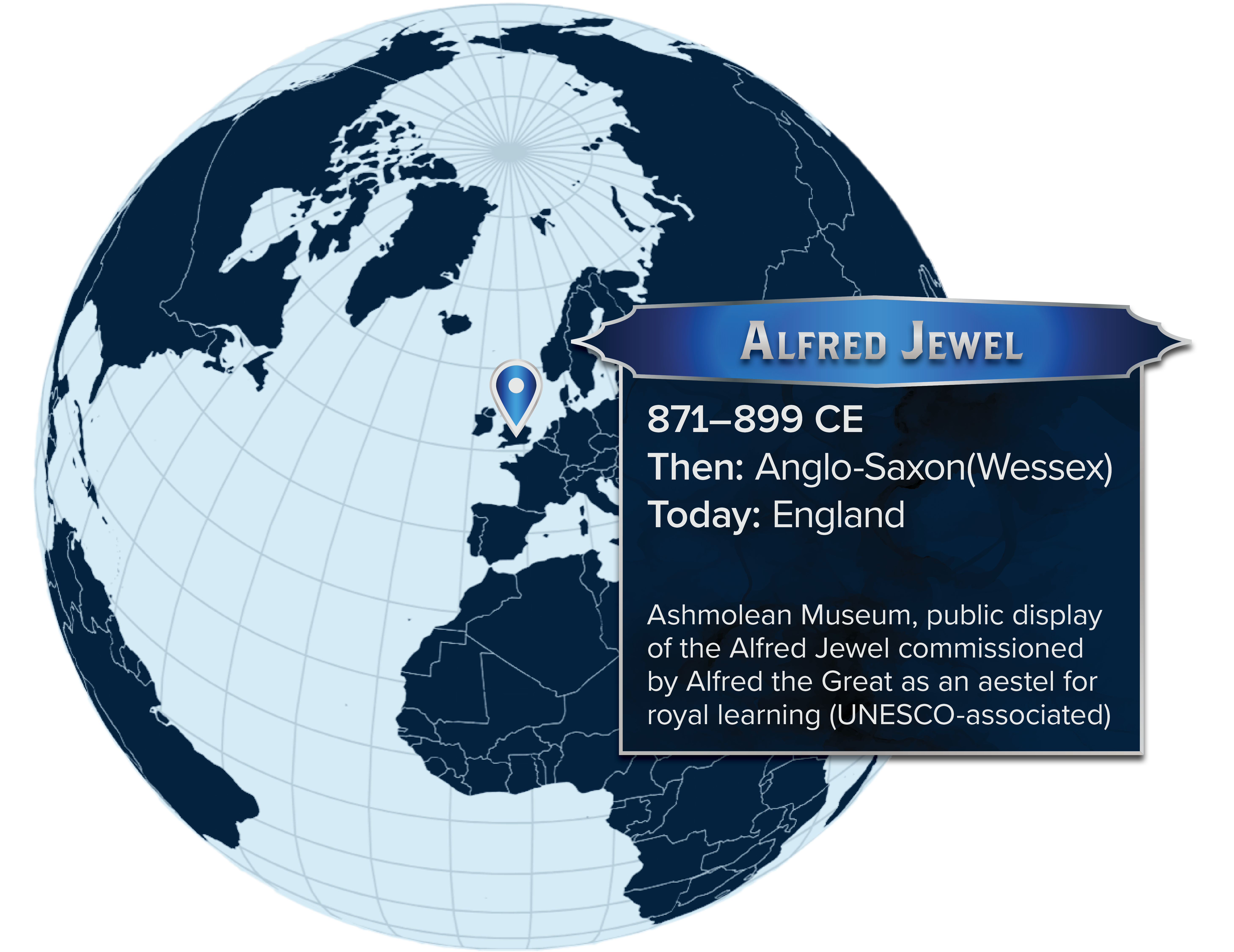
The Alfred Jewel is one of the most electrifying artifacts to survive from early medieval England — a golden, fire-bright declaration of royal ambition from a king who refused to let his kingdom die. Discovered in 1693 at North Petherton in Somerset, the jewel is a masterpiece of late ninth-century craftsmanship: a teardrop-shaped gold frame, a rock-crystal lens, and beneath it a vividly enameled figure whose gaze still feels startlingly alive. Around the rim runs a command in Old English: “ÆLFRED MEC HEHT GEWYRCAN” — Alfred ordered me made. Few artifacts speak in the first person; fewer still speak with the authority of a king.
The jewel’s construction is as impressive as its inscription. The front is dominated by a polished rock crystal, carved into a convex lens that magnifies the enamel beneath. The figure — long interpreted as Christ, or alternatively as the personification of Sight or Wisdom — stands against a field of deep blue and green, rendered in the brilliant colors of late Anglo-Saxon cloisonné enamel. The gold frame is edged with filigree and terminates in a hollow socket shaped like a beast’s head, its jaws open to grip a missing shaft of wood or bone. This socket is the key to the jewel’s function: it was almost certainly the terminal of a reading pointer, a tool used to follow lines of text.
This interpretation aligns with Alfred the Great’s sweeping educational reforms. In the late ninth century, after years of war with Viking armies, Alfred lamented the decline of learning in England and launched a program to translate essential Latin texts into Old English. He sent copies of these works to bishops across his realm, and some scholars argue that the Alfred Jewel may have accompanied one of these books as a royal gift — a literal instrument of literacy from a king determined to rebuild intellectual life in Wessex.
The jewel’s artistry also reflects the cultural crossroads of Alfred’s reign. Its enamel technique shows Continental influence, while the beast-head terminal echoes Scandinavian and Insular metalwork. This fusion mirrors the world Alfred fought to shape: a kingdom battered by Viking incursions yet capable of producing objects of extraordinary refinement.
Today, the Alfred Jewel resides in the Ashmolean Museum, where it remains one of the most iconic objects from Anglo-Saxon England. Its inscription still speaks across eleven centuries — not as a relic of a vanished world, but as a reminder of a king who believed that learning itself was a weapon worth forging.