Encyclopedia Anachronistica

Standard
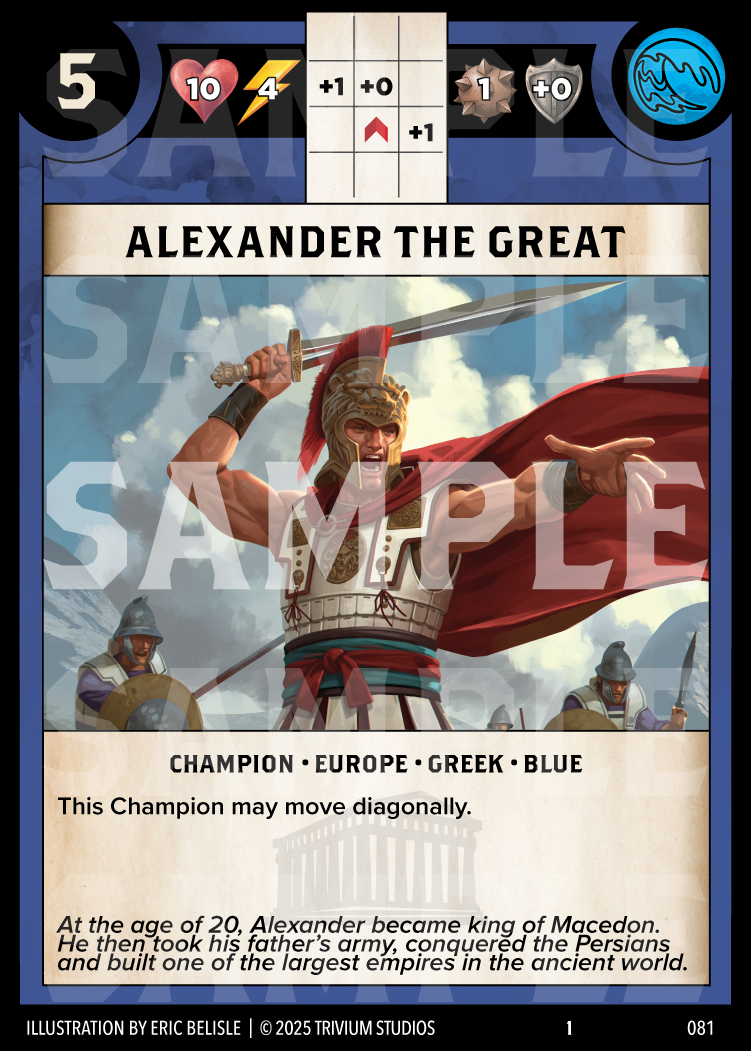
Champion
Europe
Greek
Blue
This Champion may move diagonally.
At the age of 20, Alexander became king of Macedon. He then took his father's army, conquered the Persians and built one of the largest empires in the ancient world.
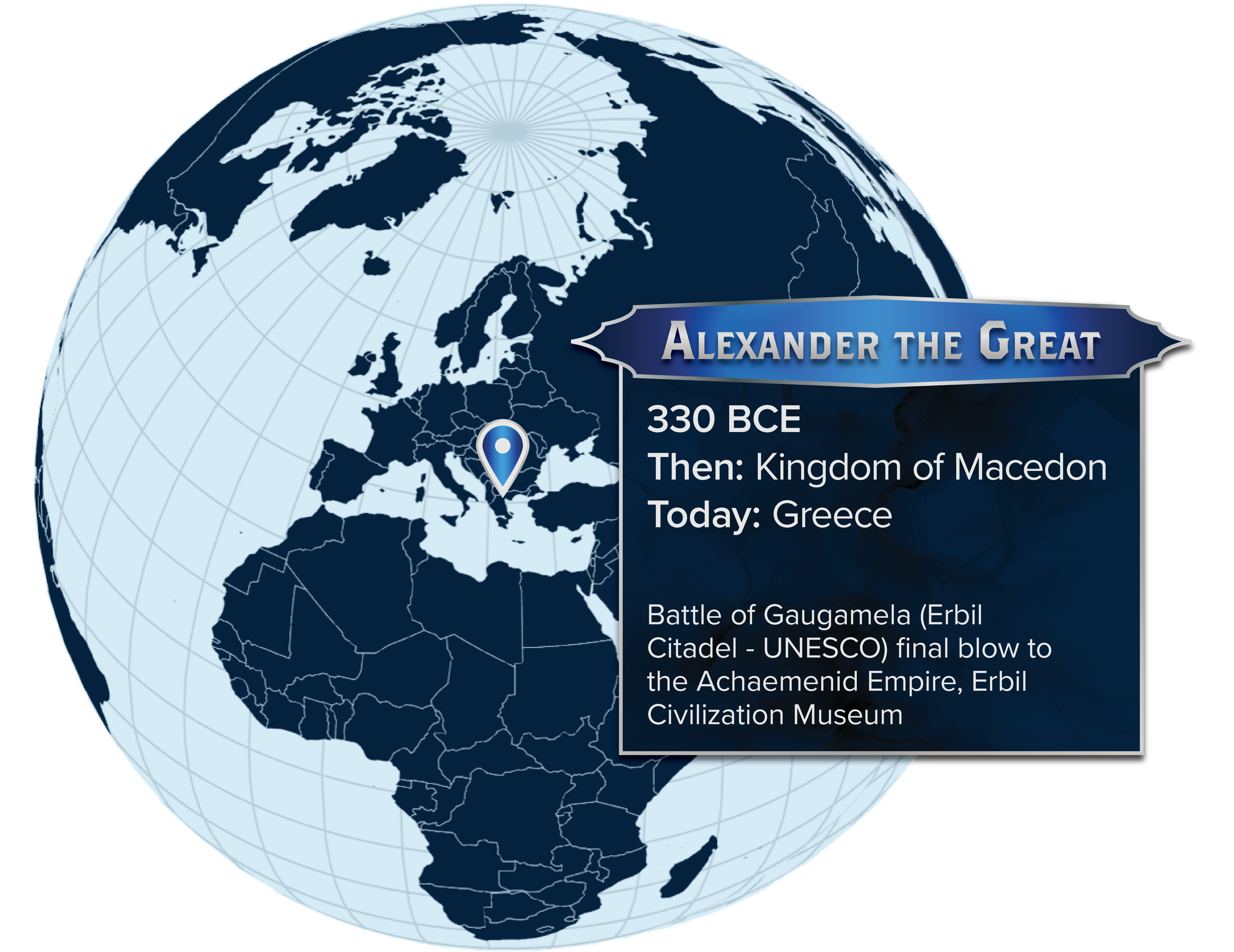
Born to Philip II of Macedon, Alexander claimed divine lineage through Zeus Ammon, a title conferred after visiting the Oracle at Siwa in Egypt. He allegedly sliced through the Gordian Knot, was declared “invincible” by the Oracle of Delphi (after forcing a prophecy), and famously tamed the wild stallion Bucephalus at age 12. Even his horse became a legend.
Bucephalus wasn’t just a horse—he was a living symbol of Alexander’s destiny. The animal was deemed untamable, lashing out at every handler and terrifying the Macedonian court. But young Alexander noticed the horse was afraid of its own shadow. He turned Bucephalus toward the sun, calmed him, and mounted him with ease. Bucephalus would ride into every major battle alongside his master, surviving wounds and chaos, and earning a city named in his honor—Bucephala—after his death in India.
Tutored by Aristotle, Alexander ascended the throne at 20 after Philip’s assassination. He swiftly consolidated power—executing a cousin, two princes, and a general, while his mother Olympias eliminated rivals with ruthless efficiency. Facing rebellion from Thracian tribes, Thessaly, and defiant Greek city-states like Athens and Thebes, Alexander led 3,000 Macedonian cavalry, flipped Thessaly’s allegiance, and razed Thebes to the ground. Athens chose survival and saluted the new king.
Alexander didn’t just inherit a throne—he inherited a war machine. Philip II had revolutionized the Macedonian army, introducing the sarissa: a 13–18 foot (4.0–5.5 meters) spear wielded by tightly packed phalanxes. These formations were nearly impenetrable from the front, and Alexander mastered their use, combining them with elite cavalry charges and siege tactics. At Granicus, Issus, and Gaugamela, his smaller forces outmaneuvered and overwhelmed Persian armies many times their size.
Then came the world tour. Alexander hurled a spear into Asian soil, claiming the continent as a divine gift. He unleashed his phalanxes and heavy cavalry against Darius III of Persia, winning decisive victories at Granicus, Issus, and Gaugamela. At Tyre, he built a causeway to reach the island city, besieged it for seven months, and after its fall, executed thousands and enslaved tens of thousands. That causeway? Still part of the landscape today.
He pressed eastward through Bactria and into India, defeating King Porus and his war elephants at the Battle of the Hydaspes. Though wounded multiple times—pierced by arrows, slashed by swords, even struck by a catapult projectile—Alexander kept fighting. He wasn’t a beast. He was a juggernaut.
By age 32, he had founded over 20 cities (including Alexandria), spread Greek culture across three continents, and laid the groundwork for the Hellenistic world and the rise of Rome. His empire didn’t last—but his legend never died.