Encyclopedia Anachronistica


Alt Art
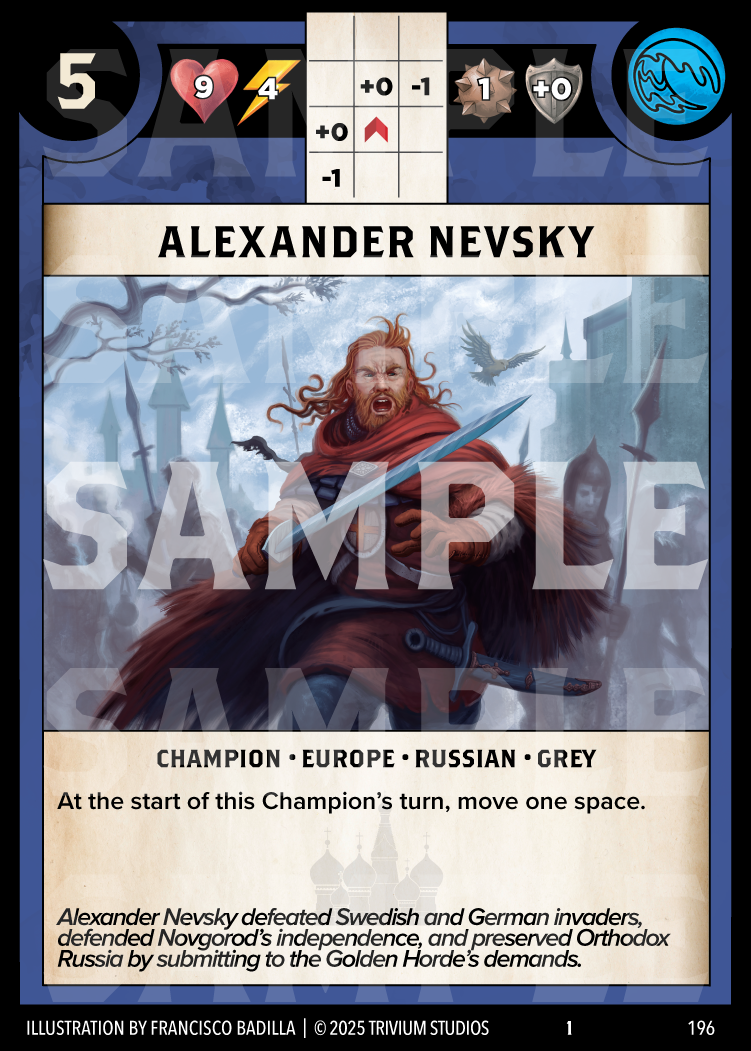
Champion
Europe
Russian
Grey
At the start of this Champion's turn, move one space.
Alexander Nevsky defeated Swedish and German invaders, defended Novgorod's independence, and preserved Orthodox Russia by submitting to the Golden Horde's demands.
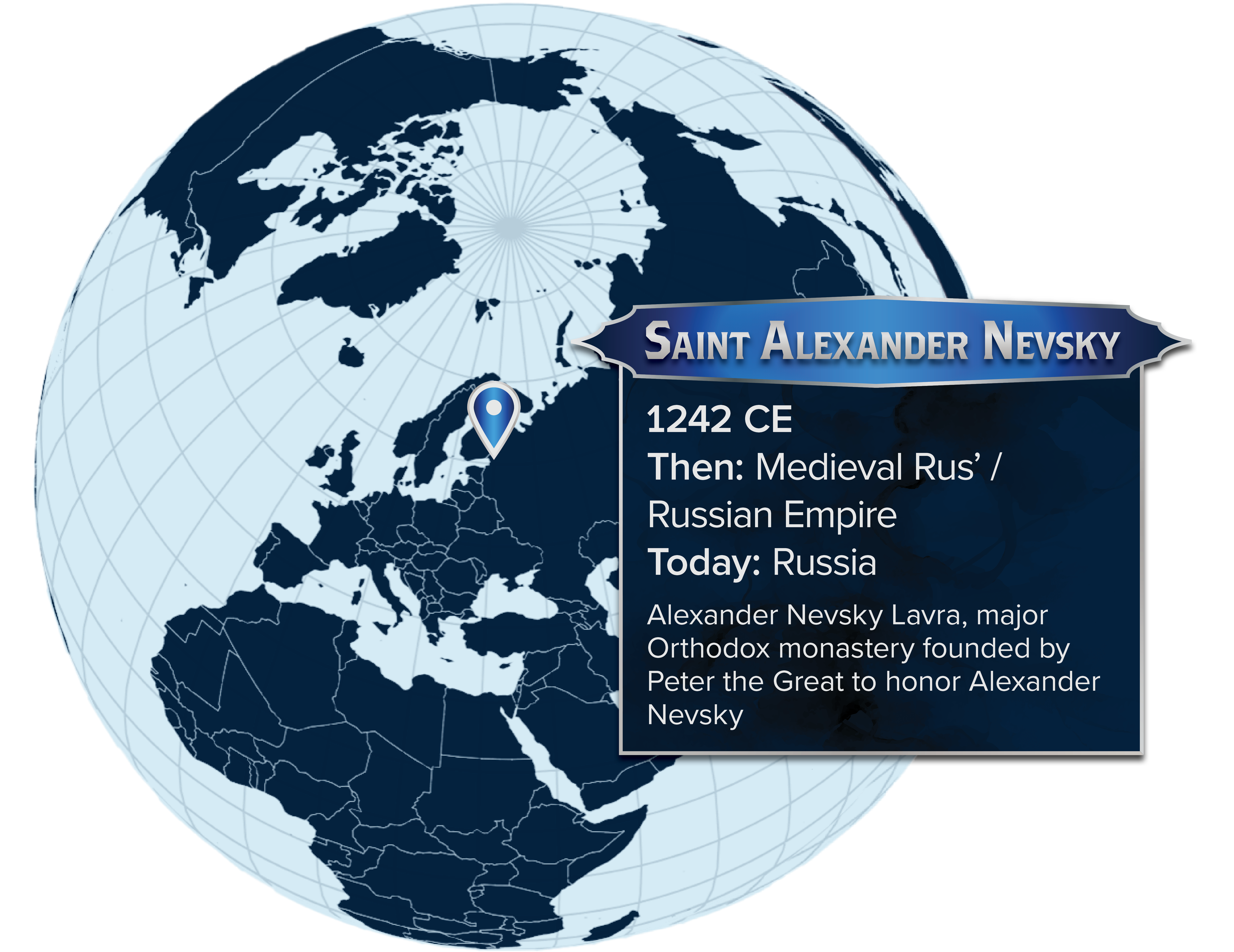
This guy’s exploits inspired George Lucas, crushed Papal dreams, and got him ranked as the number one hero of Russian history. Saint Alexander Nevsky, said to have a voice like a trumpet and stature that towered over his men, was an ancestor of the Tsars, put Russia on the map, and saved it multiple times from annihilation. He married a princess, negotiated with the Golden Horde, and fought in brutal close combat that became the stuff of legend.
As a teenager, Alexander likely witnessed the devastation of Mongol raids, including the sack of Vladimir in 1238, which showed firsthand the terror of the Khan’s armies. Against this eastern threat, he rose as Prince of Novgorod and quickly proved himself in battle.
At just 22, Alexander faced the Swedes at the Battle of the Neva (1240). According to Russian chronicles, Swedish commander Birger Jarl landed an army and sent a challenge: “Fight against me, if you dare: I already stand on your land.” Alexander didn’t wait for reinforcements. With a small force he had quickly thrown together, he struck the Swedes by surprise, routing them. Chronicles claim Alexander himself wounded Birger in the face with a spear. His victory earned him the name Nevsky—“of the Neva.”
Two years later came his most famous battle. The Pope had sanctioned crusading orders to bring Orthodox Rus’ into the Catholic fold, and the Teutonic Knights advanced into Novgorod’s lands. Alexander met them on the frozen Lake Peipus in 1242. The heavily armored knights, charging across ice, were slowed and vulnerable. Russian infantry and archers drew them in, then counterattacked. The battle became legendary as the “Battle on the Ice,” remembered for the image of knights sinking into the lake under their own weight and the rest from being bested by Nevsky’s leadership and tactics. The victory halted Catholic expansion eastward and cemented Nevsky’s reputation as defender of Rus’.
Later, Alexander turned back to the Mongols. Realizing his armies could not defeat them, he chose diplomacy. He traveled to the Horde, secured recognition as Grand Prince, and negotiated terms: Rus’ would pay tribute but retain its Orthodox faith and avoid conscription into Mongol armies. This pragmatic policy preserved Russian culture and autonomy under foreign domination.
Canonized as a saint in the Russian Orthodox Church, Alexander Nevsky became a symbol of national survival. To this day, one of Russia’s highest honors is the Order of Alexander Nevsky.