Encyclopedia Anachronistica

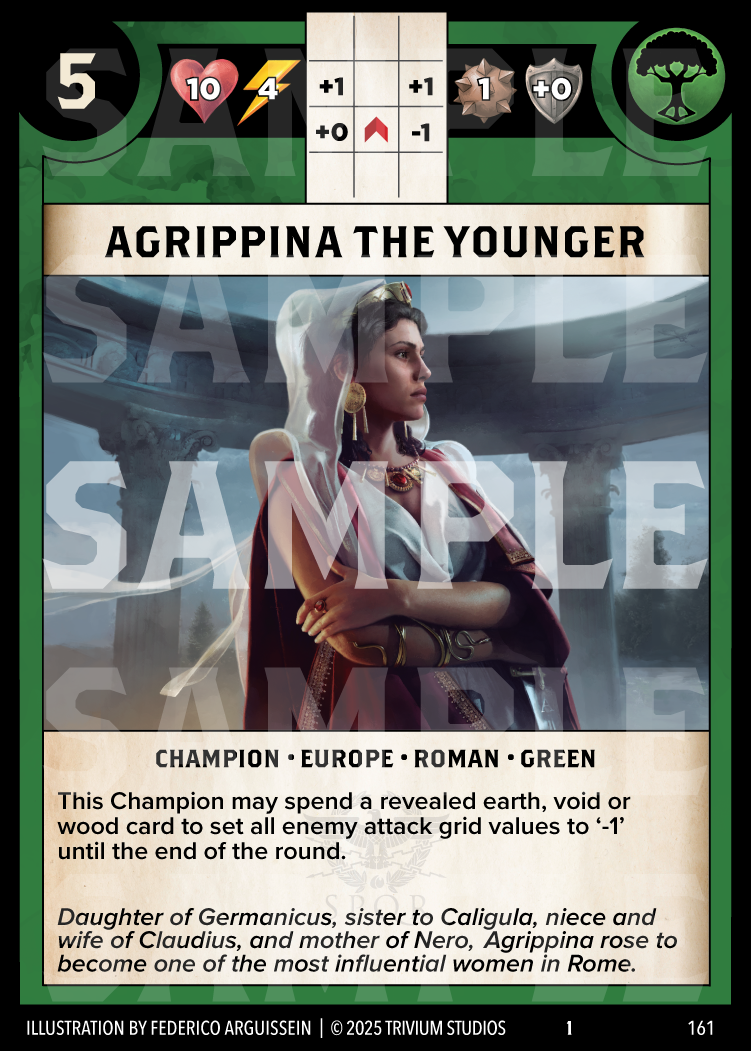
Standard
Champion
Europe
Roman
Green
This Champion may spend a revealed earth, void or wood card to set all enemy attack grid values to '-1' until the end of the round.
Daughter of Germanicus, sister to Caligula, niece and wife of Claudius, and mother of Nero, Agrippina rose to become one of the most influential women in Rome.
Before she became a cautionary tale, Agrippina the Younger was one of the most powerful women in Roman history. Born in 15 CE to Germanicus and Agrippina the Elder, she was the great-granddaughter of Augustus Caesar and raised in a dynasty built on ambition, bloodlines, and betrayal. Her brother was Caligula. Her son was Nero. Her legacy? Ruthless, regal, and unforgettable.
Agrippina grew up in the shadow of imperial politics. Her father, a beloved general, died under suspicious circumstances. Her mother and brothers were exiled and killed. She survived by staying quiet—until she didn’t. In 37 CE, Caligula became emperor and showered his sisters with honors. Coins bore their faces. Oaths invoked their names. Rumors swirled of inappropriate behavior and conspiracy. Then came the Plot of the Three Daggers. Agrippina, her sister Livilla, and Caligula’s brother-in-law Lepidus were accused of plotting to kill the emperor. Caligula produced incriminating letters, denounced them as adulteresses, and exiled the women. Their wealth was confiscated. Their reputations shattered.
When Caligula was assassinated in 41 CE, his uncle Claudius took the throne. Agrippina returned from exile. In 49 CE, she married Claudius—her own uncle—and became Empress. She was only the third Roman woman to receive the title, Augusta. From there, she moved fast. She eliminated rivals, secured her son Nero’s adoption, and orchestrated the downfall of Claudius’ biological son Britannicus.
Then came the mushrooms. In 54 CE, Claudius died after eating a suspicious plate of fungi. Ancient sources, including Tacitus and Suetonius, suggest Agrippina poisoned him—possibly with a slow-acting toxin that took days to kill. With Claudius gone, Nero ascended. Agrippina had engineered the succession. She ruled through her son, appearing beside him in public, issuing orders, and even signing imperial documents.
But Nero grew tired of her dominance. He removed her from the palace, stripped her of power, and plotted her death. After failed attempts to sink her boat and poison her, he sent assassins. In 59 CE, Agrippina was murdered—stabbed in her villa on Nero’s orders.
Physically, Agrippina was described as beautiful and commanding. Pliny the Elder noted she had a double canine in her upper jaw—a sign of fortune. Politically, she was a force of nature. Ancient and modern historians alike describe her as ambitious, violent, and calculating. She didn’t just survive Rome’s blood-soaked dynasties—she bent them to her will.
She didn’t just marry an emperor. She made one. She didn’t just play the game. She rewrote the rules. And when the empire turned on her, Agrippina met her end with the same steel she used to shape it.