Encyclopedia Anachronistica

Standard
Weapon
Europe
Briton
Sword
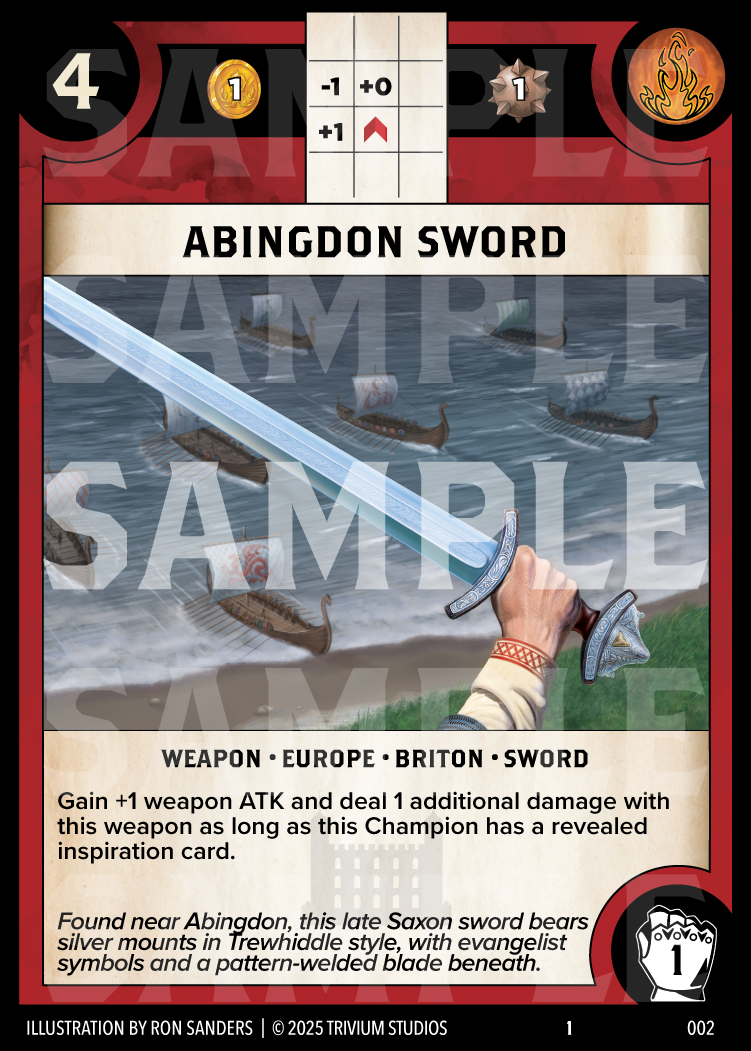
Gain +1 weapon ATK and deal 1 additional damage with this weapon as long as this Champion has a revealed inspiration card.
Found near Abingdon, this late Saxon sword bears silver mounts in Trewhiddle style, with evangelist symbols and a pattern-welded blade beneath.
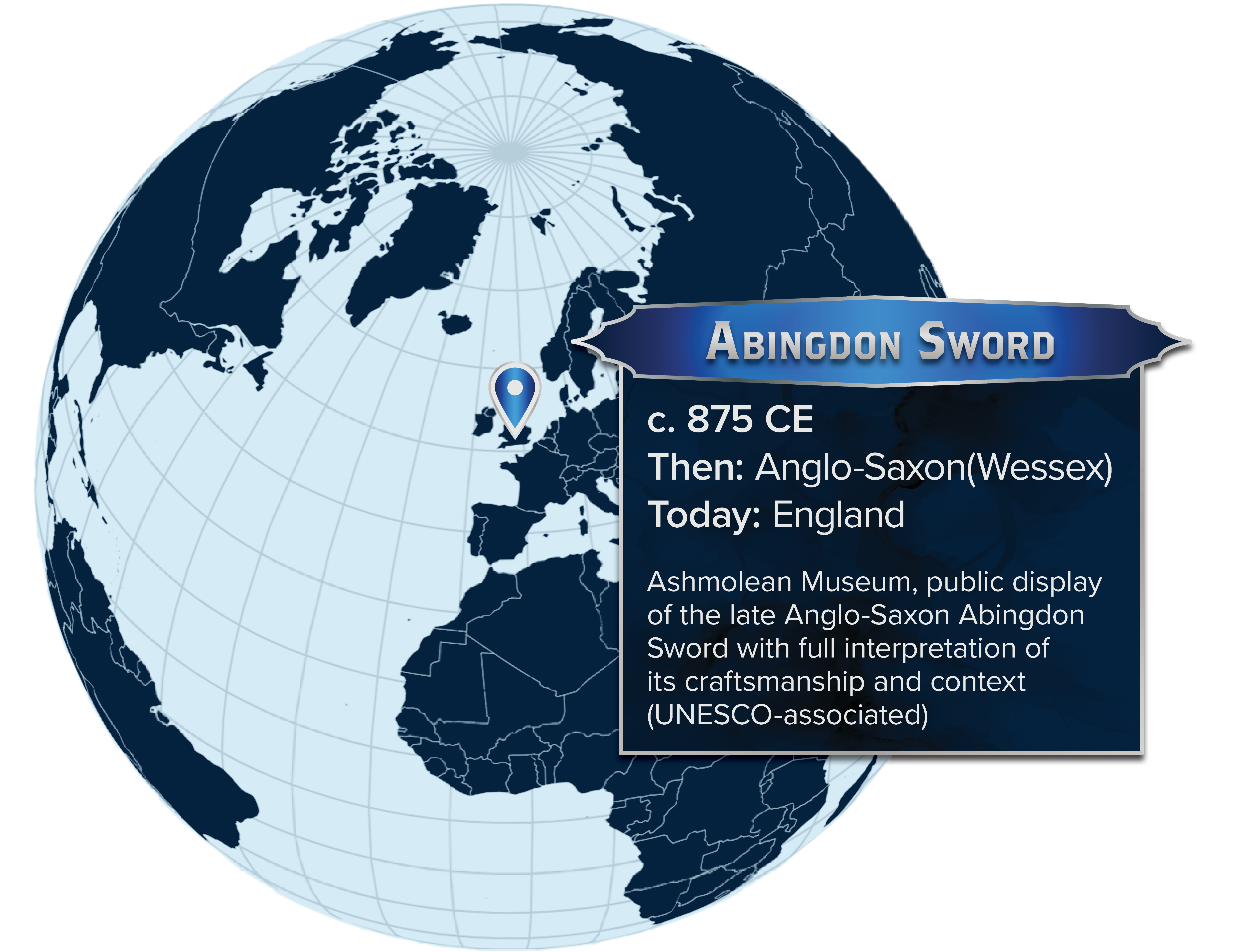
The Abingdon Sword stands out as one of the most arresting weapons to survive from late Anglo-Saxon England — a fragment of iron and silver that still radiates the authority of the warrior who once carried it. Unearthed in 1874 near Bog Mill on the River Ock outside Abingdon, Oxfordshire, the sword emerged from the ground already marked as elite. Even in its damaged state, the surviving hilt mounts display a level of craftsmanship reserved for the highest ranks of Anglo-Saxon society.
Six engraved silver fittings dominate the hilt, each executed in the Trewhiddle style, the intricate late ninth-century artistic tradition known for its fine linework, niello inlay, and densely interlaced animal forms. This is the same visual language seen on masterpieces like the Alfred Jewel, and it signals a weapon made not merely for killing but for status, allegiance, and identity. On the upper guard, scholars have identified the four symbols of the Evangelists — man, eagle, ox, and lion — woven into the metalwork. This Christian iconography was not decorative filler; it was a declaration. In an age when Wessex fought for survival against Scandinavian armies, a sword like this proclaimed its owner’s place within a Christian warrior elite.
The pommel’s twin animal heads, with their round eyes and upright ears, link the weapon to Petersen Type L hilts, a form used across both Anglo-Saxon and Scandinavian spheres. This blend of stylistic influences reflects the cultural crosscurrents of the late ninth century, when warfare, trade, and migration blurred artistic boundaries even as kingdoms clashed.
Only the upper portion of the blade survives, but X-rays reveal the unmistakable signature of pattern welding — twisted iron rods forge-welded into a strong, flexible core. By this period, pattern welding was declining in some regions, yet it remained a mark of quality in England. The Abingdon Sword was not a mass-produced battlefield tool; it was a prestige weapon, likely carried by a thegn, retainer, or local magnate whose authority rested on both land and martial reputation.
Though no direct link ties the sword to a named figure, its dating places it squarely within the world of Alfred the Great and the decades that followed. Abingdon itself was an important monastic and administrative center, making the sword’s presence there consistent with high-status Anglo-Saxon ownership rather than Scandinavian import.
Today, the Abingdon Sword resides in the Ashmolean Museum, where it remains one of the finest surviving examples of late Anglo-Saxon metalwork — a weapon that still carries the weight of its age.